Key Highlights
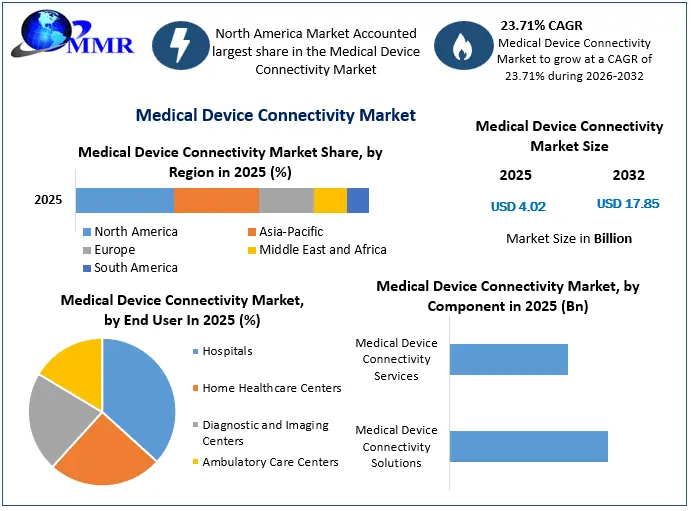
- Market valued at USD 4.02 Billion in 2025
- Expected to reach USD 17.85 Billion by 2032 at 23.71% CAGR
- North America dominates global adoption landscape
- Wireless and hybrid connectivity gaining rapid traction
- Hospitals remain primary deployment end user segment
- Remote monitoring demand accelerating home healthcare integration
- AI-enabled platforms driving real-time clinical decision support
Why This Matters Now
Healthcare systems are shifting from episodic treatment to continuous digital monitoring. Medical device connectivity is becoming the backbone of this transition. Hospitals face pressure to reduce costs, improve outcomes, and manage chronic disease burdens remotely. Connected devices directly address these needs by enabling real-time data flow between patients, clinicians, and hospital systems, reshaping operational efficiency and clinical decision-making.
Market Overview
The Medical Device Connectivity Market Size integrates medical equipment with healthcare IT systems to enable real-time data capture, transmission, and analysis. It spans connectivity solutions, integration platforms, interface devices, and telemetry systems used across hospitals, diagnostic centers, and home healthcare environments.
Demand is driven by rising chronic disease prevalence, aging populations, and increasing pressure on healthcare infrastructure. Hospitals are transitioning toward interoperable ecosystems to reduce manual workflows and improve clinical accuracy. On the supply side, cloud computing, IoT expansion, and AI-driven analytics are enabling scalable deployment of connected healthcare networks.
Key Trends Driving Growth
Cloud-based interoperability is becoming central to healthcare infrastructure, allowing hospitals to unify fragmented device data into centralized dashboards. Platforms such as enterprise connectivity systems are improving operational visibility across critical care environments.
Wireless and hybrid connectivity models are expanding due to demand for scalable, low-latency patient monitoring. These systems reduce infrastructure constraints while supporting real-time alerts in emergency care.
Regulatory acceleration is supporting adoption. The U.S. FDA’s digital health initiatives and pilot programs for connected devices are streamlining approval pathways for remote monitoring technologies.
Home healthcare is emerging as a key growth vector as hospitals shift chronic disease management outside clinical settings. This reduces inpatient load and improves cost efficiency across healthcare systems.
Explore detailed analysis, insights, and growth opportunities
Segment Insights
Dominant Segment: Hospitals (End User Segment)
Hospitals remain the largest end-user segment due to high patient volumes and demand for integrated clinical workflows. Connected systems enable interoperability between infusion pumps, monitors, and electronic health records. This reduces documentation errors and improves treatment coordination. Large hospitals are leading adoption due to higher procurement capacity and stronger IT infrastructure.
Fastest-Growing Segment: Home Healthcare Centers
Home healthcare adoption is accelerating as providers shift chronic disease management outside hospitals. Remote monitoring of diabetes, hypertension, and post-surgical recovery is reducing healthcare costs while improving patient outcomes. Connectivity solutions enable continuous data transmission from patient homes to clinicians, supporting early intervention and reducing readmissions.
Technology Segment: Hybrid Connectivity
Hybrid systems are gaining momentum due to their ability to balance wired reliability with wireless scalability. Hospitals prefer hybrid architectures for critical care environments where uninterrupted connectivity is essential.
Regional Growth Story
North America leads the global market, driven by advanced healthcare infrastructure, strong digital health adoption, and favorable regulatory frameworks. Large-scale deployment of connected care platforms is concentrated in the United States, where hospitals are investing in enterprise-wide interoperability systems.
Europe follows with strong regulatory alignment around data security and interoperability standards. Adoption is supported by national healthcare modernization programs and increasing investment in cloud-based clinical systems.
Asia Pacific is emerging as a high-growth region due to rapid hospital expansion, increasing healthcare digitization, and rising chronic disease prevalence. Cost-sensitive deployment models are accelerating adoption of scalable connectivity solutions.
Middle East & Africa and South America are in early adoption phases, with growth concentrated in urban hospital networks and private healthcare providers.
Competitive Landscape
The market is moderately consolidated, led by healthcare IT providers, medical device manufacturers, and connectivity platform developers. Competition is shifting toward integrated ecosystems rather than standalone connectivity tools.
Key players include:
- Infosys
- Lantronix
- Cisco Systems
- GE Healthcare
- Philips
- Medtronic
- Masimo Corporation
- Cerner Corporation
- Digi International
Competition is intensifying around cloud-native connectivity platforms and AI-enabled data integration. Strategic direction is shifting toward ecosystem consolidation, where device manufacturers partner with IT firms to deliver end-to-end connected care solutions. Recent expansions into cloud infrastructure and interoperability platforms reflect a transition from hardware-centric to data-centric healthcare models
Recent Developments
- Nexalin Technology acquired AI-enabled digital health platform PONM to strengthen remote patient monitoring infrastructure
- BD expanded its Incada Connected Care Platform and Pyxis Pro system across Europe using AWS cloud infrastructure
- FDA launched TEMPO pilot program to accelerate adoption of digital health and connected medical devices
- BD introduced global rollout of AI-enabled connected care platform linking infusion pumps and clinical systems for real-time visibility
Future Outlook
Market leadership will shift toward companies that combine device ecosystems with cloud-native interoperability platforms and AI-driven clinical intelligence.
About Maximize Market Research
Maximize Market Research Pvt. Ltd. (MMR) is a global market research and consulting company that provides reliable, data-focused, and practical business insights. The firm serves a wide range of industries, including healthcare, pharmaceuticals, technology, automotive, electronics, chemicals, personal care, and consumer goods. Through market forecasts, competitive analysis, strategic consulting, and industry impact assessments, MMR helps organizations understand changing market conditions, identify growth opportunities, and make informed business decisions for long-term success.
Contact Us :
2nd Floor, Navale IT Park Phase 3
Pune Banglore Highway, Narhe
Pune, Maharashtra 411041, India
+91 9607365656
sales@maximizemarketresearch.com
