Key Highlights
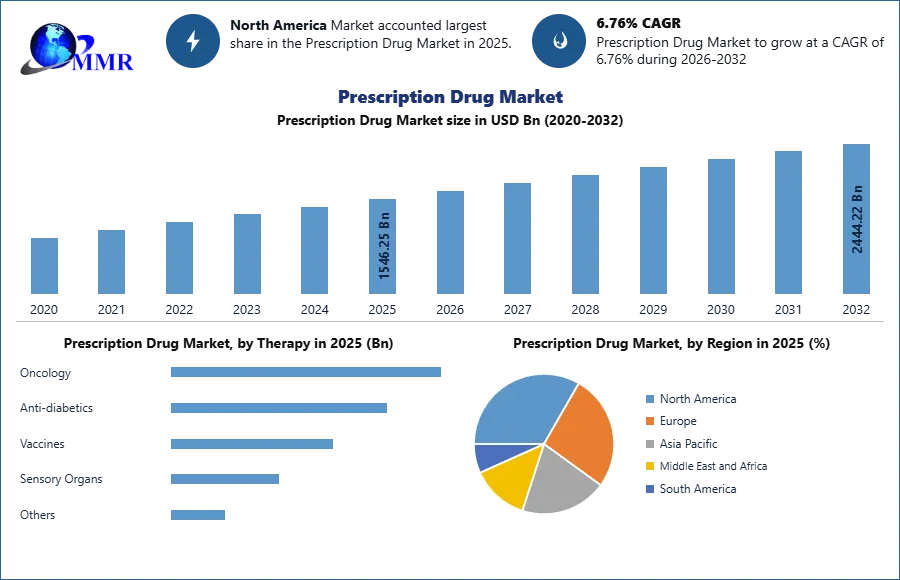
- Market valued at USD 1,546.25 Billion in 2025
- Expected to reach USD 2,444.22 Billion by 2032 at 6.76% CAGR
- North America holds dominant global revenue share
- Generic drugs account for highest volume consumption
- Oncology and anti-diabetic therapies drive revenue concentration
- Hospital pharmacies remain primary distribution channel
- Biosimilars create major cost disruption across biologics segment
Why This Matters Now
Global healthcare systems are under structural pressure from rising chronic disease incidence, aging populations, and escalating drug costs. Prescription drugs sit at the center of this shift, balancing innovation-led biologics with cost-driven generics. At the same time, regulatory pressure and biosimilar entry are reshaping pricing power across major pharmaceutical categories, forcing companies to redesign portfolios and accelerate pipeline productivity.
Market Overview
The Prescription Drug Market Size includes all physician-authorized medications across generics, orphan drugs, and branded therapies. It spans oncology, diabetes, cardiovascular diseases, vaccines, and specialty treatments delivered via hospitals, retail pharmacies, and online channels.
Demand is structurally driven by chronic disease prevalence and expanding healthcare access across emerging economies. Supply dynamics are increasingly defined by patent expirations, biosimilar competition, and aggressive pharmaceutical R&D investment. Macro conditions such as healthcare reimbursement expansion and digital prescription adoption are reshaping distribution efficiency and patient access.
Key Trends Driving Growth
R&D intensity remains a core growth lever, with pharmaceutical companies increasing investment into biologics, gene therapies, and rare disease treatments. This shift is driven by rising unmet clinical needs and high-value specialty drug demand.
Biosimilars are disrupting legacy biologic revenues as major blockbuster drugs lose exclusivity. Price reductions of up to 50% are accelerating payer adoption and reshaping competitive dynamics in high-cost therapeutic segments.
Digital prescription systems and telemedicine integration are expanding access to medicines, particularly through online pharmacies. This is reducing friction in distribution and increasing retail pharmacy competition.
Regulatory frameworks are also evolving, with faster FDA approvals for biosimilars and priority review pathways increasing market entry speed for new therapies.
Explore detailed analysis, insights, and growth opportunities
Segment Insights
Dominant Segment: Generic Drugs (by Type)
Generic drugs dominate global prescription volume due to large-scale patent expirations and aggressive cost advantages of 80–95% versus branded therapies. They account for nearly 90% of dispensed medications while representing a fraction of total spending. This creates structural cost relief for healthcare systems but compresses margins for branded manufacturers.
Fastest-Growing Segment: Biosimilars and Specialty Drugs
Biosimilars are expanding rapidly due to $100 billion+ biologic patent expirations and payer-driven substitution policies. Europe leads adoption, while the U.S. is accelerating. Specialty drugs in oncology and immunology are also driving revenue growth due to high pricing power and strong clinical demand.
Distribution Channel: Hospital Pharmacies (Dominant)
Hospitals remain the primary distribution point due to intravenous administration of oncology and complex therapies. Their dominance reflects centralized treatment protocols and high inpatient drug utilization, especially for critical and specialty care.
Regional Growth Story
North America leads the global prescription drug market, driven by high drug pricing, strong R&D investment, and dominance of major pharmaceutical players. The United States alone accounts for a significant share of global specialty drug consumption, particularly biologics and GLP-1 therapies.
Europe remains a strong biosimilar adoption hub due to payer mandates and cost-containment policies. It is a key region for generics penetration and early biologic substitution.
Asia Pacific is emerging as the fastest-expanding consumption base, supported by population scale, rising healthcare access, and government-led insurance expansion programs.
Latin America, Middle East, and Africa show gradual uptake, constrained by affordability but supported by expanding generic drug penetration.
Competitive Landscape
The market is highly consolidated among global pharmaceutical leaders competing across branded drugs, generics, and biologics portfolios. Competition is increasingly defined by pipeline strength rather than legacy drug sales.
Key players include:
- Pfizer Inc.
- Novartis AG
- Roche
- Johnson & Johnson
- Merck & Co., Inc.
- Eli Lilly and Company
- AstraZeneca
- Sanofi
- AbbVie Inc.
- Bristol Myers Squibb
Strategic competition is shifting toward biologics, oncology pipelines, and metabolic disease drugs. Large-scale acquisitions and R&D expansions are being used to offset patent cliffs. Companies are increasingly focusing on high-margin specialty therapies as generic erosion compresses traditional revenue streams.
Recent Developments (Bullet Points)
- Sanofi and Regeneron received FDA approval expansion for Dupixent in allergic fungal rhinosinusitis
- Pfizer initiated plans for 20 pivotal clinical trials including ultra-long-acting obesity therapies
- Sanofi acquired Dynavax to strengthen vaccine and immunology pipeline
- Roche announced USD 50 billion U.S. expansion into R&D and manufacturing infrastructure
- Pfizer signed U.S. cost-lowering agreement while committing USD 70 billion to domestic investment
- Merck expanded biomanufacturing capabilities through JSR Life Sciences acquisition
Future Outlook
Market leadership will consolidate around companies that successfully balance high-margin biologics innovation with biosimilar disruption resilience and scalable global drug pipelines.
Analyst Perspective: Komal Patil
The Prescription Drug Market is entering a structurally divided growth phase where volume expansion is increasingly decoupled from revenue concentration. While generics dominate global dispensing volumes, profitability is consolidating in specialty therapies, biologics, and high-value oncology drugs. This divergence is reshaping competitive strategy across the pharmaceutical value chain.
About Maximize Market Research
Maximize Market Research Pvt. Ltd. (MMR) is a global market research and consulting company that provides reliable, data-focused, and practical business insights. The firm serves a wide range of industries, including healthcare, pharmaceuticals, technology, automotive, electronics, chemicals, personal care, and consumer goods. Through market forecasts, competitive analysis, strategic consulting, and industry impact assessments, MMR helps organizations understand changing market conditions, identify growth opportunities, and make informed business decisions for long-term success.
Contact Us :
2nd Floor, Navale IT Park Phase 3
Pune Banglore Highway, Narhe
Pune, Maharashtra 411041, India
+91 9607365656
sales@maximizemarketresearch.com
