Key Highlights
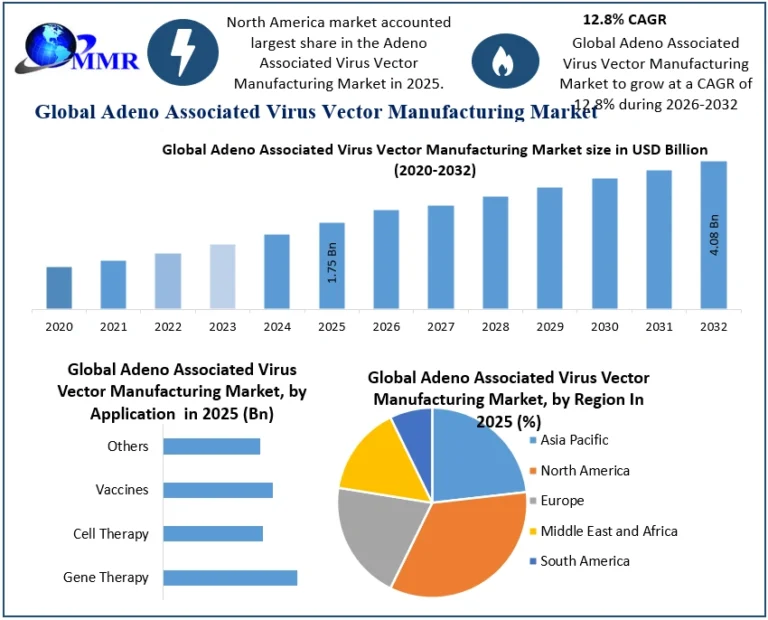
- Market valued at USD 1.75 billion in 2025; projected USD 4.08 billion by 2032
- CAGR of 12.8% driven by gene therapy pipeline expansion
- North America remains the dominant manufacturing and clinical adoption hub
- Gene augmentation therapy leads application demand
- Neurological disorders remain the largest therapeutic focus
- Strong CDMO expansion and strategic collaborations define competition
- Manufacturing scale-up remains the key bottleneck and opportunity
Why This Matters Now
Gene therapy is shifting from clinical research to commercial deployment. AAV vectors sit at the center of this transition. Manufacturing capacity now directly determines therapy availability, pricing, and time-to-market for next-generation genetic medicines.
Market Overview
The AAV vector manufacturing market Size spans production of viral vectors used in gene therapy, gene editing, and biologics development. Demand is concentrated in pharmaceutical companies, biotech firms, and academic research institutions.
Growth is driven by rising incidence of genetic disorders and expanding clinical adoption of gene therapies. Supply remains constrained by complex production processes, limited scalable infrastructure, and high purification costs.
The market is increasingly shaped by contract development and manufacturing organizations (CDMOs) expanding capacity to serve outsourced biotech pipelines. Regulatory clarity from agencies such as the FDA and EMA has accelerated therapy approvals, increasing manufacturing demand pressure.
Key Trends Driving Growth
Technological progress in vector engineering is improving transduction efficiency and tissue targeting, expanding therapeutic reach beyond rare genetic diseases into oncology and neurological disorders.
Large-scale production investment is reshaping industry structure. Manufacturers are prioritizing bioprocessing automation and scalable platforms to reduce cost per dose and address chronic capacity shortages.
Strategic collaborations are accelerating pipeline commercialization. Partnerships between biotech firms and CDMOs are reducing time-to-clinic for gene therapies while spreading manufacturing risk.
Regulatory acceleration pathways are improving commercialization timelines. Faster approvals for gene therapies are increasing demand for compliant, high-quality vector production systems.
Geographic expansion into Asia Pacific and Latin America is opening new production and demand corridors, driven by lower-cost manufacturing environments and rising biotech investments.
Explore detailed analysis, insights, and growth opportunities
Segment Insights
Dominant Segment: Gene Augmentation Therapy (Therapy Type)
Gene augmentation remains the core application of AAV manufacturing. It focuses on replacing defective genes in inherited disorders. Demand is strongest in rare diseases such as inherited blindness and metabolic conditions.
Business impact: manufacturers prioritize scalable vector production for monogenic disease pipelines, creating stable long-term demand visibility.
Fastest-Growing Segment: Neurological Disorders (Therapeutic Area)
Neurological applications are expanding rapidly due to unmet clinical need in diseases such as spinal muscular atrophy and Parkinson’s disease. AAV vectors enable targeted delivery across the central nervous system.
Business impact: pharmaceutical companies are increasing high-value clinical trials, pushing premium pricing for neuro-targeted vector platforms.
Other Key Segments
- Immunotherapy applications are expanding in oncology pipelines
- Ophthalmic disorders remain a strong early commercial success area
- Muscular and neuromuscular disorders are gaining clinical validation
- Gene therapy remains the dominant application channel across all vectors
Regional Growth Story
North America
North America dominates due to strong biotech infrastructure and early adoption of gene therapies. The United States leads both clinical trials and commercial-scale vector demand. CDMO concentration is highest in this region, strengthening supply control.
Europe
Europe maintains strong positioning through advanced regulatory systems and established gene therapy research hubs. Companies are focusing on precision manufacturing and clinical-grade vector production.
Asia Pacific
Asia Pacific is the fastest-expanding region, supported by rising biotech investment in China, India, and South Korea. Lower manufacturing costs and growing clinical trial activity are attracting global outsourcing.
Latin America and MEA
These regions remain emerging markets with gradual adoption. Growth is linked to healthcare infrastructure development and international collaborations.
Competitive Landscape
The market is consolidated around global CDMOs and biotech manufacturing specialists competing on scale, purity, and regulatory compliance.
Lonza Group Ltd. maintains strong leadership in large-scale biologics and gene therapy manufacturing through integrated CDMO capabilities.
Thermo Fisher Scientific Inc. strengthens its position via end-to-end bioprocessing solutions and global manufacturing infrastructure, enabling faster clinical supply chains.
Merck KGaA leverages its bioprocessing and purification technologies to support high-quality viral vector production for advanced therapies.
Fujifilm Diosynth Biotechnologies expands capacity across North America and Europe, targeting large-scale gene therapy production demand.
Oxford Biomedica plc focuses on specialized viral vector manufacturing, strengthening its position in gene therapy partnerships.
REGENXBIO Inc. and other biotech firms are vertically integrating manufacturing to reduce dependency on external CDMOs.
Competitive intensity is defined by capacity expansion, proprietary vector platforms, and long-term manufacturing contracts rather than price competition.
Recent Developments
- Industry players expanding large-scale bioprocessing facilities to meet rising gene therapy demand
- Strategic collaborations between biotech firms and CDMOs to improve vector scalability
- Increased investment in novel AAV serotype development for improved targeting efficiency
- Expansion of manufacturing footprint into Asia Pacific for cost optimization
- Rising focus on automated purification systems to reduce production bottlenecks
Future Outlook
Manufacturing scale and vector innovation will determine which companies dominate the next phase of gene therapy commercialization.
Analyst Perspective – Komal Patil
The AAV vector manufacturing market is entering a capacity-constrained growth phase where demand from gene therapy pipelines is outpacing scalable production infrastructure. Market leadership is shifting from technology innovation alone to manufacturing execution, regulatory readiness, and CDMO scale. Companies that secure long-term supply agreements and invest in high-yield vector platforms are positioned to capture disproportionate value as gene therapies transition from trials to commercialization.
About Maximize Market Research
Maximize Market Research Pvt. Ltd. (MMR) is a global market research and consulting company that provides reliable, data-focused, and practical business insights. The firm serves a wide range of industries, including healthcare, pharmaceuticals, technology, automotive, electronics, chemicals, personal care, and consumer goods. Through market forecasts, competitive analysis, strategic consulting, and industry impact assessments, MMR helps organizations understand changing market conditions, identify growth opportunities, and make informed business decisions for long-term success.
Contact Us :
2nd Floor, Navale IT Park Phase 3
Pune Banglore Highway, Narhe
Pune, Maharashtra 411041, India
+91 9607365656
sales@maximizemarketresearch.com
