Healthcare providers, fertility specialists, and investors are accelerating investments in reproductive medicine as infertility and delayed parenthood reshape demand for assisted reproductive services. Regulatory authorities, hospital networks, and fertility clinics are also adapting because reproductive healthcare is becoming an increasingly important component of long-term healthcare planning and specialized clinical services.
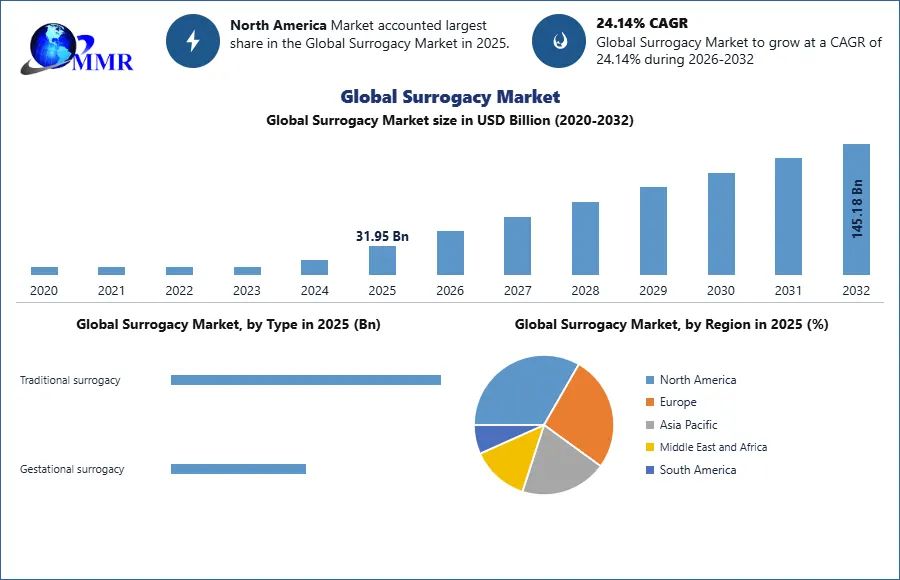
The Surrogacy Market was valued at USD 31.95 Billion in 2025 and is expected to reach USD 145.18 Billion by 2032, growing at a 24.14% CAGR during the forecast period. The pace of expansion signals sustained investment opportunities across fertility clinics, reproductive technologies, laboratory services, and patient support ecosystems.
Key Highlights
- Market valued at USD 31.95 Billion in 2025
- Expected to reach USD 145.18 Billion by 2032
- Forecast CAGR: 24.14% (2026–2032)
- Rising infertility continues driving demand for assisted reproductive technologies.
- Growing awareness of fertility treatment expands patient adoption.
- Fertility clinics continue investing in advanced reproductive technologies.
- Digital health improves patient consultation and treatment coordination.
- Regulatory frameworks continue shaping market accessibility across countries.
- Healthcare providers increasingly expand comprehensive reproductive care services.
Why This Matters Now
Infertility is becoming a significant healthcare concern globally as demographic shifts, delayed pregnancies, lifestyle factors, and reproductive health conditions increase demand for advanced fertility solutions. More patients are seeking specialized reproductive care supported by experienced fertility clinics and advanced assisted reproductive technologies.
Healthcare organizations view reproductive medicine as a high-growth specialty capable of generating long-term patient relationships and specialized clinical revenue. Investors are responding by supporting fertility clinic expansion, laboratory modernization, reproductive diagnostics, and digital fertility platforms that improve treatment accessibility and patient engagement.
Governments and regulators also face growing pressure to establish clear legal frameworks governing surrogacy, reproductive rights, and ethical clinical practices. Regulatory clarity directly influences patient confidence, provider investment, and international treatment accessibility.
Market Overview
The surrogacy market encompasses medical, clinical, and support services that enable intended parents to build families through assisted reproductive technologies and surrogate pregnancies. The market includes fertility clinics, reproductive specialists, embryo transfer procedures, laboratory services, fertility medications, counseling, and pregnancy management.
Increasing infertility prevalence remains one of the primary market drivers. Greater awareness of assisted reproductive technologies has encouraged more individuals and couples to seek fertility treatment earlier, improving treatment adoption across both developed and emerging healthcare markets.
Continuous improvements in IVF procedures, embryo preservation, reproductive diagnostics, and fertility laboratory capabilities are strengthening clinical outcomes. Hospitals and specialized fertility centers are investing in advanced reproductive technologies to improve success rates while expanding access to comprehensive fertility care.
The market is also benefiting from broader societal acceptance of assisted reproduction. Greater awareness, improved patient education, and expanding access to fertility specialists continue supporting long-term market growth.
Key Trends Driving Growth
Advanced assisted reproductive technologies continue improving clinical efficiency and patient outcomes. Fertility centers increasingly adopt sophisticated laboratory technologies that enhance embryo selection, reproductive diagnostics, and treatment planning, enabling more personalized fertility care.
Digital health is transforming patient engagement throughout fertility treatment. Virtual consultations allow reproductive specialists to conduct initial evaluations, provide counseling, monitor treatment progress, and maintain continuity of care throughout complex fertility journeys. Digital communication also improves patient convenience and treatment adherence.
Healthcare infrastructure investment remains another important growth catalyst. Specialized fertility centers continue expanding laboratory capabilities, embryology services, and multidisciplinary reproductive care teams. These investments strengthen provider competitiveness while increasing treatment capacity.
Precision medicine is gradually becoming more relevant within reproductive healthcare. Improved diagnostic technologies enable clinicians to better understand fertility challenges and develop individualized treatment approaches that optimize clinical outcomes.
Growing public awareness of infertility also encourages earlier medical consultation. Earlier diagnosis allows fertility specialists to recommend appropriate interventions sooner, increasing opportunities for successful reproductive treatment while expanding demand for specialized fertility services.
The market also benefits from continuous innovation across reproductive biotechnology, laboratory automation, cryopreservation technologies, and fertility diagnostics. These advances improve operational efficiency while supporting higher-quality reproductive care.
𝐃𝐨𝐰𝐧𝐥𝐨𝐚𝐝 𝐏𝐃𝐅 𝐁𝐫𝐨𝐜𝐡𝐮𝐫𝐞 @https://www.maximizemarketresearch.com/request-sample/66844/
Segment Insights
- Dominant Segment: Not specified in the supplied MMR report.
- Fastest-Growing Segment: Not specified in the supplied MMR report.
- Assisted reproductive technologies continue supporting broader treatment adoption.
- Fertility clinics remain central providers of comprehensive reproductive healthcare.
- Advanced reproductive diagnostics strengthen treatment planning and clinical outcomes.
- Growing patient awareness supports increased utilization of fertility services.
Regional Growth Story
The United States continues representing an important reproductive healthcare market due to advanced fertility infrastructure, specialized reproductive medicine expertise, and continuous innovation in assisted reproductive technologies. Regulatory considerations remain significant in determining treatment accessibility and provider operations.
Germany and the United Kingdom continue emphasizing reproductive healthcare within established healthcare systems while maintaining regulatory oversight for fertility treatments and surrogacy practices. Healthcare providers increasingly focus on improving clinical outcomes through advanced reproductive technologies.
China, Japan, India, and South Korea continue strengthening reproductive healthcare capabilities through expanding fertility clinics, laboratory modernization, and broader adoption of assisted reproductive technologies.
India remains an important fertility destination supported by experienced reproductive specialists, expanding healthcare infrastructure, and increasing investment in fertility services. South Korea continues advancing reproductive medicine through technology adoption and clinical innovation, while Japan and China continue investing in specialized reproductive healthcare capabilities and fertility research.
Across all major regions, healthcare investment, technological advancement, and patient awareness continue strengthening reproductive healthcare capacity.
Competitive Landscape
Competition increasingly centers on clinical success rates, patient experience, multidisciplinary expertise, and technological capabilities rather than service availability alone.
Leading fertility providers continue investing in advanced embryology laboratories, reproductive diagnostics, digital patient management platforms, and specialized clinical teams. These investments improve patient confidence while strengthening competitive positioning in an increasingly sophisticated fertility market.
Healthcare providers also recognize that comprehensive fertility care extends beyond medical procedures. Counseling services, patient education, personalized treatment planning, and coordinated reproductive care increasingly differentiate leading fertility organizations.
Regulatory compliance remains a major competitive factor. Providers operating within transparent legal frameworks are better positioned to build patient trust while attracting long-term investment into reproductive healthcare infrastructure.
Recent Developments
- Continued investment in fertility clinic infrastructure and laboratory modernization.
- Broader adoption of assisted reproductive technologies across healthcare providers.
- Expansion of digital health platforms supporting fertility consultations.
- Ongoing innovation in reproductive diagnostics and embryo preservation technologies.
- Regulatory developments continue shaping surrogacy accessibility and healthcare provider operations.
Strategic Implications
The surrogacy market increasingly represents a specialized healthcare growth segment combining reproductive medicine, biotechnology, diagnostics, and digital healthcare services.
Hospital systems expanding reproductive medicine programs can diversify specialty care offerings while strengthening long-term patient engagement. Fertility clinics investing in advanced laboratory technologies, digital care coordination, and personalized reproductive treatment are positioned to improve clinical outcomes and operational efficiency.
Biotechnology companies developing reproductive diagnostics, fertility medications, laboratory automation, and embryo technologies also benefit from sustained market expansion. Digital health providers supporting fertility consultations, treatment monitoring, and patient education create additional opportunities across reproductive healthcare ecosystems.
Healthcare organizations that combine clinical excellence, technological innovation, regulatory compliance, and patient-centered reproductive care will strengthen competitive positioning as demand continues expanding globally.
Future Outlook
The Surrogacy Market is expected to maintain strong growth as infertility treatment adoption, assisted reproductive technologies, fertility clinic expansion, digital healthcare, and reproductive innovation continue reshaping global family-building services. Organizations investing in clinical excellence, advanced reproductive technologies, and integrated patient care will define the next generation of reproductive healthcare, while slower adopters risk losing leadership in one of healthcare’s fastest-growing specialty markets.
Analyst Perspective
“The surrogacy market is entering a phase of accelerated transformation driven by advances in assisted reproductive technologies, increasing infertility awareness, and expanding fertility care infrastructure. Healthcare providers that combine clinical expertise, digital patient engagement, and responsible regulatory compliance will be best positioned to capture sustained market growth.” — Komal Patil, Analyst
About Maximize Market Research
Maximize Market Research Pvt. Ltd. (MMR) is a global market research and consulting company that provides reliable, data-focused, and practical business insights. The firm serves a wide range of industries, including healthcare, pharmaceuticals, technology, automotive, electronics, chemicals, personal care, and consumer goods. Through market forecasts, competitive analysis, strategic consulting, and industry impact assessments, MMR helps organizations understand changing market conditions, identify growth opportunities, and make informed business decisions for long-term success.
2nd Floor, Navale IT Park Phase 3
Pune Banglore Highway, Narhe
Pune, Maharashtra 411041, India
+91 9607365656
sales@maximizemarketresearch.com
