Dental care providers, orthodontic manufacturers, investors, and healthcare technology firms are accelerating investment in invisible orthodontics as patient demand shifts sharply toward aesthetic, comfortable, and digitally guided treatments. Hospitals, dental chains, and specialized orthodontic clinics are responding because clear aligners are becoming the preferred alternative to traditional braces across both adult and adolescent populations.
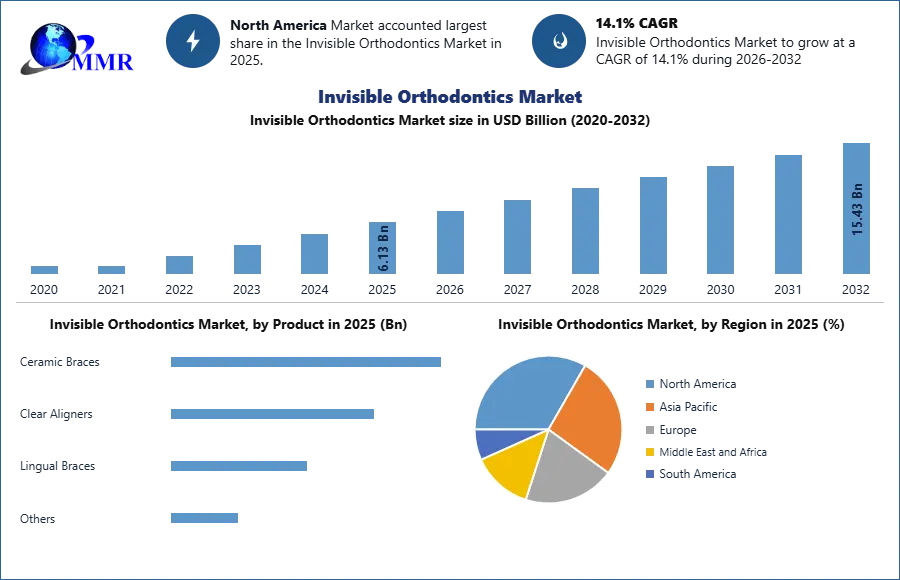
The Global Invisible Orthodontics Market was valued at USD 6.13 Billion in 2025 and is expected to reach USD 15.43 Billion by 2032, growing at a 14.1% CAGR during the forecast period. The expansion reflects structural changes in dental healthcare delivery driven by digital workflows, AI-enabled treatment planning, and rising consumer focus on aesthetic outcomes.
Key Highlights
- Market valued at USD 6.13 Billion in 2025
- Projected to reach USD 15.43 Billion by 2032
- Forecast CAGR: 14.1% (2026–2032)
- Rising aesthetic awareness drives adoption of clear aligner therapy.
- Digital orthodontics improves precision and treatment efficiency.
- Adult orthodontic demand continues expanding globally.
- AI-based treatment planning enhances customization and outcomes.
- Teledentistry expands access to orthodontic consultations.
- Dental clinics increasingly integrate 3D imaging and scanning technologies.
Why This Matters Now
Orthodontic care is shifting from corrective treatment to lifestyle-driven aesthetic healthcare. Patients increasingly prioritize discreet treatment options that fit professional and social lifestyles, accelerating demand for invisible orthodontic solutions.
Dental service providers face rising pressure to adopt digital tools that improve accuracy, reduce treatment timelines, and enhance patient experience. At the same time, manufacturers are competing to deliver advanced aligner systems supported by artificial intelligence and cloud-based treatment planning platforms.
Healthcare investors see orthodontics as a high-margin specialty driven by recurring patient demand and strong consumer willingness to pay for aesthetic outcomes. This shift is reshaping dental care into a technology-enabled consumer healthcare segment.
Market Overview
Invisible orthodontics refers to orthodontic treatments that use clear aligners instead of traditional metal braces to correct dental misalignments such as crowding, spacing, and bite issues. The market includes clear aligners, digital treatment planning software, 3D imaging systems, and orthodontic services.
The market continues expanding as dental professionals increasingly adopt digital workflows that integrate scanning, simulation, and personalized treatment planning. These technologies improve precision while reducing the need for frequent in-clinic adjustments.
Rising awareness of oral health and aesthetics is a major demand driver. Patients across all age groups, particularly working adults, are increasingly opting for discreet orthodontic solutions that offer comfort and visual appeal.
Technological advancements in dental imaging, 3D printing, and AI-driven orthodontic design are improving treatment accuracy while reducing overall treatment time. These innovations continue to expand the clinical applicability of invisible orthodontics across complex dental cases.
Key Trends Driving Growth
Digital dentistry is the strongest structural driver of market expansion. Intraoral scanners, 3D imaging systems, and cloud-based orthodontic platforms are replacing traditional mold-based workflows, improving both efficiency and accuracy.
Artificial intelligence is transforming orthodontic treatment planning. AI algorithms analyze dental scans to predict tooth movement, optimize aligner design, and reduce treatment iteration cycles, improving patient outcomes and clinical efficiency.
Teledentistry is expanding access to orthodontic consultations. Patients can now receive remote assessments, treatment planning updates, and progress monitoring, reducing dependency on in-person visits and improving care continuity.
Adult orthodontic demand continues to rise globally. Increasing focus on appearance, professional presentation, and personal confidence is driving higher adoption rates among adults compared to previous generations.
3D printing technology is accelerating manufacturing of customized aligners. This reduces production time, lowers costs, and improves personalization, strengthening scalability across dental networks.
Dental service consolidation is also shaping the market. Large dental chains and corporate providers are integrating orthodontic services with digital platforms, improving standardization and patient access.
𝐃𝐨𝐰𝐧𝐥𝐨𝐚𝐝 𝐏𝐃𝐅 𝐁𝐫𝐨𝐜𝐡𝐮𝐫𝐞 @https://www.maximizemarketresearch.com/request-sample/102627/
Segment Insights
- Dominant Segment: Not specified in the supplied MMR report.
- Fastest-Growing Segment: Not specified in the supplied MMR report.
- Clear aligners remain the primary treatment modality within invisible orthodontics.
- Digital orthodontic platforms improve treatment planning efficiency.
- Adult orthodontics continues to drive demand expansion globally.
- 3D imaging and scanning technologies strengthen diagnostic precision.
Regional Growth Story
The United States leads the invisible orthodontics market due to high aesthetic demand, strong dental care expenditure, and widespread adoption of clear aligner systems supported by advanced digital dentistry infrastructure.
Germany and the United Kingdom maintain strong orthodontic markets driven by advanced healthcare systems, increasing adult orthodontic adoption, and integration of digital dental technologies into clinical practice.
China continues expanding dental healthcare access while rapidly adopting digital orthodontics and clear aligner technologies across urban centers. Increasing consumer awareness is accelerating treatment uptake.
Japan demonstrates strong demand supported by advanced healthcare infrastructure and growing focus on dental aesthetics. India is emerging as a high-growth market driven by expanding dental care access, rising middle-class spending, and increasing availability of digital orthodontic services. South Korea continues to lead in aesthetic dentistry adoption, supported by strong cosmetic healthcare culture and advanced dental technologies.
Across all major regions, increasing healthcare digitization, rising disposable income, and consumer-driven aesthetic demand are strengthening orthodontic market expansion.
Competitive Landscape
Competition in the invisible orthodontics market is increasingly technology-driven. Companies are competing through AI-enabled treatment planning platforms, advanced clear aligner materials, and integrated digital dentistry ecosystems.
Manufacturers are investing heavily in software development, cloud-based orthodontic platforms, and predictive modeling systems that improve treatment accuracy and reduce clinician workload.
Dental service providers are expanding orthodontic offerings through integrated care models combining diagnostics, treatment planning, and follow-up monitoring under unified digital systems.
Strategic partnerships between dental technology companies, orthodontic clinics, and digital health platforms are accelerating innovation and improving patient experience across treatment pathways.
Recent Developments
- Continued expansion of AI-based orthodontic treatment planning systems.
- Increasing adoption of intraoral scanning and 3D imaging technologies.
- Growth in teledentistry-enabled orthodontic consultations.
- Expansion of clear aligner product portfolios globally.
- Rising investment in digital dental workflow platforms.
- Continued integration of 3D printing in orthodontic manufacturing.
Strategic Implications
Invisible orthodontics is shifting dentistry from a procedural specialty to a digitally enabled consumer healthcare category. Providers adopting integrated digital workflows improve efficiency, treatment accuracy, and patient satisfaction while strengthening competitive positioning.
Manufacturers investing in AI-driven orthodontic platforms and advanced materials gain stronger differentiation in a rapidly commoditizing aligner market. Dental clinics integrating end-to-end digital systems improve scalability and service quality.
Investors increasingly view orthodontics as a high-growth healthcare segment driven by recurring demand, aesthetic preferences, and strong consumer willingness to pay for premium outcomes.
Organizations combining digital dentistry, AI, and patient-centered service models will lead the next phase of orthodontic transformation.
Future Outlook
The Global Invisible Orthodontics Market is expected to maintain strong growth as digital dentistry, AI-driven treatment planning, teledentistry, and aesthetic healthcare demand continue transforming orthodontic care. Companies that integrate advanced technology with patient-focused service delivery will define future market leadership, while traditional orthodontic models risk losing relevance in a rapidly digitizing dental ecosystem.
Analyst Perspective
“Invisible orthodontics is evolving into a digitally enabled healthcare segment where AI, 3D imaging, and patient-centric design are redefining treatment standards. Organizations that successfully integrate technology with clinical expertise will shape the future of global orthodontic care.” — Komal Patil, Analyst
About Maximize Market Research
Maximize Market Research Pvt. Ltd. (MMR) is a global market research and consulting company that provides reliable, data-focused, and practical business insights. The firm serves a wide range of industries, including healthcare, pharmaceuticals, technology, automotive, electronics, chemicals, personal care, and consumer goods. Through market forecasts, competitive analysis, strategic consulting, and industry impact assessments, MMR helps organizations understand changing market conditions, identify growth opportunities, and make informed business decisions for long-term success.
2nd Floor, Navale IT Park Phase 3
Pune Banglore Highway, Narhe
Pune, Maharashtra 411041, India
+91 9607365656
sales@maximizemarketresearch.com
