PUNE, July 1, 2026 – The Semiconductor Manufacturing Chemical Market is witnessing strong momentum as global semiconductor production continues to expand in response to rising demand for artificial intelligence (AI), electric vehicles (EVs), advanced consumer electronics, and high-performance computing. Increased investments in wafer fabrication facilities, coupled with the transition toward smaller process nodes, are driving the need for high-purity chemicals that ensure precision, reliability, and manufacturing efficiency across semiconductor fabrication processes.
Semiconductor manufacturing chemicals are essential materials used throughout chip fabrication, including wafer cleaning, etching, deposition, photolithography, polishing, and packaging. These chemicals play a critical role in achieving defect-free production while enabling manufacturers to meet increasingly stringent quality standards. As semiconductor devices become more compact and technologically advanced, the demand for ultra-high-purity chemicals continues to rise across global fabrication facilities.
𝐃𝐨𝐰𝐧𝐥𝐨𝐚𝐝 𝐅𝐫𝐞𝐞 𝐏𝐃𝐅 𝐁𝐫𝐨𝐜𝐡𝐮𝐫𝐞: https://www.stellarmr.com/report/req_sample/Semiconductor-Manufacturing-Chemical-Market/2022
AI and Advanced Chips Reshape Market Dynamics
The rapid commercialization of artificial intelligence has transformed semiconductor manufacturing into one of the world’s fastest-growing industrial sectors. AI processors require advanced manufacturing technologies that depend heavily on specialty chemicals with exceptional purity and consistency. As semiconductor manufacturers move toward 3nm, 2nm, and next-generation process technologies, chemical suppliers are investing in research and development to deliver innovative formulations capable of supporting increasingly sophisticated production processes.
Governments worldwide are also strengthening domestic semiconductor ecosystems through financial incentives and industrial policies. Large-scale investments in semiconductor fabrication plants across North America, Europe, and Asia-Pacific are creating sustained demand for electronic-grade chemicals, specialty gases, photoresists, wet chemicals, and chemical mechanical planarization (CMP) slurries.
Key Market Trends
Several transformative trends are shaping the Semiconductor Manufacturing Chemical Market:
- Growing demand for high-purity wet chemicals for wafer cleaning applications.
- Rising adoption of EUV lithography driving innovation in advanced photoresist materials.
- Expansion of semiconductor fabrication facilities supported by government incentive programs.
- Increasing production of AI chips, automotive semiconductors, and memory devices.
- Greater focus on environmentally sustainable chemical manufacturing and recycling technologies.
- Investment in localized chemical supply chains to improve supply security.
- Development of advanced CMP slurries and specialty process chemicals for leading-edge nodes.
Market Drivers
One of the primary growth drivers is the rapid expansion of semiconductor manufacturing capacity worldwide. Leading foundries and integrated device manufacturers continue investing billions of dollars in new fabrication plants to meet increasing global demand for advanced chips.
Another important factor is the growing adoption of electric vehicles and autonomous driving technologies. Modern vehicles require hundreds to thousands of semiconductor components, significantly increasing demand for manufacturing chemicals used during chip fabrication.
The accelerating deployment of cloud computing infrastructure, 5G networks, industrial automation, and Internet of Things (IoT) devices further strengthens semiconductor demand, creating long-term opportunities for specialty chemical manufacturers.
Market Challenges
Despite positive growth prospects, the industry faces several challenges. Manufacturing ultra-high-purity chemicals requires complex purification technologies and strict quality control procedures, resulting in high production costs. Even minor contamination can affect semiconductor yields, making quality assurance a critical requirement.
In addition, fluctuations in raw material availability, geopolitical tensions, and disruptions in global supply chains can impact production schedules and pricing. Environmental regulations governing chemical handling, waste disposal, and emissions also require manufacturers to invest continuously in sustainable production technologies.
Technology and Sustainability Trends
Technological innovation remains a defining characteristic of the Semiconductor Manufacturing Chemical Market. Chemical manufacturers are developing advanced formulations that support next-generation semiconductor architectures while improving production efficiency and reducing defect rates.
Digital manufacturing, artificial intelligence-based process monitoring, and predictive quality management are increasingly being integrated into chemical production facilities. These technologies enhance process control, reduce waste, and improve consistency throughout semiconductor manufacturing operations.
Sustainability has become another major strategic priority. Manufacturers are investing in water recycling systems, low-emission production processes, green solvents, and environmentally friendly cleaning chemicals to comply with stricter environmental standards while lowering operational costs. Circular economy initiatives aimed at recovering and reusing valuable chemicals are also gaining momentum across the semiconductor supply chain.
Regional Outlook
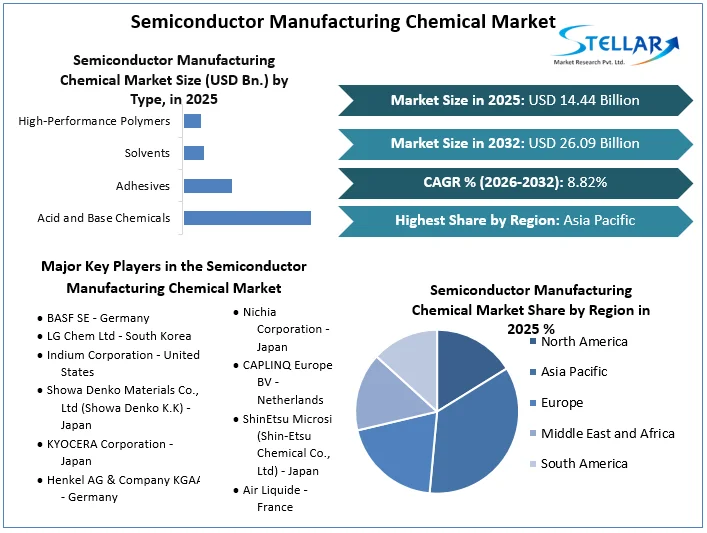
Asia-Pacific continues to dominate the Semiconductor Manufacturing Chemical Market due to its extensive semiconductor manufacturing ecosystem. Countries such as China, Taiwan, South Korea, Japan, and Singapore host many of the world’s largest semiconductor fabrication facilities, driving substantial demand for specialty chemicals.
North America is experiencing significant growth as governments and private companies invest heavily in domestic semiconductor production. New fabrication facilities and strategic investments in advanced manufacturing are strengthening regional demand for electronic-grade chemicals.
Europe is also expanding its semiconductor capabilities through industrial initiatives focused on supply chain resilience and technological independence. Investments in automotive electronics, industrial automation, and research infrastructure are contributing to market growth across the region.
Emerging economies in Southeast Asia and India are attracting increasing semiconductor investments, creating new opportunities for chemical suppliers seeking long-term market expansion.
𝐀𝐜𝐜𝐞𝐬𝐬 𝐭𝐡𝐞 𝐅𝐮𝐥𝐥 𝐑𝐞𝐩𝐨𝐫𝐭: https://www.stellarmr.com/report/Semiconductor-Manufacturing-Chemical-Market/2022
Competitive Landscape
The Semiconductor Manufacturing Chemical Market is highly competitive, with manufacturers focusing on innovation, product purity, strategic partnerships, and regional production expansion. Companies are investing heavily in research and development to introduce next-generation process chemicals compatible with advanced semiconductor technologies.
Leading market participants are also strengthening relationships with semiconductor manufacturers through long-term supply agreements, collaborative research projects, and localized production facilities. Capacity expansion, sustainability initiatives, and digital manufacturing capabilities have become important competitive differentiators.
Future Outlook
The future of the Semiconductor Manufacturing Chemical Market remains highly promising as global semiconductor demand continues to increase across artificial intelligence, electric vehicles, consumer electronics, industrial automation, telecommunications, and healthcare applications. Continued investments in advanced fabrication technologies, government support for domestic semiconductor manufacturing, and ongoing innovation in specialty chemicals are expected to create substantial growth opportunities over the coming years.
As chip designs become increasingly sophisticated and manufacturing tolerances continue to tighten, demand for ultra-high-purity chemicals, advanced photoresists, CMP materials, specialty gases, and precision cleaning solutions will remain strong. Companies capable of delivering innovative, sustainable, and reliable chemical solutions while strengthening regional supply chains are expected to maintain a competitive advantage in this rapidly evolving market.
