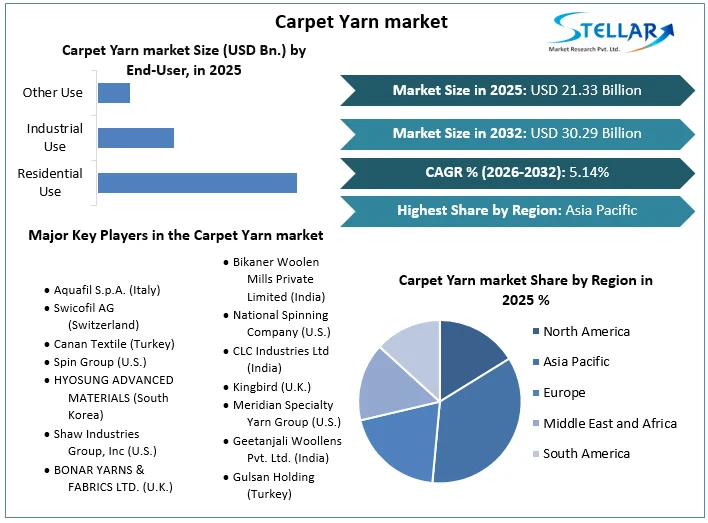
The Carpet Yarn Market is witnessing steady growth as demand for durable, aesthetically appealing, and sustainable flooring solutions continues to rise across residential, commercial, and industrial sectors. Increasing construction activities, home renovation projects, urbanization, and growing consumer preference for premium interior décor are driving the adoption of high-performance carpet yarns. Manufacturers are investing in advanced fiber technologies, recycled materials, and innovative production processes to meet evolving customer expectations while supporting environmental sustainability.
Carpet yarn serves as the primary raw material used in the production of carpets, rugs, and floor coverings. It is manufactured from a variety of natural and synthetic fibers, including nylon, polyester, polypropylene, wool, and blended materials. The selection of yarn significantly influences carpet durability, texture, stain resistance, color retention, and overall performance. As modern consumers seek flooring products that combine functionality with visual appeal, demand for technologically advanced carpet yarn continues to expand worldwide.
𝐃𝐨𝐰𝐧𝐥𝐨𝐚𝐝 𝐅𝐫𝐞𝐞 𝐏𝐃𝐅 𝐁𝐫𝐨𝐜𝐡𝐮𝐫𝐞: https://www.stellarmr.com/report/req_sample/Carpet-Yarn-Market/744
Growing Construction and Interior Design Activities Fuel Market Growth
Rapid urbanization and rising investments in residential and commercial infrastructure are among the strongest growth drivers for the Carpet Yarn Market. New housing developments, office buildings, hotels, healthcare facilities, educational institutions, and retail spaces are generating sustained demand for high-quality carpeting solutions.
Homeowners are increasingly investing in interior remodeling and premium home décor, leading to higher consumption of carpets that offer enhanced comfort, insulation, and acoustic performance. The hospitality industry also remains a major consumer of carpet flooring, where luxury hotels and resorts prioritize visually attractive and durable carpet installations to enhance guest experiences.
Commercial offices continue to adopt modular carpet solutions that provide design flexibility, noise reduction, and ease of maintenance, further boosting demand for innovative carpet yarn products.
Key Market Drivers
One of the primary drivers of market expansion is the growing popularity of synthetic fibers such as nylon, polyester, and polypropylene. These materials offer excellent durability, stain resistance, affordability, and design flexibility, making them highly suitable for residential and commercial applications.
Increasing consumer awareness regarding environmentally sustainable products is encouraging manufacturers to develop carpet yarn using recycled polymers, bio-based fibers, and renewable raw materials. Sustainable flooring solutions are becoming an important purchasing criterion for architects, designers, and commercial property developers.
Technological advancements in yarn manufacturing have also enhanced carpet performance. Innovations in fiber engineering improve softness, resilience, moisture resistance, colorfastness, and wear resistance, allowing manufacturers to meet the evolving requirements of modern construction projects.
𝐀𝐜𝐜𝐞𝐬𝐬 𝐭𝐡𝐞 𝐅𝐮𝐥𝐥 𝐑𝐞𝐩𝐨𝐫𝐭: https://www.stellarmr.com/report/Carpet-Yarn-Market/744
Emerging Industry Trends
Sustainability remains one of the most influential trends shaping the Carpet Yarn Market. Manufacturers are expanding the use of recycled PET bottles, regenerated nylon, and renewable fiber sources to reduce environmental impact while supporting circular economy initiatives. Low-emission manufacturing processes and eco-friendly dyeing technologies are also gaining widespread adoption.
Customization has become another major trend as consumers increasingly seek personalized flooring designs, textures, and colors. Advanced digital dyeing and precision tufting technologies enable manufacturers to deliver highly customized carpet solutions for residential, hospitality, and corporate environments.
Smart manufacturing technologies, including automation, artificial intelligence, and digital quality monitoring, are improving production efficiency while reducing material waste and operational costs. These innovations help manufacturers maintain consistent product quality and respond more quickly to changing market demand.
Market Challenges
Despite favorable growth prospects, the Carpet Yarn Market faces several challenges. Fluctuations in crude oil prices directly affect the cost of synthetic fibers such as nylon and polypropylene, creating pricing uncertainty throughout the supply chain. Volatile raw material costs may impact manufacturer profitability and influence purchasing decisions.
Environmental regulations concerning plastic waste and carbon emissions also require manufacturers to invest in cleaner production technologies and sustainable raw materials. Compliance with evolving environmental standards increases operational costs but also creates opportunities for innovation in eco-friendly carpet yarn development.
Competition from alternative flooring materials such as luxury vinyl tiles, hardwood flooring, ceramic tiles, and laminate flooring presents another challenge, particularly in residential construction projects where consumers increasingly evaluate multiple flooring options.
Regional Insights
Asia-Pacific dominates the Carpet Yarn Market owing to rapid urbanization, expanding construction activities, growing manufacturing capabilities, and increasing consumer spending on home improvement. Countries such as China, India, Japan, and South Korea continue to drive regional demand through infrastructure development and rising residential construction.
North America represents a significant market supported by strong home renovation activities, commercial office modernization, and increasing demand for premium flooring products. Sustainable construction practices and green building certifications are encouraging greater adoption of environmentally friendly carpet materials across the region.
Europe maintains a substantial market share due to stringent environmental regulations, growing demand for recyclable flooring products, and strong consumer preference for sustainable interior solutions. Countries including Germany, the United Kingdom, France, and Italy continue investing in high-performance carpet manufacturing technologies.
The Middle East, Africa, and Latin America are emerging as promising markets as commercial construction, hospitality expansion, and urban infrastructure development accelerate across major economies.
Competitive Landscape
The Carpet Yarn Market remains highly competitive, with manufacturers focusing on product innovation, sustainability, and operational efficiency to strengthen market position. Leading companies are investing in advanced fiber technologies, recycled material development, automation, and capacity expansion to address increasing global demand.
Strategic collaborations with carpet manufacturers, interior designers, distributors, and construction companies are enabling suppliers to broaden their market reach. Product differentiation through enhanced durability, stain resistance, softness, and sustainable material composition has become a key competitive strategy.
Research and development activities continue to focus on lightweight fibers, bio-based polymers, low-carbon manufacturing processes, and advanced dyeing technologies that improve both product performance and environmental sustainability.
Future Outlook
The future of the Carpet Yarn Market remains promising as construction activities, urban development, and consumer spending on home interiors continue to expand globally. Rising demand for sustainable flooring materials, premium residential décor, and commercial renovation projects will support long-term market growth.
Manufacturers are expected to increase investments in recycled fibers, bio-based materials, digital manufacturing, and smart production technologies to improve efficiency and meet sustainability objectives. As green building initiatives gain momentum and consumers increasingly prioritize environmentally responsible products, carpet yarn producers capable of delivering innovative, durable, and eco-friendly solutions will be well positioned to capitalize on emerging opportunities across residential, commercial, and industrial flooring markets.
