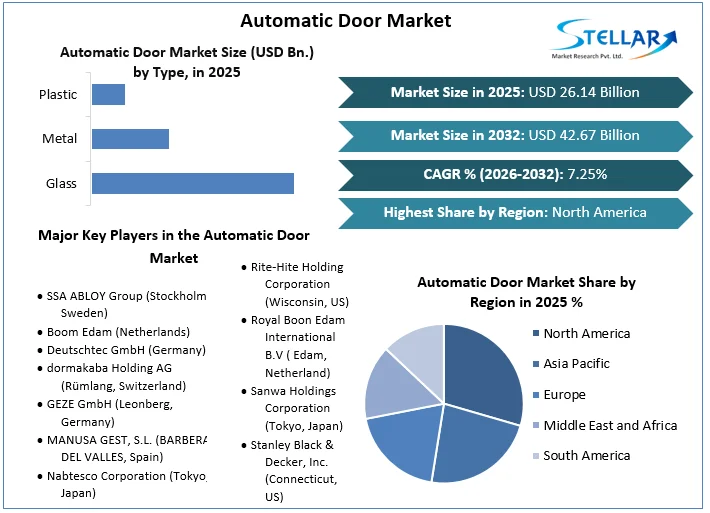
The Automatic Door Market is experiencing strong growth as demand for smart infrastructure, touchless entry systems, and energy-efficient building solutions continues to increase across commercial, residential, healthcare, industrial, and transportation sectors. Rapid urbanization, rising investments in modern infrastructure, and the growing emphasis on accessibility and safety are encouraging the adoption of automatic doors worldwide. Building owners and facility managers are increasingly integrating automated entrance systems that enhance convenience, improve security, optimize energy consumption, and deliver seamless user experiences.
Automatic doors have become an essential component of modern buildings due to their ability to provide hands-free operation while supporting high pedestrian traffic. These systems use sensors, motion detectors, access control technologies, and intelligent automation to open and close doors without manual intervention. Sliding doors, swinging doors, revolving doors, folding doors, and telescopic doors are widely installed across shopping malls, airports, hospitals, hotels, office complexes, educational institutions, and industrial facilities. Continuous advancements in automation technology are expanding their application across diverse end-use industries.
𝐃𝐨𝐰𝐧𝐥𝐨𝐚𝐝 𝐅𝐫𝐞𝐞 𝐏𝐃𝐅 𝐁𝐫𝐨𝐜𝐡𝐮𝐫𝐞: https://www.stellarmr.com/report/req_sample/Automatic-Door-Market/875
Smart Infrastructure and Contactless Access Drive Market Growth
The increasing adoption of smart buildings is one of the primary factors fueling the Automatic Door Market. Building developers are incorporating intelligent entrance systems into commercial and residential projects to improve operational efficiency, security, and energy management. Automatic doors integrated with Internet of Things (IoT) platforms, facial recognition systems, biometric authentication, and cloud-based access control enable real-time monitoring and centralized building management.
The growing demand for contactless solutions has further accelerated market expansion. Hospitals, airports, retail stores, hotels, and public buildings increasingly prefer automatic doors to minimize physical contact, improve hygiene, and enhance customer convenience. As organizations continue investing in safer and more accessible facilities, automated entrance systems are becoming a standard feature in modern infrastructure projects.
Key Market Drivers
Rapid urbanization and infrastructure development remain major growth drivers for the Automatic Door Market. Governments and private investors are investing heavily in commercial buildings, transportation hubs, healthcare facilities, and smart city initiatives, creating sustained demand for advanced entrance automation systems.
The expansion of the healthcare sector also contributes significantly to market growth. Hospitals and medical facilities require automatic doors to improve infection control, facilitate patient movement, and ensure accessibility for individuals with disabilities. The increasing number of healthcare construction projects worldwide supports continued demand for reliable automated door systems.
Another important driver is the growing emphasis on energy efficiency. Automatic doors help reduce heating and cooling losses by minimizing unnecessary door openings, thereby lowering energy consumption and improving building sustainability. Many commercial property owners view automated entrance systems as an effective solution for reducing operational costs while complying with green building standards.
Emerging Industry Trends
Technological innovation is transforming the Automatic Door Market through the integration of artificial intelligence, IoT connectivity, and advanced sensor technologies. Modern automatic doors are equipped with intelligent motion detection, occupancy monitoring, predictive maintenance capabilities, and remote diagnostics that improve operational reliability and reduce maintenance costs.
Touchless access technologies continue to gain widespread adoption across public infrastructure. Facial recognition, smartphone-based access control, RFID authentication, QR code entry, and voice-enabled automation are becoming increasingly common in commercial and institutional buildings. These technologies enhance security while improving user convenience.
Sustainability is another key trend influencing market development. Manufacturers are designing energy-efficient automatic doors using recyclable materials, low-power motors, insulated glass, and advanced sealing technologies that minimize energy loss. Compliance with green building certifications and environmental regulations is encouraging further innovation in sustainable entrance systems.
𝐀𝐜𝐜𝐞𝐬𝐬 𝐭𝐡𝐞 𝐅𝐮𝐥𝐥 𝐑𝐞𝐩𝐨𝐫𝐭: https://www.stellarmr.com/report/Automatic-Door-Market/875
Market Challenges
Despite favorable growth prospects, the Automatic Door Market faces several challenges. High installation and maintenance costs may limit adoption among small businesses and budget-sensitive construction projects. Automated entrance systems require specialized components, periodic servicing, and skilled technical support to ensure long-term performance.
Cybersecurity has also emerged as an important consideration as automatic doors become increasingly connected to digital building management systems. Manufacturers must implement secure communication protocols and software updates to protect automated access systems from unauthorized access and cyber threats.
Additionally, fluctuating raw material prices and supply chain disruptions affecting electronic components, sensors, aluminum, and steel can influence manufacturing costs and project timelines.
Regional Insights
Asia-Pacific dominates the Automatic Door Market due to rapid urbanization, expanding commercial construction, growing healthcare infrastructure, and increasing investments in smart cities. China, Japan, South Korea, and India continue to drive regional demand through large-scale infrastructure development and modernization projects.
North America represents a significant market supported by widespread adoption of smart buildings, stringent accessibility regulations, and increasing investments in commercial renovation. High demand for energy-efficient construction and advanced security systems continues to stimulate market growth across the United States and Canada.
Europe remains an important market owing to strict building safety standards, sustainability initiatives, and widespread implementation of automated building technologies. Countries including Germany, the United Kingdom, France, and Italy are investing in intelligent infrastructure that incorporates advanced automatic door systems.
The Middle East, Latin America, and Africa are emerging as attractive growth regions due to expanding airports, shopping centers, hotels, healthcare facilities, and smart city developments. Government infrastructure investments and tourism expansion are creating new opportunities for automatic door manufacturers.
Competitive Landscape
The Automatic Door Market is highly competitive, with manufacturers focusing on product innovation, technological integration, and strategic partnerships to strengthen their market presence. Companies are investing in research and development to introduce intelligent door systems featuring enhanced safety, improved energy efficiency, remote monitoring, and predictive maintenance capabilities.
Market participants are expanding manufacturing capacity, strengthening global distribution networks, and collaborating with construction firms, architects, and smart building solution providers. Product differentiation through advanced sensors, customizable designs, biometric access integration, and environmentally sustainable materials has become a key competitive strategy.
Increasing investments in digital building automation platforms are enabling manufacturers to offer comprehensive entrance management solutions that integrate seamlessly with broader building control systems.
Future Outlook
The Automatic Door Market is expected to witness sustained growth over the coming years as smart infrastructure, digital building management, and contactless technologies become increasingly widespread. Rising investments in healthcare facilities, commercial real estate, transportation infrastructure, and smart cities will continue to generate strong demand for automated entrance systems.
Future innovation will focus on AI-powered access control, IoT-enabled predictive maintenance, biometric authentication, cloud-connected monitoring, and energy-efficient designs that enhance building performance while reducing operational costs. As sustainability, accessibility, and intelligent automation become central priorities in modern construction, automatic door manufacturers that invest in advanced technologies and customer-focused solutions will be well positioned to capitalize on long-term growth opportunities across global markets.
