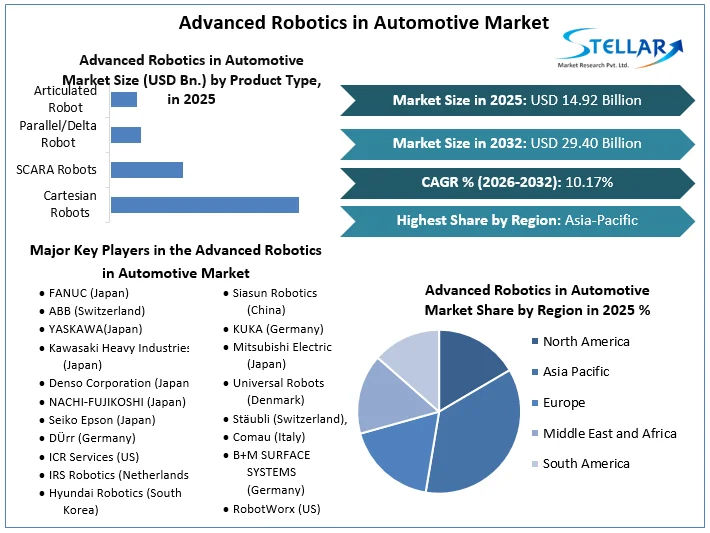
The Advanced Robotics in Automotive Market is experiencing substantial growth as automotive manufacturers increasingly adopt intelligent automation, artificial intelligence (AI), and Industry 4.0 technologies to improve production efficiency, product quality, and workplace safety. Growing demand for electric vehicles (EVs), connected vehicles, and customized automotive components is encouraging automakers to invest in advanced robotic systems that streamline manufacturing processes, reduce operational costs, and enhance production flexibility. As the automotive industry undergoes rapid digital transformation, advanced robotics has become a critical enabler of next-generation vehicle manufacturing.
Advanced robotics encompasses industrial robots, collaborative robots (cobots), autonomous mobile robots (AMRs), robotic vision systems, AI-powered robotic arms, and automated material handling solutions. These technologies are widely deployed across welding, painting, assembly, inspection, packaging, material handling, and quality control operations. By combining robotics with machine learning, computer vision, and real-time analytics, manufacturers can achieve greater precision, consistency, and productivity while minimizing production downtime.
𝐃𝐨𝐰𝐧𝐥𝐨𝐚𝐝 𝐅𝐫𝐞𝐞 𝐏𝐃𝐅 𝐁𝐫𝐨𝐜𝐡𝐮𝐫𝐞: https://www.stellarmr.com/report/req_sample/Advanced-Robotics-in-Automotive-Market/425
Smart Manufacturing and Electric Vehicle Production Drive Market Growth
One of the primary factors fueling the Advanced Robotics in Automotive Market is the increasing adoption of smart manufacturing practices. Automotive manufacturers are modernizing production facilities by integrating robotics with Industrial Internet of Things (IIoT) platforms, cloud computing, digital twins, and predictive analytics. These connected manufacturing environments enable real-time monitoring, automated decision-making, and optimized production workflows, improving operational efficiency across assembly lines.
The rapid expansion of electric vehicle manufacturing is another major growth driver. EV production requires highly precise assembly processes for battery packs, electric drivetrains, lightweight materials, and electronic components. Advanced robotic systems provide the accuracy, repeatability, and flexibility required to manufacture these complex components while maintaining high quality standards and reducing production errors.
Key Market Drivers
The growing need for improved manufacturing efficiency remains a significant driver for the Advanced Robotics in Automotive Market. Automotive manufacturers are under increasing pressure to reduce production costs, shorten product development cycles, and enhance manufacturing flexibility to meet changing consumer demands. Robotic automation enables continuous production, minimizes human error, and improves throughput while maintaining consistent product quality.
Rising labor shortages and increasing labor costs are also accelerating robotic adoption. Manufacturers are deploying robots to perform repetitive, hazardous, and physically demanding tasks, allowing human workers to focus on higher-value activities such as system supervision, engineering, and process optimization.
Stringent quality and safety standards further support market growth. Advanced robotic inspection systems equipped with AI-powered vision technologies can identify defects with exceptional accuracy, ensuring compliance with strict automotive manufacturing requirements and reducing warranty claims.
Emerging Industry Trends
Artificial intelligence is transforming the Advanced Robotics in Automotive Market by enabling robots to learn, adapt, and optimize manufacturing operations. AI-powered robotic systems can analyze production data, adjust operational parameters, and improve performance without extensive manual programming, increasing manufacturing flexibility.
Collaborative robots are gaining widespread adoption across automotive assembly facilities. Unlike traditional industrial robots, cobots are designed to work safely alongside human operators, improving productivity while reducing workplace injuries. Their ease of deployment and programming makes them particularly attractive for small and medium-sized automotive manufacturers.
Autonomous mobile robots are becoming increasingly common in automotive factories for material transportation, inventory management, and logistics operations. These intelligent systems navigate production facilities independently, improving material flow while reducing manual handling requirements.
Computer vision, digital twins, and predictive maintenance technologies are also emerging as important trends. Manufacturers are using digital simulations to optimize robotic workflows and leveraging predictive analytics to identify maintenance needs before equipment failures occur, minimizing production disruptions.
𝐀𝐜𝐜𝐞𝐬𝐬 𝐭𝐡𝐞 𝐅𝐮𝐥𝐥 𝐑𝐞𝐩𝐨𝐫𝐭: https://www.stellarmr.com/report/Advanced-Robotics-in-Automotive-Market/425
Market Challenges
Despite favorable growth prospects, the Advanced Robotics in Automotive Market faces several challenges. High initial investment costs for robotic equipment, software integration, and infrastructure upgrades may limit adoption among smaller manufacturers. Implementing advanced automation systems often requires significant capital expenditure and specialized technical expertise.
The integration of robotics with legacy manufacturing systems can also present operational challenges. Companies must ensure compatibility between new automation technologies and existing production infrastructure while minimizing downtime during implementation.
Cybersecurity has become an increasingly important concern as robotic systems become more connected through industrial networks and cloud-based platforms. Manufacturers must implement robust cybersecurity measures to protect production systems, operational data, and intellectual property from evolving cyber threats.
Additionally, workforce training remains essential for successful automation. Companies must invest in employee upskilling to enable effective operation, programming, and maintenance of advanced robotic systems.
Regional Insights
Asia-Pacific dominates the Advanced Robotics in Automotive Market due to its strong automotive manufacturing base, expanding electric vehicle production, and increasing investments in smart factories. China, Japan, South Korea, and India continue to lead regional demand through large-scale automotive production and government initiatives supporting industrial automation.
North America represents a significant market driven by technological innovation, advanced manufacturing capabilities, and growing investments in electric vehicle production. Automotive manufacturers across the United States, Canada, and Mexico are increasingly adopting AI-powered robotics to enhance production efficiency and competitiveness.
Europe remains a key market owing to its established automotive industry, strong emphasis on Industry 4.0, and stringent manufacturing quality standards. Countries including Germany, France, Italy, and the United Kingdom are investing heavily in intelligent robotic systems to support sustainable and highly automated vehicle production.
Latin America and the Middle East & Africa are gradually emerging as promising markets due to increasing industrialization, expanding automotive assembly operations, and rising investments in manufacturing modernization.
Competitive Landscape
The Advanced Robotics in Automotive Market is highly competitive, with leading robotics manufacturers focusing on technological innovation, AI integration, and strategic collaborations to strengthen their market position. Companies are investing in research and development to introduce faster, more intelligent, and energy-efficient robotic solutions capable of handling increasingly complex automotive manufacturing tasks.
Strategic partnerships between robotics companies, automotive manufacturers, software developers, and industrial automation providers are accelerating innovation across the industry. Manufacturers are also expanding service offerings that include predictive maintenance, remote monitoring, robotic programming, and digital manufacturing solutions to deliver comprehensive automation ecosystems.
Future Outlook
The Advanced Robotics in Automotive Market is expected to witness sustained growth over the coming years as vehicle manufacturers continue their transition toward smart factories, electric mobility, and digital manufacturing. Increasing adoption of AI, machine learning, autonomous robotics, cloud computing, and Industrial Internet of Things technologies will further enhance manufacturing productivity, quality, and operational flexibility.
Future innovation is likely to focus on autonom
About Stellar Market Research:
Stellar Market Research is a multifaceted market research and consulting company with professionals from several industries. Some industries we cover include medical devices, pharmaceutical manufacturers, science and engineering, electronic components, industrial equipment, technology and communication, cars and automobiles, chemical products and substances, general merchandise, beverages, personal care, and automated systems.
Contact Stellar Market Research:
S.no.8, h.no. 4-8 Pl.7/4,
Pinnacle Memories Fl. No. 3,
Pune, Maharashtra, 411029
sales@stellarmr.com
+91 9607365656
