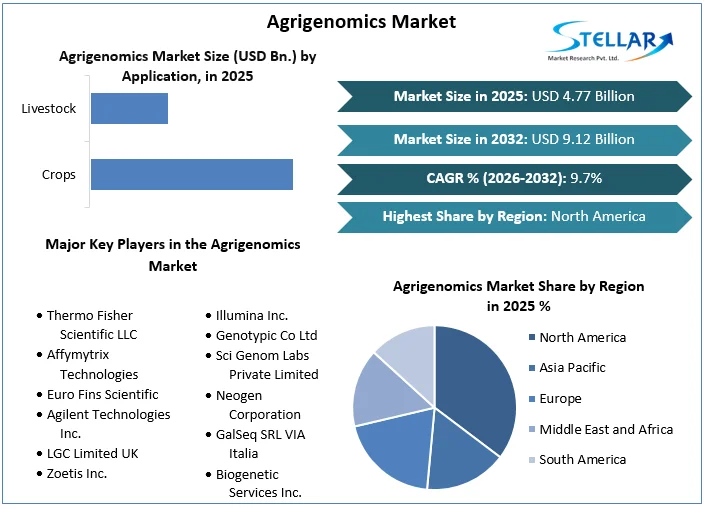
The Agrigenomics Market is experiencing robust growth as advances in genomic technologies, precision agriculture, and biotechnology reshape crop and livestock production worldwide. Increasing demand for higher agricultural productivity, improved food security, and sustainable farming practices is driving the adoption of agrigenomics across the agriculture sector. Governments, research institutions, and agribusiness companies are investing heavily in genomic research to develop high-yielding, disease-resistant, and climate-resilient crop varieties while improving livestock health and productivity.
Agrigenomics involves the application of genomics, DNA sequencing, molecular markers, bioinformatics, and gene expression analysis to improve agricultural production. These technologies enable researchers and farmers to identify desirable genetic traits, accelerate breeding programs, enhance disease resistance, and optimize crop performance under changing environmental conditions. As climate change, population growth, and resource limitations place increasing pressure on global food production, agrigenomics has become a critical tool for achieving sustainable agricultural development.
𝐃𝐨𝐰𝐧𝐥𝐨𝐚𝐝 𝐅𝐫𝐞𝐞 𝐏𝐃𝐅 𝐁𝐫𝐨𝐜𝐡𝐮𝐫𝐞: https://www.stellarmr.com/report/req_sample/Agrigenomics-Market/396
Precision Agriculture and Food Security Drive Market Growth
One of the primary factors fueling the Agrigenomics Market is the growing need to improve agricultural productivity while minimizing environmental impact. Farmers are increasingly adopting genomic technologies to develop crops with enhanced resistance to pests, diseases, drought, and salinity. These improvements help maximize yields, reduce crop losses, and decrease dependence on chemical pesticides and fertilizers.
The rising global demand for food is another major driver. With the world’s population continuing to grow, agricultural producers must increase production using limited arable land and water resources. Agrigenomics enables faster development of high-performance crop varieties and livestock breeds, supporting efficient and sustainable food production systems.
Key Market Drivers
Technological advancements in next-generation sequencing (NGS), polymerase chain reaction (PCR), genotyping, gene editing, and bioinformatics remain major growth drivers for the Agrigenomics Market. These innovations have significantly reduced sequencing costs while improving the speed and accuracy of genetic analysis, making genomic technologies more accessible for agricultural applications.
The increasing adoption of precision agriculture is further supporting market expansion. Farmers are combining genomic data with satellite imaging, drones, artificial intelligence, and precision farming tools to optimize planting decisions, irrigation management, nutrient application, and crop monitoring. This integrated approach improves productivity while reducing resource consumption and operational costs.
Growing investments in agricultural biotechnology research by governments, universities, and private companies are accelerating the development of innovative genomic solutions for crop improvement, livestock breeding, and disease management.
Emerging Industry Trends
Gene editing technologies, particularly CRISPR-based genome editing, are transforming the Agrigenomics Market by enabling precise modification of plant and animal genomes. Researchers are developing crop varieties with improved nutritional value, higher yields, greater environmental resilience, and enhanced resistance to pests and diseases.
Artificial intelligence and bioinformatics are becoming increasingly important in genomic data analysis. AI-powered platforms can process large genomic datasets, identify valuable genetic markers, and accelerate breeding programs by predicting desirable traits with greater accuracy.
Livestock genomics is also gaining significant attention. Genomic selection techniques are improving breeding efficiency for cattle, poultry, swine, sheep, and aquaculture species by enhancing productivity, disease resistance, feed efficiency, and reproductive performance.
The integration of cloud computing and digital agriculture platforms is further enhancing genomic research by enabling secure data sharing, collaborative research, and advanced computational analysis across global agricultural organizations.
𝐀𝐜𝐜𝐞𝐬𝐬 𝐭𝐡𝐞 𝐅𝐮𝐥𝐥 𝐑𝐞𝐩𝐨𝐫𝐭: https://www.stellarmr.com/report/Agrigenomics-Market/396
Market Challenges
Despite strong growth potential, the Agrigenomics Market faces several challenges. High costs associated with advanced sequencing technologies, laboratory infrastructure, and genomic data analysis may limit adoption among smaller agricultural enterprises and research organizations.
Regulatory complexity surrounding genetically modified organisms (GMOs) and gene-edited crops varies across countries, creating uncertainty for commercial product development and international trade. Manufacturers and researchers must comply with evolving regulatory frameworks while ensuring product safety and transparency.
Limited technical expertise and inadequate genomic infrastructure in developing regions may also slow adoption. Expanding education, research funding, and technical training will be essential for broader implementation of agrigenomic technologies.
Additionally, data privacy, intellectual property protection, and ethical considerations related to genetic information continue to influence market development and technology adoption.
Regional Insights
North America holds a significant share of the Agrigenomics Market due to advanced agricultural biotechnology research, strong government support, and widespread adoption of precision agriculture technologies. Extensive investments in crop improvement, livestock genomics, and agricultural innovation continue to drive regional market growth.
Europe remains an important market supported by substantial research funding, sustainable agriculture initiatives, and growing adoption of advanced breeding technologies. Countries such as Germany, France, the United Kingdom, and the Netherlands continue to invest in genomic research aimed at improving agricultural productivity and environmental sustainability.
Asia-Pacific is expected to register the fastest growth during the forecast period. Rapid population growth, increasing food demand, expanding agricultural biotechnology research, and government initiatives supporting modern farming practices are driving adoption across China, India, Japan, Australia, and Southeast Asian countries.
Latin America, the Middle East, and Africa are emerging as promising markets due to growing investments in agricultural modernization, crop improvement programs, and sustainable farming initiatives designed to improve food security and agricultural resilience.
Competitive Landscape
The Agrigenomics Market is highly competitive, with biotechnology companies, agricultural research organizations, genomics technology providers, and seed developers focusing on continuous innovation to strengthen their market positions. Companies are investing in advanced sequencing platforms, molecular breeding technologies, bioinformatics software, and gene-editing research to develop next-generation agricultural solutions.
Strategic collaborations among universities, government agencies, biotechnology firms, seed producers, and agricultural companies are accelerating innovation and commercial adoption. Research partnerships, technology licensing agreements, and investment in genomic databases continue to expand the industry’s capabilities and market reach.
Future Outlook
The Agrigenomics Market is expected to witness sustained growth over the coming years as genomic technologies become increasingly integrated into modern agriculture. Rising demand for sustainable food production, climate-resilient crops, precision livestock breeding, and resource-efficient farming practices will continue to create significant growth opportunities.
Future innovations are likely to focus on AI-powered genomic analysis, advanced gene-editing technologies, digital breeding platforms, multi-omics integration, and personalized crop improvement strategies. As agriculture continues its transition toward data-driven and sustainable production systems, companies that invest in genomic research, technological innovation, and collaborative partnerships will be well positioned to capitalize on the expanding opportunities in the Agrigenomics Market.
About Stellar Market Research:
Stellar Market Research is a multifaceted market research and consulting company with professionals from several industries. Some industries we cover include medical devices, pharmaceutical manufacturers, science and engineering, electronic components, industrial equipment, technology and communication, cars and automobiles, chemical products and substances, general merchandise, beverages, personal care, and automated systems.
Contact Stellar Market Research:
S.no.8, h.no. 4-8 Pl.7/4,
Pinnacle Memories Fl. No. 3,
Pune, Maharashtra, 411029
sales@stellarmr.com
+91 9607365656
