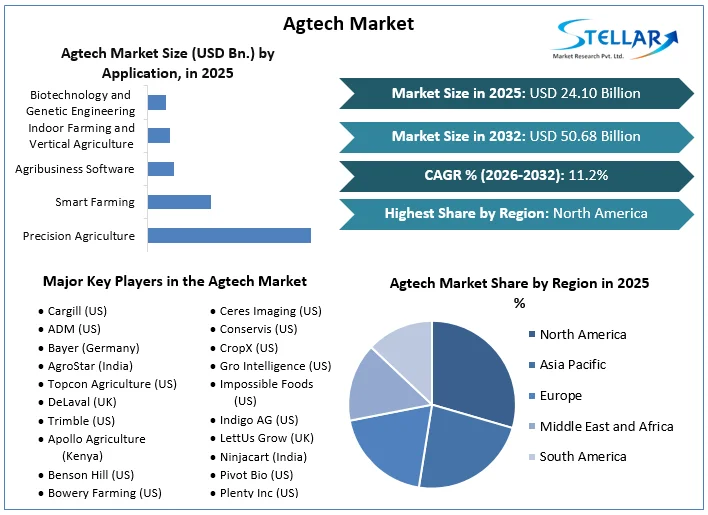
The AgTech Market is witnessing remarkable growth as digital technologies, automation, and data-driven farming solutions revolutionize agricultural practices worldwide. Increasing pressure to improve crop yields, optimize resource utilization, and ensure food security for a growing global population is driving the adoption of advanced agricultural technologies. Farmers, agribusinesses, and governments are investing in smart farming solutions that enhance productivity, reduce operational costs, and promote sustainable agriculture. The integration of artificial intelligence (AI), Internet of Things (IoT), robotics, drones, satellite imaging, and data analytics is enabling the transition toward highly efficient and precision-based farming systems.
AgTech encompasses a broad range of technologies, including precision agriculture, smart irrigation systems, autonomous tractors, agricultural drones, robotic harvesting, farm management software, vertical farming, greenhouse automation, livestock monitoring, and digital supply chain solutions. These innovations enable farmers to make data-driven decisions, improve crop health, optimize fertilizer and pesticide application, and maximize agricultural output while minimizing environmental impact. As climate change and resource scarcity continue to challenge traditional farming methods, AgTech is becoming a vital component of modern agriculture.
𝐃𝐨𝐰𝐧𝐥𝐨𝐚𝐝 𝐅𝐫𝐞𝐞 𝐏𝐃𝐅 𝐁𝐫𝐨𝐜𝐡𝐮𝐫𝐞: https://www.stellarmr.com/report/req_sample/Agtech-Market/1804
Precision Agriculture and Sustainable Farming Drive Market Growth
One of the primary factors fueling the AgTech Market is the increasing adoption of precision agriculture. Farmers are utilizing sensors, GPS technology, satellite imagery, and AI-powered analytics to monitor soil conditions, crop growth, weather patterns, and irrigation requirements in real time. Precision farming enables targeted application of water, fertilizers, and crop protection products, reducing waste while improving productivity and profitability.
The growing emphasis on sustainable agriculture is another major growth driver. Governments and agricultural organizations are promoting environmentally responsible farming practices that reduce greenhouse gas emissions, conserve natural resources, and improve soil health. AgTech solutions help farmers achieve these sustainability goals by increasing efficiency and minimizing the environmental footprint of agricultural operations.
Key Market Drivers
Rising global food demand remains one of the strongest drivers for the AgTech Market. With the global population expected to continue growing, agricultural producers must generate higher yields from limited arable land and water resources. Advanced farming technologies provide practical solutions for increasing productivity while preserving valuable natural resources.
Labor shortages in agriculture are also accelerating the adoption of automation and robotics. Autonomous tractors, robotic harvesters, automated irrigation systems, and livestock monitoring technologies help address workforce challenges while improving operational efficiency and reducing labor costs.
Government support for digital agriculture is further contributing to market growth. Many countries are investing in smart farming initiatives, agricultural digitization programs, and rural technology infrastructure to improve food production, strengthen supply chains, and enhance climate resilience.
The expansion of agricultural financing and venture capital investments is encouraging innovation across the AgTech ecosystem. Startups and established technology companies are introducing advanced solutions that improve farm management, supply chain visibility, and agricultural productivity.
Emerging Industry Trends
Artificial intelligence is transforming the AgTech Market by enabling predictive analytics, crop disease detection, yield forecasting, and automated decision-making. AI-powered farm management platforms analyze data collected from sensors, drones, satellites, and weather stations to provide actionable recommendations that improve farm performance.
Agricultural drones continue to gain widespread adoption for crop monitoring, aerial mapping, spraying, and field analysis. Equipped with multispectral cameras and advanced imaging technologies, drones enable farmers to identify crop stress, pest infestations, and nutrient deficiencies with greater accuracy.
Vertical farming and controlled environment agriculture are becoming increasingly popular as urbanization and land scarcity drive demand for efficient food production methods. Smart greenhouses equipped with climate control systems, automated lighting, and hydroponic technologies enable year-round cultivation while reducing water and land use.
IoT-enabled smart irrigation systems are another significant trend. Connected sensors continuously monitor soil moisture levels, weather conditions, and crop requirements, allowing farmers to optimize irrigation schedules and conserve water resources.
𝐀𝐜𝐜𝐞𝐬𝐬 𝐭𝐡𝐞 𝐅𝐮𝐥𝐥 𝐑𝐞𝐩𝐨𝐫𝐭: https://www.stellarmr.com/report/Agtech-Market/1804
Market Challenges
Despite strong growth prospects, the AgTech Market faces several challenges. High initial investment costs for advanced farming equipment, software platforms, sensors, and automation technologies may limit adoption among small and medium-sized farms. Access to financing remains a critical barrier in many developing regions.
Limited digital infrastructure and internet connectivity in rural areas can also hinder the implementation of connected farming technologies. Reliable communication networks are essential for supporting real-time data collection and remote farm management.
Data privacy and cybersecurity have become increasingly important as farms generate and store large volumes of operational data. Technology providers must ensure secure data management systems that protect sensitive agricultural information while maintaining system reliability.
Additionally, limited technical expertise and resistance to adopting new technologies may slow market penetration, highlighting the need for farmer education, training programs, and technical support services.
Regional Insights
North America holds a significant share of the AgTech Market due to widespread adoption of precision agriculture, advanced farming equipment, and digital farm management solutions. Strong investments in agricultural innovation, supportive government policies, and a well-developed technology ecosystem continue to drive regional growth.
Europe remains an important market supported by sustainability initiatives, smart farming programs, and increasing investments in agricultural automation. Countries including Germany, France, the Netherlands, the United Kingdom, and Denmark are leading the adoption of digital agriculture technologies to improve efficiency and environmental performance.
Asia-Pacific is expected to register the fastest growth during the forecast period. Rising food demand, expanding agricultural modernization initiatives, increasing smartphone penetration, and government investments in digital farming are accelerating market expansion across China, India, Japan, Australia, and Southeast Asian countries.
Latin America and the Middle East & Africa are emerging as promising markets due to increasing mechanization, growing awareness of precision farming, expanding agribusiness investments, and government programs supporting sustainable agricultural development.
Competitive Landscape
The AgTech Market is highly competitive, with technology companies, agricultural equipment manufacturers, software developers, drone producers, and precision farming solution providers investing heavily in innovation. Companies are focusing on AI-powered analytics, autonomous machinery, smart sensors, cloud-based farm management platforms, and robotics to strengthen their market positions.
Strategic partnerships among technology providers, agricultural cooperatives, research institutions, and government organizations are accelerating the commercialization of advanced farming solutions. Mergers, acquisitions, and venture capital investments continue to expand product portfolios and improve global market reach.
Future Outlook
The AgTech Market is expected to witness sustained growth over the coming years as digital transformation continues to reshape agriculture. Increasing adoption of AI, IoT, robotics, drones, autonomous machinery, and precision farming technologies will enhance agricultural productivity, improve sustainability, and strengthen global food security.
Future innovations are likely to focus on autonomous farm operations, AI-driven crop management, climate-smart agriculture, blockchain-enabled supply chain traceability, advanced biotechnology, and carbon-efficient farming solutions. As agriculture evolves into a more connected and data-driven industry, companies that prioritize technological innovation, sustainability, and farmer-centric solutions will be well positioned to capitalize on the expanding opportunities in the AgTech Market.
About Stellar Market Research:
Stellar Market Research is a multifaceted market research and consulting company with professionals from several industries. Some industries we cover include medical devices, pharmaceutical manufacturers, science and engineering, electronic components, industrial equipment, technology and communication, cars and automobiles, chemical products and substances, general merchandise, beverages, personal care, and automated systems.
Contact Stellar Market Research:
S.no.8, h.no. 4-8 Pl.7/4,
Pinnacle Memories Fl. No. 3,
Pune, Maharashtra, 411029
sales@stellarmr.com
+91 9607365656
