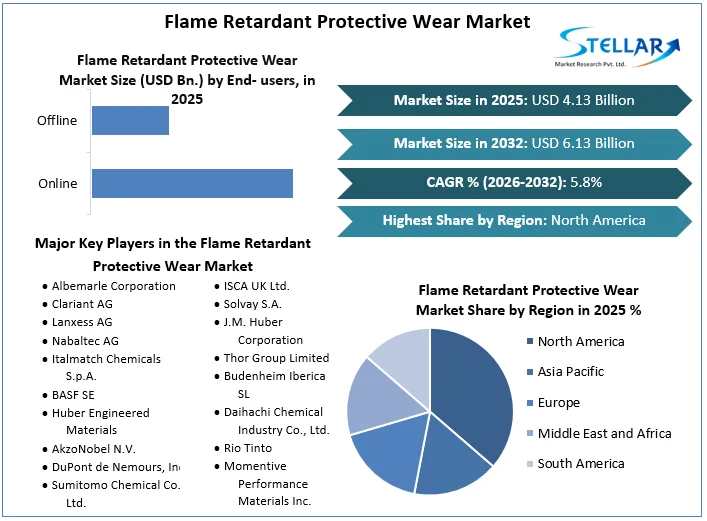
The Flame Retardant Protective Wear Market is experiencing robust growth as industries increasingly prioritize worker safety, regulatory compliance, and advanced personal protective equipment (PPE). Rising awareness of occupational hazards, stricter workplace safety standards, and growing investments in industrial safety programs are driving demand for flame-resistant apparel across sectors such as oil & gas, electrical utilities, manufacturing, mining, chemicals, construction, and firefighting. Employers are adopting high-performance protective garments that provide superior protection against flash fires, arc flashes, molten metal splashes, and thermal hazards while ensuring worker comfort and durability.
Flame retardant protective wear includes coveralls, jackets, trousers, shirts, bib overalls, lab coats, firefighting suits, and specialized protective clothing manufactured using inherently flame-resistant fibers or treated fabrics. These garments are designed to minimize burn injuries by resisting ignition, limiting flame spread, and providing thermal insulation during hazardous workplace incidents. Continuous advancements in textile engineering, lightweight materials, and ergonomic designs are enhancing garment performance while improving mobility and wearer comfort.
𝐃𝐨𝐰𝐧𝐥𝐨𝐚𝐝 𝐅𝐫𝐞𝐞 𝐏𝐃𝐅 𝐁𝐫𝐨𝐜𝐡𝐮𝐫𝐞: https://www.stellarmr.com/report/req_sample/Flame-Retardant-Protective-Wear-Market/1540
Increasing Workplace Safety Standards Drive Market Growth
One of the primary factors fueling the Flame Retardant Protective Wear Market is the implementation of stringent occupational health and safety regulations across industrial sectors. Employers are required to provide certified protective clothing for workers exposed to fire, heat, electrical arc flash, and explosive environments. Compliance with national and international safety standards has significantly increased the adoption of flame-resistant workwear.
The expansion of the oil & gas, petrochemical, and power generation industries is another major market driver. Employees working in hazardous environments require protective garments capable of reducing injury risks during accidental fires, electrical faults, and high-temperature operations. Growing investments in industrial infrastructure continue to support long-term demand for certified flame-retardant apparel.
Key Market Drivers
The increasing focus on worker health and occupational risk management remains a significant growth driver for the Flame Retardant Protective Wear Market. Organizations are investing in advanced PPE programs to reduce workplace accidents, improve employee safety, and minimize operational disruptions associated with industrial incidents.
The rapid expansion of electrical transmission and renewable energy infrastructure is also contributing to market growth. Electrical utility workers require arc-rated flame-resistant clothing to protect against arc flash incidents during maintenance, installation, and repair operations. The increasing deployment of renewable energy facilities and power distribution networks is generating additional demand for specialized protective wear.
Growing industrial automation and modernization are encouraging companies to adopt advanced safety equipment alongside automated production systems. Even as automation reduces certain workplace risks, skilled personnel continue to require reliable protective clothing during maintenance and operational activities.
Emerging Industry Trends
Innovation in high-performance textile materials is transforming the Flame Retardant Protective Wear Market. Manufacturers are developing lightweight, breathable, moisture-wicking, and stretchable fabrics that improve worker comfort without compromising protection. Advanced fiber technologies provide enhanced thermal resistance, durability, and extended garment life.
Smart protective clothing is gaining increasing attention across industrial workplaces. Integrated sensors capable of monitoring worker temperature, environmental conditions, physiological parameters, and hazardous gas exposure are enhancing workplace safety through real-time monitoring and predictive risk management.
Sustainability has become another major trend influencing market development. Manufacturers are investing in eco-friendly textile production, recycled materials, water-efficient dyeing technologies, and environmentally responsible manufacturing processes to reduce environmental impact while meeting growing customer demand for sustainable protective apparel.
Customization and ergonomic garment design continue to improve user acceptance. Modern protective wear offers better fit, greater flexibility, enhanced visibility, and improved compatibility with helmets, gloves, respiratory equipment, and other personal protective equipment.
𝐀𝐜𝐜𝐞𝐬𝐬 𝐭𝐡𝐞 𝐅𝐮𝐥𝐥 𝐑𝐞𝐩𝐨𝐫𝐭: https://www.stellarmr.com/report/Flame-Retardant-Protective-Wear-Market/1540
Market Challenges
Despite favorable growth prospects, the Flame Retardant Protective Wear Market faces several challenges. High production costs associated with specialized flame-resistant fibers, advanced textile treatments, and certification requirements may increase product prices and limit adoption among smaller organizations.
Maintaining garment performance after repeated washing and prolonged use remains an important consideration. Manufacturers must ensure long-term durability while preserving flame-resistant properties throughout the product lifecycle.
The market also faces increasing competition from alternative protective materials and regional manufacturers offering lower-cost products. Companies must differentiate themselves through product quality, certification compliance, comfort, and technological innovation.
Additionally, fluctuations in raw material prices and supply chain disruptions affecting technical fibers, textiles, and manufacturing inputs may influence production costs and product availability.
Regional Insights
North America holds a significant share of the Flame Retardant Protective Wear Market due to strict workplace safety regulations, a well-established industrial sector, and strong investments in occupational health programs. High demand from oil & gas, utilities, manufacturing, and emergency response organizations continues to support market growth.
Europe remains an important market driven by comprehensive worker safety legislation, industrial modernization, and increasing adoption of advanced personal protective equipment. Countries such as Germany, the United Kingdom, France, Italy, and the Netherlands continue to invest in high-quality flame-resistant workwear across multiple industries.
Asia-Pacific is expected to register the fastest growth during the forecast period. Rapid industrialization, expanding manufacturing activities, increasing infrastructure development, and stronger workplace safety awareness are driving market expansion across China, India, Japan, South Korea, and Southeast Asian countries. Government initiatives promoting occupational safety further support regional demand.
Latin America and the Middle East & Africa are emerging as promising markets due to expanding oil & gas exploration, mining activities, power generation projects, and industrial construction that require certified protective clothing for hazardous work environments.
Competitive Landscape
The Flame Retardant Protective Wear Market is highly competitive, with manufacturers focusing on advanced textile technologies, product certification, ergonomic design, and sustainable manufacturing to strengthen their market positions. Companies are investing in research and development to improve fabric performance, enhance wearer comfort, reduce garment weight, and extend product lifespan.
Strategic collaborations with industrial employers, safety equipment distributors, textile technology providers, and regulatory organizations are expanding market opportunities. Product differentiation through multi-hazard protection, lightweight construction, moisture management, smart wearable integration, and environmentally responsible materials has become a key competitive strategy.
Future Outlook
The Flame Retardant Protective Wear Market is expected to witness sustained growth over the coming years as industries continue strengthening workplace safety programs and complying with increasingly stringent occupational safety regulations. Rising investments in industrial infrastructure, renewable energy, electrical utilities, and hazardous manufacturing operations will continue to generate strong demand for certified flame-resistant protective clothing.
Future innovations are likely to focus on smart protective garments, AI-enabled safety monitoring, advanced flame-resistant fibers, sustainable textile manufacturing, wearable sensor integration, and enhanced ergonomic designs. As organizations increasingly prioritize worker safety, operational efficiency, and regulatory compliance, manufacturers that invest in technological innovation, sustainable production, and high-performance protective solutions will be well positioned to capitalize on the expanding opportunities in the Flame Retardant Protective Wear Market.
About Stellar Market Research:
Stellar Market Research is a multifaceted market research and consulting company with professionals from several industries. Some industries we cover include medical devices, pharmaceutical manufacturers, science and engineering, electronic components, industrial equipment, technology and communication, cars and automobiles, chemical products and substances, general merchandise, beverages, personal care, and automated systems.
Stellar Market Research
Address: Phase 3, Navale IT Zone, S.No. 51/2A/2, Office No. 202, 2nd floor, Near, Navale Brg, Narhe, Pune, Maharashtra 411041
Website: http://stellarmr.com/
Email: sales@stellarmr.com
Mobile: +91 9607365656
