Key Highlights
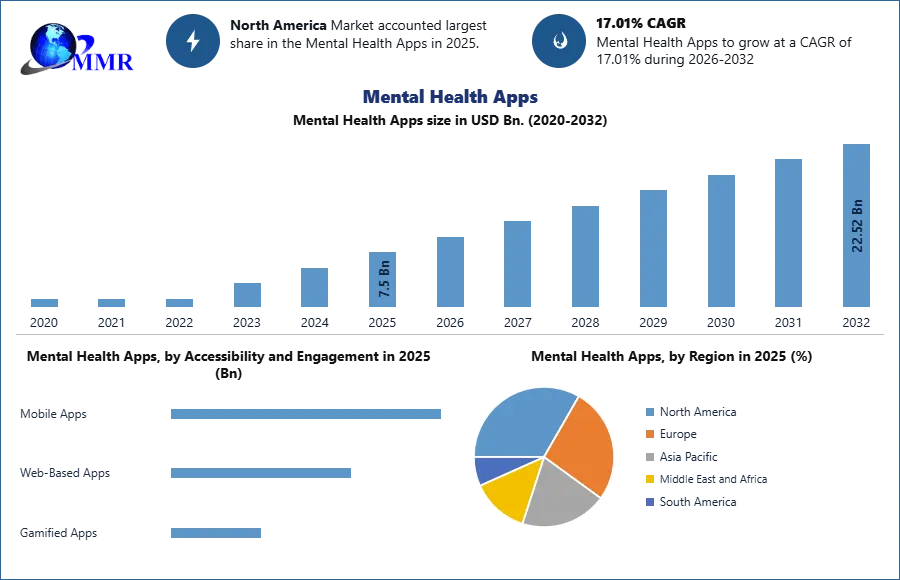
Substantial Valuation Scaling: The global mental health apps market is projected to expand from USD 7.50 billion in 2025 to USD 22.52 billion by 2032, moving at an accelerated 17.01% compound annual growth rate (CAGR).
Clinical Focus Area Dominance: Depression and anxiety management tools captured the largest market share in 2025, commanding 32.15% of total revenue due to skyrocketing global patient volumes.
Rapid Stress Management Acceleration: Stress management features stand as the fastest-growing application segment, capturing massive enterprise wellness contracts and proactive consumer adoption.
Platform Demographics Favor iOS: The iOS operating system represents the dominant deployment channel, holding a 51.23% market share in 2025 due to perceived security advantages and high-income user engagement.
Structural Vulnerability in Purity: Market growth faces a major restraint from acute data privacy concerns and a lack of standardized clinical validation, limiting universal medical integration.
Why This Matters Now Corporate employers, healthcare insurance networks, and medical systems are confronting a severe shortfall in traditional psychiatric infrastructure. A growing loneliness epidemic affects nearly 50 million adults in the United States alone, outstripping the capacity of brick-and-mortar clinics and driving patient queues to historic lengths. Virtual barriers, long geographic distances, and high out-of-pocket costs prevent large patient cohorts from ever receiving early clinical interventions.
Mental health apps resolve this supply-and-demand crisis by delivering scalable, evidence-based psychotherapeutic tools directly to user smartphones. For venture capital investors and digital health developers, the current landscape offers a unique window to integrate teletherapy and remote patient monitoring into mainstream care. Platforms that can successfully combine automated cognitive behavioral therapy (CBT) with immediate live human counseling will capture dominant market share as enterprise health plans actively seek to de-risk their behavioral health expenditures.
Market Overview The global mental health apps market is moving rapidly from standalone lifestyle tools to fully integrated medical software ecosystems. The industry achieved a valuation of USD 7.50 billion in 2025 and is on track to reach USD 22.52 billion by 2032. This expansion represents a steady 17.01% CAGR over the forecast period.
These applications use mobile hardware to deliver remote mindfulness lessons, automated journaling, objective mood monitoring, and virtual therapeutic appointments. By shifting the entry point of behavioral healthcare away from physical emergency rooms and psychiatric clinics, these apps lower the threshold for patient enrollment. As public health initiatives focus heavily on preventive care models, both public and private payers are viewing mobile mental health platforms as essential tools to manage patient populations cost-effectively.
Key Trends Driving Growth The most pronounced commercial trend is the seamless integration of teletherapy and live human support into automated software architectures. Modern applications no longer rely solely on pre-recorded audio or static text inputs. Instead, they act as triage mechanisms, connecting users to licensed network therapists via text, voice, or video channels when real-time clinical intervention is required. This combination of automated self-help tools and live professional support significantly boosts long-term platform engagement and medical credibility.
Concurrently, developers are deploying advanced artificial intelligence and machine learning algorithms to achieve true personalization. By processing biometric inputs, user progress logs, and behavioral choices, AI engines can adjust therapeutic modules to match an individual’s unique emotional state. Furthermore, modern apps utilize built-in smartphone sensors to provide real-time tracking of physiological markers. This allows the software to capture objective data regarding an individual’s stress responses, long before the patient can articulate their distress.
𝐃𝐨𝐰𝐧𝐥𝐨𝐚𝐝 𝐏𝐃𝐅 𝐁𝐫𝐨𝐜𝐡𝐮𝐫𝐞 @ https://www.maximizemarketresearch.com/request-sample/213831/
Segment Insights
Depislation and Anxiety Management (Dominant Segment): Securing a clear 32.15% market share in 2025, this application category leads overall revenue generation. Volume is sustained by rising global disease prevalence and growing clinical trust in mobile apps for managing mild-to-moderate chronic mood disorders.
Stress Management (Fastest-Growing Segment): This application path is expected to grow at the fastest rate through 2032. Expansion is propelled by corporate wellness buyers seeking to lower workplace burnout and improve productivity metrics.
iOS Platforms (Dominant Platform): The iOS ecosystem commanded 51.23% of the market share in 2025. This dominance stems from rigid app store quality controls, a premium consumer base, and strong built-in security features that appeal to users sharing sensitive emotional data.
Android Platforms: This platform drives high-volume accessibility across expanding international sectors, providing affordable, multi-language therapeutic tools to previously unreached demographics.
Regional Growth Story North America holds the largest share of the global mental health apps market and is projected to maintain this leading position through 2032. Growth across the United States and Canada is supported by an advanced digital infrastructure, high smartphone saturation, and proactive corporate deployment of digital health benefits. With roughly 1 in 10 American adults navigating a mental health condition during their lifetime, regional employers utilize these applications to mitigate losses related to healthcare claims and employee absenteeism.
Europe stands as the second largest regional ecosystem, anchored by digital health laws in nations like Germany and the United Kingdom. Public health administrators across these countries are creating formal prescription pathways that allow doctors to prescribe verified mobile applications, with costs fully covered by national insurance systems.
The Asia-Pacific region will achieve the highest growth rate during the forecast period. Expansion across China, India, Japan, and South Korea is fueled by expanding mobile internet networks, a swelling middle class, and a generational shift that reduces the historical stigma around seeking behavioral care.
Competitive Landscape The competitive field within the mental health apps market is shifting from fragmented, boutique application developers toward a consolidated landscape led by well-funded platforms like Calm, Talkspace, and Headspace. These enterprise leaders compete primarily on the breadth of their feature suites, offering a mix of mindfulness exercises, video-based education, and automated cognitive behavioral tools.
To solidify their market positions, dominant players are moving away from direct-to-consumer marketing in favor of securing high-margin business-to-business (B2B) partnerships. Companies are aggressively vying for inclusion in employee benefit packages and managed care formularies. This shift has turned corporate procurement approvals and regulatory clearance into critical competitive battlegrounds.
Recent Developments
Prominent platforms have acquired smaller, niche digital therapeutic developers to add specialized, clinical-grade CBT modules to their mass-market wellness interfaces.
Digital platforms have introduced advanced sensor-tracking protocols that sync with popular commercial smartwatches, allowing for automated, passive anxiety detection based on heart-rate variability.
Major market operators have formalized strategic alliances with national healthcare networks, establishing data pipelines that transmit user mood logs directly to Electronic Health Records (EHR) to improve physician-led care.
Strategic Implications The rapid commercialization of digital mental health platforms carries major strategic implications across the broader life sciences and healthcare delivery spectrum. For hospital networks, deploying these apps as pre-clinical or post-discharge management tools helps lower readmission rates and reduces the operational burden on overwhelmed emergency departments. For the pharmaceutical industry, partnering with established app platforms provides a rich source of longitudinal data regarding patient mood and behavior, which can be utilized to evaluate the real-world effectiveness of central nervous system therapeutics.
However, developers must proactively confront a shifting regulatory and legal landscape. The rapid rise of between 10,000 and 15,000 publicly available mental health apps has created a highly fragmented marketplace with vast differences in clinical quality and evidence-based validation. Organizations that invest early in rigorous clinical trials and data safety protocols will distinguish themselves from low-quality alternatives, positioning their software to capture lucrative insurance reimbursement codes.
Future Outlook The global mental health apps market through 2032 will transition into a highly regulated tier of prescription digital therapeutics. As validation standards tighten globally, standard lifestyle applications will separate from clinical software platforms that are fully integrated into regional medical systems. The competitive divide over the next decade will be stark. The market will be led exclusively by platforms that can provide bulletproof data privacy protections and clear, evidence-based clinical outcomes, leaving unverified, consumer-only lifestyle applications to fade into a crowded marketplace.
Analyst Perspective “The mental health apps market is no longer just a collection of basic consumer wellness tools,” says Komal Patil, Research Analyst at Maximize Market Research. “By integrating real-time physiological tracking with scalable teletherapy access, these mobile platforms are successfully addressing a massive gap in international healthcare delivery, transforming how societies manage chronic psychological conditions.”
About Maximize Market Research
Maximize Market Research Pvt. Ltd. (MMR) is a global market research and consulting company that provides reliable, data-focused, and practical business insights. The firm serves a wide range of industries, including healthcare, pharmaceuticals, technology, automotive, electronics, chemicals, personal care, and consumer goods. Through market forecasts, competitive analysis, strategic consulting, and industry impact assessments, MMR helps organizations understand changing market conditions, identify growth opportunities, and make informed business decisions for long-term success.
2nd Floor, Navale IT Park Phase 3
Pune Banglore Highway, Narhe
Pune, Maharashtra 411041, India
+91 9607365656
sales@maximizemarketresearch.com
