Key Highlights
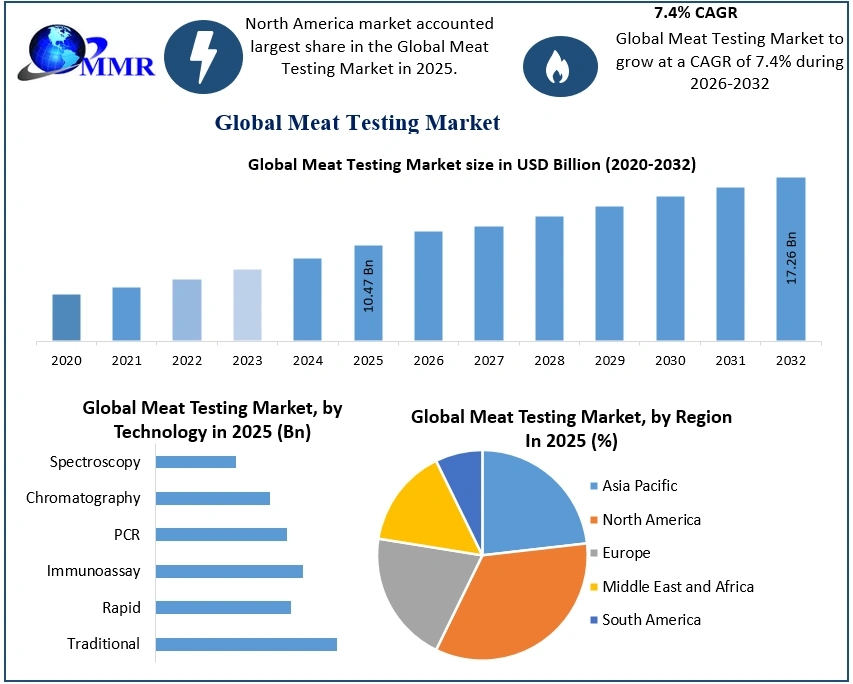
Aggressive Capital Expansion: The global meat testing market is projected to grow from USD 9.21 billion in 2024 to USD 19.03 billion by 2032, expanding at an 8.40% compound annual growth rate (CAGR).
Pathogen Testing Dominates Target Fields: Screening for infectious micro-organisms like Salmonella and E. coli accounts for the largest market share, driven by immediate consumer safety mandates.
Seafood Testing Scales at Pace: While the meat segment holds the majority revenue share, the seafood sub-vertical represents the fastest-growing sample type due to rising chemical and heavy metal contamination risks.
Rapid Technology Challenges Heritage Assays: Advanced PCR and liquid chromatography systems are capturing high-value market share from traditional culture methods by drastically reducing turnaround times.
North American Infrastructure Leads: Strict regulatory enforcement and high-volume meat production consolidate North America as the dominant regional revenue generator.
Why This Matters Now Food safety regulators, commercial livestock processors, and global export syndicates are facing an unprecedented operational crisis due to complex international supply lines and shifting pathogen profiles. Conventional microbiological cultivation methods create dangerous supply chain delays, forcing perishable meat inventory to remain in storage for days while awaiting clearance. A single unintercepted pathogen strain can trigger nationwide product recalls, destroying brand equity and threatening public health.
Meat testing innovations resolve this biological bottleneck by introducing high-throughput, automated screening directly into the production line. For agricultural enterprises and meat processors, the timeframe to adopt modern molecular diagnostics is shrinking. Facilities that deploy automated PCR platforms and rapid immunoassay kits can instantly clear inventory for distribution, secure compliance with cross-border trade mandates, and isolate contaminated lots before they exit the processing floor.
Market Overview The global meat testing market is moving rapidly from passive quality assurance toward active, data-driven biosecurity. The industry achieved a market valuation of USD 9.21 billion in 2024 and is projected to expand to USD 19.03 billion by 2032. This trajectory represents a steady 8.40% CAGR, driven by rising global meat consumption and strict regulatory frameworks worldwide.
Ensuring product authenticity and chemical purity is an essential foundation of modern value-based agricultural commerce. As commercial processing facilities increase daily throughput to meet global food demand, food safety testing has become a critical operational metric. Implementing reliable diagnostic software and testing instruments allows processing operations to protect consumer health, verify nutritional labeling, and prevent fraudulent species substitution across complex distribution pipelines.
Key Trends Driving Growth The most impactful technological shift in the current landscape is the mass migration from traditional culture plates to rapid testing technologies. Processing companies are integrating real-time polymerase chain reaction (PCR) instruments and automated enzyme-linked immunosorbent assays (ELISA) to identify pathogen DNA within hours. This rapid turnaround allows logistics managers to reduce cold-storage overhead and accelerate delivery timelines.
Concurrently, international trade agreements are forcing the standardization of testing protocols across different jurisdictions. Regulatory bodies are demanding precise molecular verification of species origin and exact chemical quantification of veterinary drug residues, such as hormones and antibiotics. This pressure has transformed chemical and residue screening from an occasional quality check into a continuous, mandatory gatekeeper for international market access.
Furthermore, laboratory networks are implementing artificial intelligence and automated software workflows to manage large analytical datasets. By automating sample preparation, tracking barcodes, and generating immediate digital reports, these systems eliminate human error in high-volume testing facilities. This digital health integration ensures that traceability data remains linked to specific meat lots throughout the entire distribution lifecycle.
Segment Insights
Meat Segment (Dominant Segment): Controlling a substantial 38.5% market share, this sample type commands global revenue. Massive consumer demand for fresh, frozen, and processed red meat fuels continuous volume across testing networks.
Seafood Segment (Fastest-Growing Segment): This sample block exhibits the steepest growth trajectory through 2032. Expansion is propelled by rising international seafood trade and mounting regulatory concerns regarding mercury, histamine, and micro-organism contamination.
Pathogen Testing (Dominant Target): This testing segment generates the highest recurring revenue. Continuous processing demands require frequent procurement of specialized reagents to intercept Salmonella, Listeria, and E. coli.
Traditional Testing: This technology continues to hold a significant revenue block due to its long-established regulatory acceptance, serving as the baseline verification method for global reference laboratories.
Regional Growth Story North America holds the dominant market share in the global meat testing market and is on track to maintain its leading position through 2032. Growth across the United States and Canada is anchored by highly industrialized livestock processing systems, strict food safety enforcement, and high consumer awareness regarding foodborne illness prevention. Regional operators invest heavily in automated testing infrastructure to satisfy stringent regulatory compliance codes.
Europe operates as a major secondary power center, with Germany and the United Kingdom spearheading regional adoption. The European market is defined by strict regulatory frameworks governing animal welfare, genetically modified organisms (GMOs), and antibiotic residues. Public health mandates prioritize complete visibility across food supply chains, driving consistent corporate spending on high-purity chemical testing instruments.
The Asia-Pacific region is projected to register the fastest growth rate during the forecast period. Expanding middle-class populations, urban development, and shifting dietary habits across China, India, and Japan are driving higher domestic meat consumption. To support this growth safely, regional governments are modernizing local agricultural facilities and building centralized food-testing networks to enforce uniform safety standards.
Competitive Landscape The competitive architecture of the global meat testing market is characterized by strategic consolidation and digital platform expansion among leading testing providers. Dominant analytical networks are focused heavily on acquiring regional laboratories to expand their geographical reach and increase sample volume capacity.
Rather than competing solely on individual test prices, market leaders differentiate themselves by building comprehensive digital laboratory systems. These cloud networks allow corporate meat processors to monitor real-time safety data across multiple processing plants simultaneously. By embedding automated notification systems into their service offerings, major testing providers help processing operations flag potential contamination risks before products are packaged.
Recent Developments
Global testing operations have expanded their laboratory networks by opening large, specialized food and feed testing facilities in major agricultural shipping hubs to handle increased cross-border sample volume.
Analytical chemistry providers have introduced advanced mass spectrometry systems designed to detect and quantify multi-mycotoxin and drug residues in complex meat matrices with lower maintenance requirements.
Industrial laboratory networks have deployed automated, AI-driven workflow software across their facilities, optimizing sample preparation and reducing turnaround times for high-volume corporate food clients.
Strategic Implications The rapid scaling of advanced meat testing infrastructure carries major operational implications across the global food and agriculture sector. For commercial processors, integrating rapid testing kits directly into processing facilities minimizes the risk of product holds, optimizing supply chain velocity. For retail and food-service networks, enforcing strict testing mandates among suppliers provides a defensible shield against legal liability and brand damage stemming from foodborne outbreaks.
However, procurement executives must balance upfront equipment costs against long-term operational savings. While advanced molecular systems require initial capital investment, they substantially reduce the waste associated with product expiration during long testing holds. Food production organizations that invest early in high-throughput testing systems will secure a clear competitive edge, allowing them to participate in high-margin international trade markets ahead of uncertified producers.
Future Outlook The evolution of the global meat testing market through 2032 will be shaped by the complete normalization of real-time, automated traceability systems. As global food distribution chains face tighter regulatory oversight, static batch testing will transition into continuous, data-linked molecular monitoring from farm to table. The market will inevitably split based on technological capacity. The future belongs exclusively to agile testing providers and processors who build automated, cloud-integrated diagnostic workflows that deliver verified safety data in real time, leaving slow, analog testing models behind.
Analyst Perspective “The modern meat testing market is transitioning from a basic compliance box into a critical component of supply chain logistics,” says Komal Patil, Research Analyst at Maximize Market Research. “By replacing slow, traditional culture methods with automated, high-throughput molecular tools, the industry is enabling meat processors to protect public health while keeping production lines moving efficiently.”
About Maximize Market Research
Maximize Market Research Pvt. Ltd. (MMR) is a global market research and consulting company that provides reliable, data-focused, and practical business insights. The firm serves a wide range of industries, including healthcare, pharmaceuticals, technology, automotive, electronics, chemicals, personal care, and consumer goods. Through market forecasts, competitive analysis, strategic consulting, and industry impact assessments, MMR helps organizations understand changing market conditions, identify growth opportunities, and make informed business decisions for long-term success.
2nd Floor, Navale IT Park Phase 3
Pune Banglore Highway, Narhe
Pune, Maharashtra 411041, India
+91 9607365656
sales@maximizemarketresearch.com
