Key Highlights
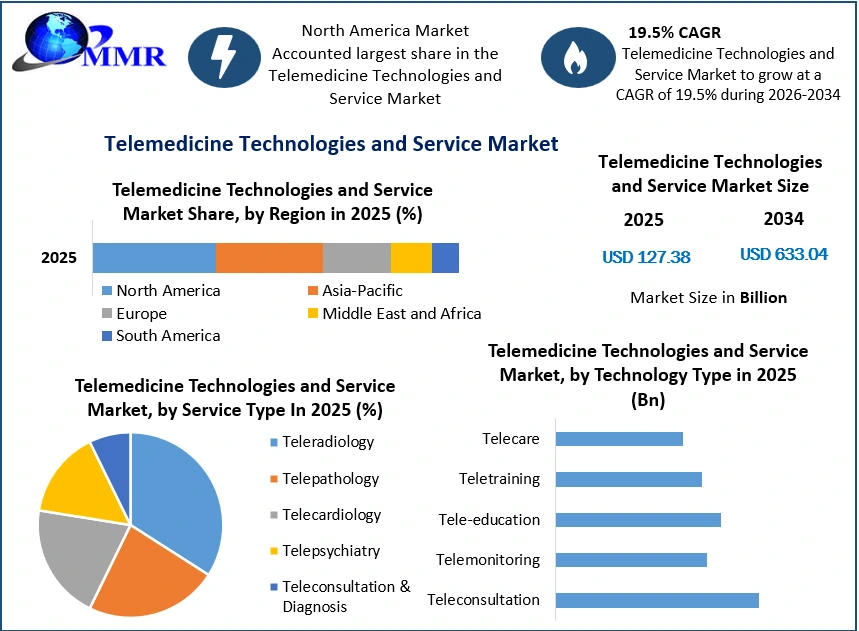
The global telemedicine technologies and service market size reached USD 106.64 billion in 2024 and is projected to hit USD 453.13 billion by 2032, growing at a compound annual growth rate (CAGR) of 19.5%.
The teleconsultation segment commanded the dominant share of the market in 2024, securing between 40% and 50% of total revenue due to low-cost digital care alternatives.
Cloud-based delivery solutions dominated the operational architecture, holding a 42% to 45% market share as clinics and hospital networks prioritized scalable data integration.
The United States Centers for Medicare & Medicaid Services (CMS) enacted permanent Medicare reimbursement for 43 distinct telehealth services starting January 2024.
In the Asia-Pacific region, India expanded rural care by deploying over 150,000 teleconsultation units by mid-2024 under the Ayushman Bharat Digital Mission.
Why This Matters Now Delayed technology capital expenditures are no longer an option for healthcare networks balancing acute physician shortages against rising operational expenses. The systemic burden of chronic diseases such as diabetes, heart disease, and hypertension demands continuous clinical visibility outside hospital walls. Operating margins depend directly on moving non-emergency treatments into lower-cost remote environments.
For life sciences corporations and institutional investors, telemedicine represents the primary highway for longitudinal real-world patient data collection. The convergence of AI clinical triage and decentralized diagnostic tools changes the commercial risk profile of healthcare delivery. Capital allocation is shifting rapidly away from physical facilities toward automated cloud networks that can scale clinical delivery across borders.
Market Overview The global telemedicine technologies and service market represents the infrastructure of modern distributed medicine, integrating virtual consultations, real-time remote tracking, and electronic prescriptions. The baseline market value stood at USD 106.64 billion in 2024. Accelerating cloud deployments and structural changes in payer models will push the global market valuation to USD 453.13 billion by 2032. This trajectory reflects a sustained 19.5% CAGR over the eight-year forecast period.
The underlying demand is driven by the global reality of an aging population paired with an expanding chronic disease burden. Traditional, facility-reliant healthcare models lack the human and physical capacity to handle continuous monitoring for millions of long-term patients. Telemedicine addresses this gap by replacing intermittent physical check-ins with constant data tracking and automated diagnostic support. However, growth encounters friction from regional regulatory differences, uneven rural internet access, and data privacy vulnerabilities in traditional medical software environments.
Key Trends Driving Growth Artificial intelligence has transitioned from an experimental software feature to an essential operational component for diagnostic support and patient triage. Large-scale hospital networks utilize natural language processing and diagnostic AI tools to review patient symptoms prior to live clinical interaction. This software layer shortens patient wait times and lightens the daily administrative burden on clinical staff.
Simultaneously, remote patient monitoring (RPM) is expanding due to advancements in Internet of Things (IoT) medical wearables. These devices capture real-time physiological metrics, including electrocardiogram (ECG) readouts and blood glucose measurements. Real-time vital sign tracking allows medical teams to identify early health deterioration and prevent costly emergency room re-admissions.
𝐃𝐨𝐰𝐧𝐥𝐨𝐚𝐝 𝐏𝐃𝐅 𝐁𝐫𝐨𝐜𝐡𝐮𝐫𝐞 @ https://www.maximizemarketresearch.com/request-sample/15761/
Segment Insights
Teleconsultation (Dominant Segment): Capturing a 40% to 45% market share in 2024, this technology type leads due to its rapid consumer adoption and low upfront barriers for practitioners. Secure cloud architectures, integrated mobile scheduling apps, and AI diagnostics continue to reinforce this segment’s substantial lead.
Cloud-based Solutions (Dominant Segment): Securing approximately 42% to 45% of the delivery infrastructure market share, cloud deployments outpace on-premise setups. Hospital networks favor these platforms because they lower capital software expenses while offering smooth data sharing across multiple care sites.
Service Type and Delivery Channels: The broader market structure is segmented by technology type into Teleconsultation, Telemonitoring, Tele-education, Teletraining, and Telecare. By service type, the market splits into Teleradiology, Telepathology, Telecardiology, Telepsychiatry, and Teleconsultation & Diagnosis. The mode of delivery segment includes On-premise Solutions, Cloud-based Solutions, Web-based Solutions, and Mobile Applications.
Regional Growth Story North America maintains the largest regional market share, accounting for 33% to 42% of global telemedicine revenue in 2024. The United States heads this geography, backed by comprehensive institutional infrastructure and proactive federal regulatory support. Expanded Medicare coverage and commercial insurer reimbursement parity laws have made remote clinical care financially viable for private providers. Large US operators, including Teladoc Health and Amwell, are leveraging this stable regulatory environment to deploy capital directly into long-term patient tracking services.
In Europe, digital transformation focuses on public-private partnerships to lower national healthcare deficits. In the United Kingdom and France, platform providers such as Babylon Health and Doctolib work closely with state medical systems to automate electronic prescriptions. Regulatory updates in Estonia and the Netherlands launched blockchain-backed patient consent engines in 2024, protecting over 1 million digital health files.
The Asia-Pacific region represents the fastest-growing geographical market, fueled by massive government initiatives to connect isolated rural populations. India’s digital health strategy delivered over 150,000 teleconsultation units to rural communities and secondary cities by mid-2024. In Japan and South Korea, market expansion is tied directly to the medical requirements of rapidly aging populations.
Competitive Landscape Enterprise software consolidation and strategic technology additions dominate corporate actions as vendors compete to build comprehensive digital health ecosystems. Top-tier providers are moving past basic video platforms to acquire specialized clinical capabilities in areas like remote cardiac tracking and mental health. Market players are competing on their ability to integrate directly with existing hospital electronic health records (EHR) systems.
Startups are challenging established healthcare companies by offering targeted digital tools for specific chronic conditions. This specialized competition forces legacy developers to increase their research and development investments in artificial intelligence and automation. The long-term commercial value belongs to companies that can combine sensor data, clinical histories, and predictive software into a single workflow.
Recent Developments
In March 2024, Aidoc expanded its integrated AI radiology platform to more than 1,000 hospitals worldwide, improving diagnostic precision within remote viewing workflows.
Teladoc Health deployed an AI-enabled clinical decision support interface in 2024, optimizing emergency triage sorting and improving patient care metrics.
Philips upgraded its core Health Suite digital platform in 2024, increasing its overall processing power for multi-hospital remote health tracking.
Teladoc Health launched an updated AI-assisted virtual mental health solution utilizing natural language processing to customize therapy plans.
Strategic Implications The permanent addition of 43 telehealth procedures to the US Medicare reimbursement list establishes remote care as a stable, predictable corporate revenue stream. Health systems can confidently allocate long-term capital to remote monitoring tools without the risk of sudden policy reversals. This regulatory stability lowers the financial risk for venture capital and private equity groups investing in digital medical platforms.
For the pharmaceutical and biotech industries, widespread digital access accelerates patient enrollment and data collection for decentralized clinical trials. Real-time patient monitoring cuts down the need for physical clinical trial sites, lowering drug development costs. Medical device manufacturers must ensure all new diagnostic hardware features native cloud connectivity to remain compatible with modern hospital purchases.
Future Outlook The global market will transition from basic video consultations to automated, predictive virtual care systems over the next decade. Continuous data streams from home medical sensors will feed directly into hospital analytics engines, warning physicians before acute medical emergencies occur. This shift will reward technology companies that possess the data architecture to manage and secure massive streams of patient information. Healthcare organizations that rely on outdated, unintegrated on-premise software will face escalating operating costs and declining patient numbers. Future market leaders will be defined by their ability to convert real-time physiological data into immediate, actionable clinical decisions, while lagging organizations remain restricted to basic, non-integrated video appointments.
Analyst Perspective “The permanent expansion of reimbursement codes by major regulators has cleared the path for multi-year corporate capital investments in digital health. Telemedicine is no longer an emergency safety valve; it is the primary infrastructure for value-based care delivery globally. Technology providers that combine automated AI triage with secure, scalable cloud systems will dominate health system budgets.” — Komal Patil, Research Analyst, Maximize Market Research
About Maximize Market Research
Maximize Market Research Pvt. Ltd. (MMR) is a global market research and consulting company that provides reliable, data-focused, and practical business insights. The firm serves a wide range of industries, including healthcare, pharmaceuticals, technology, automotive, electronics, chemicals, personal care, and consumer goods. Through market forecasts, competitive analysis, strategic consulting, and industry impact assessments, MMR helps organizations understand changing market conditions, identify growth opportunities, and make informed business decisions for long-term success.
2nd Floor, Navale IT Park Phase 3
Pune Banglore Highway, Narhe
Pune, Maharashtra 411041, India
+91 9607365656
sales@maximizemarketresearch.com
