Key Highlights
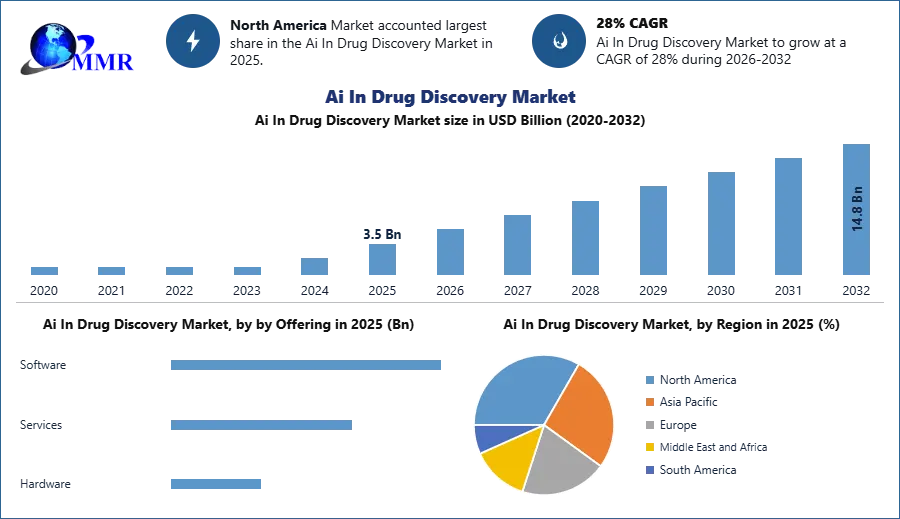
- Market valued at USD 3.5 billion in 2025.
- Expected to reach USD 14.8 billion by 2032.
- Forecast CAGR stands at 28% between 2026 and 2032.
- North America accounted for more than 56% revenue share in 2025.
- Software remains the dominant offering segment.
- Oncology leads therapeutic applications.
- Drug design and drug screening represent major application areas.
- Clinical studies are emerging as a critical growth segment.
- Strategic alliances between pharmaceutical and technology companies are reshaping competitive dynamics.
- AI is increasingly reducing development timelines and improving research productivity.
Why This Matters Now
Drug development costs continue to rise while clinical success rates remain under pressure. AI is becoming a strategic response to both challenges. Pharmaceutical companies are no longer viewing AI as a support tool. They are integrating it directly into target identification, molecule design, biomarker discovery, and clinical trial execution. The result is a shift from traditional laboratory-driven discovery toward data-driven development models that can improve efficiency, reduce costs, and accelerate commercialization.
Market Overview
The AI in Drug Discovery Market encompasses software, hardware, and services that apply artificial intelligence technologies to pharmaceutical research and development. These platforms support target identification, drug screening, lead optimization, preclinical studies, and clinical research activities.
Demand is being driven by the pharmaceutical industry’s need to shorten development timelines and improve research productivity. Traditional drug discovery often requires years of experimentation and significant capital investment. AI platforms enable researchers to analyze complex biological and chemical datasets faster and with greater precision.
The market’s growth is also linked to increasing investments from both pharmaceutical companies and technology firms. Major biopharmaceutical organizations are either building internal AI capabilities or forming strategic partnerships with specialized AI developers to strengthen their research pipelines.
Supply-side dynamics are evolving rapidly. AI-focused biotechnology firms are developing specialized algorithms, predictive models, and discovery platforms, while large technology companies are providing computing infrastructure and advanced machine-learning capabilities. This convergence is creating a new innovation ecosystem that combines computational expertise with pharmaceutical domain knowledge.
Macro-level factors further support expansion. Rising drug development costs, increasing demand for personalized medicine, growing volumes of biological data, and advances in machine learning technologies are all contributing to broader market adoption. At the same time, concerns around data quality, data ownership, and confidentiality remain key operational challenges.
Key Trends Driving Growth
Pharma-Tech Partnerships Become a Competitive Necessity
The strongest trend shaping the market is the growing collaboration between pharmaceutical companies and technology providers. Drug developers increasingly rely on AI specialists to enhance target identification, molecular modeling, and predictive analytics capabilities.
Collaborations involving Microsoft, NVIDIA, pharmaceutical companies, and AI startups demonstrate a broader industry shift. These partnerships allow pharmaceutical firms to access advanced computing power without building extensive technology infrastructure internally.
AI Moves Drug Discovery from Physical Labs to Virtual Models
AI is enabling researchers to simulate molecular interactions and predict biological outcomes before laboratory testing begins. This transition reduces dependence on extensive experimental screening and improves resource allocation.
For pharmaceutical companies, this means fewer failed candidates entering expensive development stages and a greater probability of identifying promising compounds earlier.
Focus Shifts from Quantity to Quality
The industry is increasingly prioritizing candidate quality rather than simply expanding screening volumes. AI systems can evaluate large datasets and identify compounds with desirable efficacy and safety profiles.
This trend directly impacts R&D productivity. Companies are investing in AI because improving candidate selection can significantly reduce downstream development risks and costs.
Data-Centric Discovery Gains Momentum
Companies such as Insitro have demonstrated growing interest in generating high-quality biological datasets specifically designed for machine-learning applications.
Data quality is becoming a competitive asset. Organizations with access to larger and more reliable datasets can build stronger predictive models and improve discovery outcomes.
Clinical Trial Optimization Expands AI Adoption
AI is increasingly used to identify biomarkers, recruit suitable patient populations, and improve trial design. These capabilities can increase clinical trial success rates while reducing operational inefficiencies.
For pharmaceutical companies, improved trial performance translates directly into lower costs and faster commercialization timelines.
Technical Barriers Remain a Strategic Challenge
Despite rapid adoption, data fragmentation and confidentiality concerns continue to limit broader implementation. Many organizations remain cautious about sharing proprietary research information.
As a result, companies capable of developing secure collaborative frameworks and federated learning models may gain a competitive advantage by enabling multi-party data utilization without compromising ownership.
Explore detailed analysis, insights, and growth opportunities
Segment Insights
Dominant Segment: Software
Software is expected to remain the leading offering segment throughout the forecast period because it forms the foundation of AI-enabled drug discovery. AI software platforms allow pharmaceutical companies to process vast biological datasets, simulate molecular interactions, identify biomarkers, and predict drug efficacy with greater speed than conventional research methods.
The integration of machine learning, predictive analytics, and natural language processing enables researchers to automate complex discovery workflows while improving decision-making accuracy. Cloud-based deployment further strengthens software adoption by allowing seamless integration with existing research infrastructure and supporting scalable computing.
Business impact: Software has become a strategic asset rather than a research tool. Pharmaceutical companies investing in advanced AI platforms can shorten development timelines, optimize R&D spending, and improve candidate selection before compounds reach costly laboratory and clinical stages.
Fastest-Growing Segment: Clinical Studies
Clinical studies are projected to become the fastest-growing application segment as AI expands beyond early-stage discovery into clinical development.
AI models help identify disease biomarkers, recognize suitable patient populations, predict treatment responses, and improve patient recruitment. These capabilities increase trial efficiency while reducing delays associated with enrollment and protocol design.
Business impact: Faster and more targeted clinical studies improve the probability of successful regulatory outcomes while reducing overall development costs. Companies capable of integrating AI throughout clinical research are likely to strengthen product pipelines and accelerate commercialization.
Additional Segment Insights
Oncology dominates therapeutic applications. Cancer remains one of the most complex therapeutic areas due to its genetic diversity. AI enables researchers to analyze genomic information, identify molecular targets, and develop personalized treatment strategies more efficiently than traditional approaches.
Drug Design and Drug Screening maintain strong adoption. AI significantly improves virtual screening by evaluating molecular properties before laboratory testing. According to the report, AI-based drug screening accurately predicted toxic properties with only a 4% error rate while correctly identifying antimicrobial activity in 70% of evaluated compounds.
Machine Learning remains the core enabling technology. Predictive algorithms continue driving improvements across target identification, lead optimization, and biomarker discovery, making machine learning the technological backbone of AI-powered pharmaceutical research.
- Regional Growth Story
North America
North America accounted for more than 56% of global revenue in 2025, maintaining the industry’s strongest competitive position.
The United States benefits from a mature AI ecosystem supported by leading technology companies, pharmaceutical manufacturers, research institutions, and biotechnology innovators. Strategic collaborations between technology firms and pharmaceutical companies continue accelerating AI deployment across drug design, disease modeling, and drug repurposing.
The region’s competitive advantage lies in its ability to combine advanced computing infrastructure with large-scale pharmaceutical R&D investments.
Europe
Europe continues strengthening its position through AI innovation, pharmaceutical research capabilities, and collaborative development programs.
Companies across the region are investing in AI-driven drug discovery partnerships to improve productivity and accelerate the development of therapies across multiple disease areas. Cross-border collaboration between biotechnology firms and pharmaceutical companies supports continued innovation.
Asia Pacific
Asia Pacific is expected to capture a growing share of the global market as healthcare digitalization accelerates.
Growing acceptance of smart technologies, expanding pharmaceutical research capabilities, and increasing population across countries including China and India are supporting broader AI adoption in drug discovery. These developments position the region as an increasingly important destination for future AI investments.
Middle East, Africa, and South America
These regions continue representing emerging opportunities as healthcare modernization and pharmaceutical research capabilities gradually expand. Although adoption remains lower than in developed markets, increasing digital transformation creates long-term investment potential.
Competitive Landscape
Competition is shifting from standalone AI software development toward integrated pharmaceutical innovation ecosystems.
Technology companies, biotechnology firms, and pharmaceutical manufacturers are increasingly collaborating rather than competing independently. This model combines AI infrastructure, biological expertise, and clinical development capabilities to accelerate commercialization.
NVIDIA Corporation has strengthened its market position by expanding AI infrastructure partnerships that support biomedical research and pharmaceutical modeling.
IBM Corporation and Microsoft Corporation continue leveraging advanced computing platforms to support pharmaceutical AI initiatives through strategic collaborations.
AI-first biotechnology companies including Insilico Medicine, Atomwise Inc., Insitro, Exscientia, BenevolentAI, Schrödinger, Inc., Owkin Inc., and Iktos focus on accelerating molecule discovery, predictive modeling, and therapeutic research.
Meanwhile, pharmaceutical companies increasingly use partnerships instead of developing AI capabilities independently. This reduces technology adoption risk while allowing faster integration into existing R&D pipelines.
The competitive landscape increasingly favors organizations capable of combining proprietary datasets, advanced AI models, and pharmaceutical expertise within collaborative research ecosystems.
Recent Developments
- 13 January 2025: NVIDIA announced collaborations with IQVIA, Illumina, Mayo Clinic, and Arc Institute to expand AI-powered accelerated computing for genomics research and drug discovery.
- 13 June 2025: AstraZeneca entered a USD 5.3 billion AI-driven collaboration with CSPC Pharmaceuticals Group to accelerate discovery of novel oral therapies for chronic diseases.
- 11 July 2025: Elix, Inc. and the Life Intelligence Consortium commercialized Elix Discovery™, the first federated-learning AI drug discovery platform trained using datasets from 16 pharmaceutical companies.
- 14 October 2025: Nabla Bio expanded its research collaboration with Takeda Pharmaceutical Company using the Joint Atomic Model platform to accelerate protein therapeutic design.
- 12 January 2026: NVIDIA and Eli Lilly announced a USD 1 billion AI co-innovation laboratory based on the NVIDIA BioNeMo platform to develop next-generation AI-powered drug discovery systems.
Strategic Implications
The competitive advantage in AI-enabled drug discovery is increasingly determined by access to high-quality biological data, advanced computational infrastructure, and collaborative innovation rather than laboratory capacity alone.
Technology companies are becoming strategic pharmaceutical partners, while AI specialists are evolving into platform providers supporting multiple drug developers simultaneously. This reduces development risk and enables pharmaceutical companies to expand research productivity without building every AI capability internally.
Organizations investing in secure data-sharing frameworks, scalable AI platforms, and integrated discovery ecosystems will strengthen long-term competitive positioning as AI becomes central to pharmaceutical R&D.
Analyst Perspective: Komal Patil
The AI in Drug Discovery Market is moving beyond experimental adoption into a commercially significant transformation of pharmaceutical research. Strategic alliances between AI developers and global drug manufacturers indicate that competitive differentiation will increasingly depend on computational capability, proprietary datasets, and collaborative innovation models. Companies that successfully integrate AI across discovery, development, and clinical research will be better positioned to improve productivity, reduce development timelines, and strengthen long-term pipeline performance.
About Maximize Market Research
Maximize Market Research Pvt. Ltd. (MMR) is a global market research and consulting company that provides reliable, data-focused, and practical business insights. The firm serves a wide range of industries, including healthcare, pharmaceuticals, technology, automotive, electronics, chemicals, personal care, and consumer goods. Through market forecasts, competitive analysis, strategic consulting, and industry impact assessments, MMR helps organizations understand changing market conditions, identify growth opportunities, and make informed business decisions for long-term success.
Contact Us :
2nd Floor, Navale IT Park Phase 3
Pune Banglore Highway, Narhe
Pune, Maharashtra 411041, India
+91 9607365656
sales@maximizemarketresearch.com
