Key Highlights
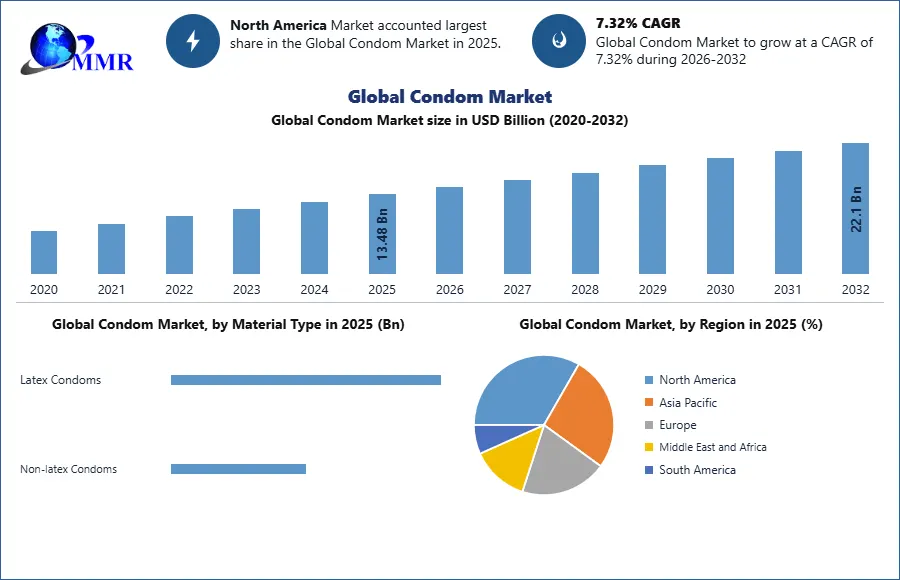
- Global Condom Market valued at USD 13.48 billion in 2025.
- Market projected to reach USD 22.1 billion by 2032.
- Forecast CAGR stands at 7.32%.
- Latex condoms account for 86% of the material segment.
- Male condoms represent 95.2% of product demand.
- North America remains the leading regional market.
- Sustainable and vegan condoms are emerging as premium growth categories.
- E-commerce continues expanding product accessibility and consumer privacy.
Why This Matters Now
The condom market is evolving beyond traditional contraception into a broader sexual wellness industry. Rising sexually transmitted infection (STI) cases, stronger public health campaigns, and increasing consumer preference for sustainable products are creating new commercial opportunities. Manufacturers are responding with premium, ultra-thin, latex-free, and environmentally responsible products that strengthen differentiation in an increasingly competitive marketplace.
Market Overview
The global condom market remains a vital component of preventive healthcare, supporting both contraception and protection against sexually transmitted infections, including HIV. Continuous product innovation, expanding healthcare awareness, and broader product accessibility continue to support long-term market expansion.
Growing public awareness of sexual health remains the primary demand driver. Governments, healthcare organizations, and non-governmental agencies continue promoting condom usage through education programs and free distribution initiatives, particularly in developing economies where STI prevention remains a public health priority.
Supply-side competition is increasingly driven by innovation rather than pricing alone. Manufacturers are introducing thinner materials, improved textures, enhanced comfort, and specialized products designed to improve user experience while maintaining protection standards.
Consumer preferences are also shifting toward premium and sustainable offerings. Eco-friendly manufacturing, biodegradable packaging, and ethically sourced natural latex have become important purchasing factors, particularly in developed markets.
At the same time, competition from long-term contraceptive methods such as intrauterine devices (IUDs), hormonal contraceptives, and implants is encouraging condom manufacturers to emphasize their unique role in preventing both unintended pregnancies and sexually transmitted infections.
Key Trends Driving Growth
Increasing awareness of sexually transmitted infections continues to reshape purchasing behavior. Public health campaigns led by governments, WHO, and HIV prevention initiatives reinforce condoms as the first line of protection against disease transmission.
Product innovation remains a major competitive differentiator. Manufacturers continue launching ultra-thin, textured, flavored, and close-fit variants designed to improve comfort and encourage consistent usage.
Sustainability has emerged as one of the industry’s fastest-growing trends. Consumers increasingly prefer biodegradable, vegan, and chemical-free condoms manufactured using ethically sourced natural latex and recyclable packaging.
Digital commerce continues transforming distribution. Online retail offers greater privacy, wider product selection, and easier access to premium products, making e-commerce one of the fastest-expanding sales channels.
Brand differentiation increasingly depends on education alongside products. QR-enabled sexual health education, awareness campaigns, and digital engagement strategies are becoming valuable marketing tools for attracting younger consumers.
Explore detailed analysis, insights, and growth opportunities
Segment Insights
Dominant Segment: Latex Condoms
Latex condoms remain the dominant material segment, accounting for 86% of the global market in 2025.
Their leadership is supported by affordability, durability, elasticity, and widespread consumer familiarity. Latex products are available in numerous sizes, flavors, colors, textures, and thicknesses, allowing manufacturers to serve multiple consumer segments without compromising protection standards.
For manufacturers, latex remains the most cost-effective material, supporting high production volumes and broad retail availability across both developed and emerging markets.
Fastest-Growing Segment: Non-Latex Condoms
Non-latex condoms are expected to record the fastest growth throughout the forecast period.
Products manufactured using polyisoprene, polyurethane, nitrile butadiene rubber (NBR), and lambskin address consumers with latex allergies while offering improved comfort and reduced odor.
Growing demand for premium sexual wellness products and increasing product innovation are expanding this category beyond its traditional niche, creating higher-margin opportunities for manufacturers.
Additional High-Value Segments
Male condoms continue dominating the product segment with a 95.2% market share in 2025, supported by broad consumer acceptance, lower manufacturing costs, and widespread distribution.
Female condoms represent a smaller but rapidly expanding segment. Greater awareness of women’s sexual health, increasing product availability, and regulatory developments are encouraging broader adoption, particularly in developed countries.
Among distribution channels, drug stores and public health distribution remain critical sales channels, while e-commerce continues gaining market share by providing convenience, product privacy, and extensive brand selection.
Regional Growth Story
North America leads the global condom market through high consumer awareness, premium product adoption, and well-established healthcare infrastructure.
The United States remains the region’s largest contributor, supported by extensive public health initiatives, strong retail penetration, and major global brands including Trojan and Durex. High STI incidence continues reinforcing preventive healthcare demand.
Europe continues demonstrating steady growth through comprehensive sexual education, favorable healthcare policies, and increasing consumer preference for sustainable products, including vegan and biodegradable condoms.
Asia Pacific represents one of the most attractive long-term growth regions. Expanding healthcare awareness, improving access to contraceptive products, government family planning initiatives, and large population bases continue supporting volume growth across China, India, and Southeast Asia.
The Middle East & Africa and South America continue offering emerging opportunities through expanding public health campaigns, increasing urbanization, and broader access to reproductive healthcare products.
Competitive Landscape
Competition in the condom market is increasingly centered on innovation, sustainability, premium positioning, and consumer engagement.
Industry leaders including Reckitt Benckiser (Durex), Church & Dwight (Trojan), Karex Berhad, LifeStyles Healthcare, Okamoto Industries, Sagami Rubber Industries, Cupid Limited, HLL Lifecare, Mankind Pharma, and GLYDE Health continue investing in differentiated product portfolios targeting comfort, performance, sustainability, and specialized consumer needs.
Manufacturers are moving beyond conventional product competition by introducing ultra-thin materials, latex-free alternatives, eco-friendly packaging, and digital consumer education initiatives.
Strategic portfolio expansion into female condoms, sustainable product lines, and premium non-latex categories demonstrates the industry’s shift toward higher-value segments with stronger long-term growth potential.
Companies capable of balancing affordability with innovation and environmental responsibility are strengthening competitive positioning as consumer expectations continue evolving.
Recent Developments
- September 2024: Durex launched the Close Fit Invisible Condom in India, introducing an ultra-thin close-fit design focused on enhanced comfort.
- December 2024: Veru Inc. divested its FC2 Female Condom business to Riva Ridge Capital Management and co-investors for USD 18 million, reflecting portfolio realignment.
- March 2024: Branmover introduced the FeelGood range featuring vegan materials, FSC-certified natural latex, and fully recycled paper packaging.
- March 2023: Durex launched Real Free, a polyisoprene-based latex-free condom portfolio for consumers with latex allergies.
- February 2023: Stix introduced QR code-enabled sexual health education alongside free product distribution across selected college campuses.
- June 2022: SKORE launched the NOTHING condom range supported by its WearAnUnCondom awareness campaign.
- January 2021: Pee Safe entered the female condom category with a dedicated women-focused product range.
Future Outlook
Manufacturers that combine premium innovation, sustainable production, digital consumer engagement, and expanded sexual wellness portfolios will secure the strongest competitive advantage as the global condom market continues evolving.
Analyst Perspective — Komal Patil
The condom market is transitioning from a volume-driven business to a value-driven sexual wellness industry. Future market leadership will depend on how effectively companies integrate sustainability, premium product innovation, consumer education, and omnichannel distribution while addressing evolving preferences for comfort, inclusivity, and environmentally responsible products.
About Maximize Market Research
Maximize Market Research Pvt. Ltd. (MMR) is a global market research and consulting company that provides reliable, data-focused, and practical business insights. The firm serves a wide range of industries, including healthcare, pharmaceuticals, technology, automotive, electronics, chemicals, personal care, and consumer goods. Through market forecasts, competitive analysis, strategic consulting, and industry impact assessments, MMR helps organizations understand changing market conditions, identify growth opportunities, and make informed business decisions for long-term success.
Contact Us :
2nd Floor, Navale IT Park Phase 3
Pune Banglore Highway, Narhe
Pune, Maharashtra 411041, India
+91 9607365656
sales@maximizemarketresearch.com
