Key Highlights
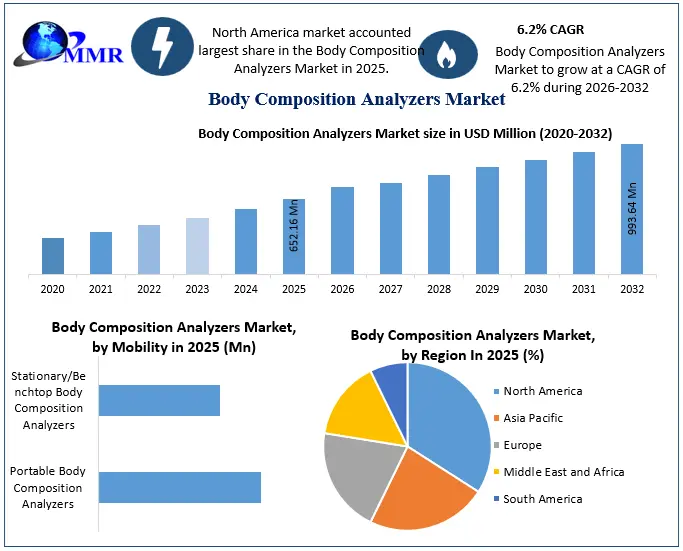
- Body Composition Analyzers Market valued at USD 652.16 million in 2025
- Forecast to reach USD 993.64 million by 2032
- Expected CAGR of 6.2% during 2026–2032
- Rising obesity prevalence continues to expand clinical demand
- Government and healthcare institution funding supports adoption
- AI-enabled analytics and cloud-connected platforms improve diagnostic capabilities
- Sports medicine and wellness sectors remain important commercial growth avenues
- Preventive healthcare strategies are increasing utilization across hospitals and clinics
Why This Matters Now
Healthcare economics are shifting from treatment to prevention. Hospitals, insurers, and governments increasingly recognize that identifying body composition changes before chronic diseases become severe can improve patient outcomes while reducing long-term healthcare costs.
The growing prevalence of obesity and associated metabolic disorders is making advanced body composition analysis a valuable clinical assessment tool. Simultaneously, digital health platforms, connected devices, and AI-assisted analytics are expanding the role of these analyzers beyond specialist clinics into broader healthcare delivery.
Market Overview
The Body Composition Analyzers Market measure parameters including fat mass, muscle mass, bone mass, body water, and related physiological indicators that provide clinicians with a more comprehensive assessment than body weight alone.
Market growth is being driven by increasing healthcare investments, government funding, support from international healthcare organizations, and expanding awareness of preventive health management. The sports industry has also emerged as a significant end-user, where sports scientists, trainers, and athletic organizations rely on detailed body composition data to improve performance and rehabilitation programs.
Consumer awareness around fitness and healthy lifestyles has further broadened demand as individuals seek accurate monitoring of muscle development and fat reduction rather than relying solely on traditional weight measurements.
Key Trends Driving Growth
Artificial intelligence is becoming an increasingly important differentiator within body composition analysis. AI-powered software enhances interpretation of measurement data, enabling clinicians to generate faster and more personalized health assessments.
Cloud-based platforms and digital connectivity are improving accessibility by allowing healthcare professionals to review patient data remotely. This trend aligns closely with expanding telehealth services and remote patient monitoring initiatives.
Preventive healthcare continues to reshape purchasing priorities. Healthcare providers are integrating body composition analysis into routine health assessments, chronic disease management programs, and wellness initiatives aimed at early intervention.
Sports medicine remains another important growth engine. Professional teams, fitness organizations, and rehabilitation centers increasingly depend on body composition analytics to optimize athletic performance while reducing injury risks.
Government support and institutional funding further strengthen market expansion by encouraging broader adoption of advanced diagnostic technologies across healthcare systems.
Get Exclusive Market Insights with a Free Sample Research Report
Segment Insights
- Dominant Segment: Not specified in the supplied MMR report.
- Fastest-Growing Segment: Not specified in the supplied MMR report.
- Government-funded healthcare institutions continue expanding utilization of body composition analyzers.
- Sports organizations, personal trainers, and athletic performance centers represent rapidly growing commercial users.
- Increasing obesity management programs are creating sustained demand across preventive healthcare settings.
Regional Growth Story
North America continues to benefit from advanced healthcare infrastructure, high healthcare expenditure, widespread preventive screening programs, and strong adoption of digital health technologies.
Germany and the UK are expanding investments in preventive healthcare while encouraging digital transformation across hospitals and diagnostic facilities. Healthcare providers increasingly incorporate advanced diagnostic tools into value-based care models.
China, Japan, South Korea, and India are experiencing rising demand driven by expanding healthcare infrastructure, growing awareness of obesity management, increasing sports participation, and broader digital healthcare adoption. Government healthcare investments and improving diagnostic accessibility are supporting long-term market opportunities across these economies.
As healthcare spending continues to rise globally, regional competition is shifting from simple device sales toward integrated diagnostic platforms that combine analytics, connectivity, and clinical decision support.
Competitive Landscape
Competition within the Body Composition Analyzers Market is increasingly centered on technology differentiation rather than hardware alone.
Manufacturers are investing in AI integration, cloud-enabled reporting, improved software capabilities, and enhanced measurement accuracy. Companies that successfully combine diagnostic precision with digital connectivity are positioning themselves to secure stronger relationships with hospitals, wellness providers, and sports organizations.
Investment activity across the sector also signals growing emphasis on preventive healthcare, remote monitoring, and personalized patient management. Organizations capable of integrating body composition data into broader healthcare information systems are expected to strengthen their competitive position as healthcare providers prioritize workflow efficiency and clinical interoperability.
Recent Developments
- AI and machine learning capabilities are being integrated into body composition analyzer platforms.
- Cloud-based healthcare platforms continue expanding remote monitoring functionality.
- Telemedicine adoption is increasing opportunities for connected body composition analysis.
- Government and healthcare institution funding remains a significant market growth catalyst.
- Technological innovation continues improving diagnostic accuracy and clinical usability.
Strategic Implications
Healthcare providers increasingly require diagnostic technologies that support preventive medicine while improving operational efficiency. Body composition analyzers fit this requirement by delivering clinically relevant information that supports earlier intervention and personalized treatment planning.
Medical device manufacturers should prioritize software innovation, AI-enabled analytics, interoperability, and digital integration alongside hardware development. Hospitals and healthcare networks are expected to evaluate vendors based not only on measurement performance but also on their ability to integrate with broader digital health ecosystems.
For investors, continued expansion of preventive healthcare, obesity management, wellness programs, and sports medicine suggests stable long-term demand supported by both public and private healthcare spending.
Future Outlook
The next phase of market growth will be defined by intelligent diagnostics, connected healthcare platforms, and preventive care integration. Companies that combine accurate measurement, AI-driven clinical insights, and seamless digital connectivity will shape the industry’s next generation, while those focused solely on standalone hardware risk losing competitive relevance.
Analyst Perspective
“The Body Composition Analyzers Market is entering a phase where clinical diagnostics, preventive healthcare, and digital innovation are converging. Organizations that invest in AI-enabled analysis, connected healthcare platforms, and patient-centered technologies will be best positioned to capture long-term market opportunities.” — Komal Patil
About Maximize Market Research
Maximize Market Research Pvt. Ltd. (MMR) is a global market research and consulting company that provides reliable, data-focused, and practical business insights. The firm serves a wide range of industries, including healthcare, pharmaceuticals, technology, automotive, electronics, chemicals, personal care, and consumer goods. Through market forecasts, competitive analysis, strategic consulting, and industry impact assessments, MMR helps organizations understand changing market conditions, identify growth opportunities, and make informed business decisions for long-term success.
Contact Us
2nd Floor, Navale IT Park Phase 3
Pune Banglore Highway, Narhe
Pune, Maharashtra 411041, India
+91 9607365656
sales@maximizemarketresearch.com
