Key Highlights
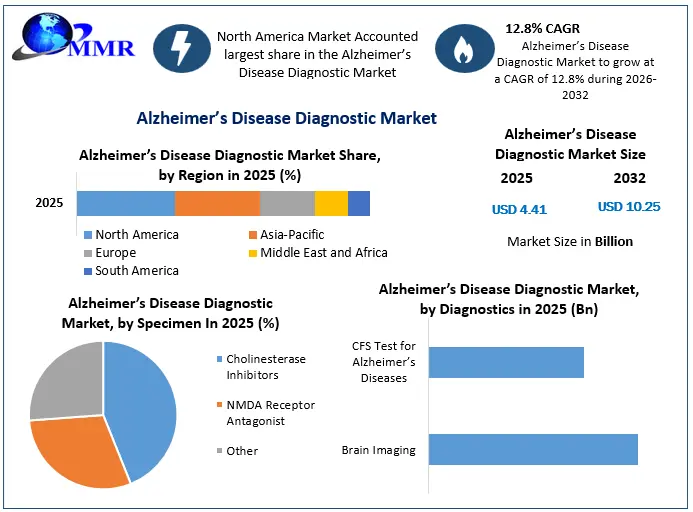
- Global market valued at US$ 4.41 billion in 2025.
- Revenue projected to reach US$ 10.25 billion by 2032.
- Forecast CAGR stands at 12.8%.
- North America accounts for the largest regional share at 39.5%.
- Blood-based biomarker testing is reshaping early diagnosis.
- Cholinesterase inhibitors remain the leading therapeutic segment.
- CSF testing continues to dominate diagnostic procedures.
- FDA approvals are accelerating commercialization of next-generation diagnostic platforms.
- Public and private investments are expanding biomarker research and AI-assisted diagnostics.
Why This Matters Now
Alzheimer’s diagnosis is shifting from symptom-based evaluation toward earlier biological detection. Healthcare systems increasingly recognize that identifying patients before irreversible cognitive decline improves treatment planning, supports emerging disease-modifying therapies, and reduces long-term care costs. Regulatory approvals for plasma biomarkers and expanding research funding are moving diagnostics from specialized neurology centers into broader clinical practice, creating new commercial opportunities across laboratory testing, imaging, and precision medicine.
Market Overview
The Alzheimer’s Disease Diagnostic Market encompasses laboratory diagnostics, brain imaging technologies, biomarker testing, and therapeutic support used to identify and manage Alzheimer’s disease. Demand continues to rise alongside rapid population aging and increasing dementia prevalence worldwide.
The market is primarily driven by growing cases of Alzheimer’s disease, expanding investments in biomarker discovery, increasing clinical research, and stronger adoption of early diagnostic strategies. Healthcare providers are prioritizing earlier intervention as disease-modifying therapies become more widely available.
Supply-side momentum is equally strong. Diagnostic manufacturers are investing heavily in blood-based assays, imaging technologies, and AI-supported diagnostic platforms to improve clinical accuracy while reducing dependence on invasive procedures.
Government agencies, academic institutions, and pharmaceutical companies continue to increase funding for Alzheimer’s research, supporting both therapeutic development and companion diagnostics. However, lengthy clinical validation, high research costs, and regulatory complexity remain significant commercialization challenges.
Key Trends Driving Growth
Blood-based biomarker diagnostics are emerging as one of the industry’s most disruptive innovations. New plasma-based tests simplify patient screening while lowering dependence on expensive PET imaging and invasive cerebrospinal fluid collection.
Regulatory agencies are accelerating approvals for innovative diagnostic technologies. Recent FDA clearances for plasma biomarker tests demonstrate growing confidence in less-invasive diagnostic pathways, expanding access across primary healthcare settings.
Artificial intelligence is increasingly supporting imaging interpretation and biomarker analysis. AI-assisted diagnostics improve consistency while helping clinicians identify disease progression more efficiently.
Growing pharmaceutical investment in disease-modifying therapies is creating stronger demand for accurate companion diagnostics. As new treatments target amyloid and tau pathology, diagnostic precision becomes commercially essential.
Public funding is also expanding. Large-scale investments in biomarker research and clinical validation are expected to accelerate commercialization of next-generation diagnostic technologies targeting multiple neurological pathways.
Explore detailed analysis, insights, and growth opportunities
Segment Insights
Dominant Segment: Cholinesterase Inhibitors
Cholinesterase inhibitors continue to lead the therapeutic segment because they remain the standard treatment for managing cognitive symptoms associated with mild to moderate Alzheimer’s disease. Widely prescribed therapies such as Exelon, Aricept, and Razadyne maintain strong physician acceptance and established reimbursement pathways.
The segment also benefits from continuous pharmaceutical investment. New product innovations, including transdermal drug delivery systems, improve patient compliance while extending product life cycles. For manufacturers, incremental formulation improvements offer sustainable commercial opportunities despite increasing competition from emerging therapies.
Fastest-Growing Segment: Brain Imaging
Brain imaging is expected to witness accelerated expansion as advanced PET, MRI, and CT technologies become increasingly integrated with quantitative analysis and digital interpretation tools.
Recent regulatory approvals enabling treatment monitoring through amyloid PET imaging strengthen the clinical importance of imaging beyond initial diagnosis. This expands recurring utilization among patients receiving anti-amyloid therapies and creates new revenue opportunities for imaging providers.
Additional Key Sub-Segments
Cerebrospinal fluid (CSF) testing remains the dominant diagnostic approach due to its high clinical reliability in detecting amyloid-beta and tau biomarkers. Despite its invasive nature, CSF testing continues to serve as a critical reference standard, particularly within specialist centers and research institutions.
Blood-based biomarker diagnostics are rapidly complementing traditional CSF testing by offering faster, less-invasive screening suitable for broader clinical adoption. Their growing role is expected to improve patient access while reducing healthcare system costs.
Regional Growth Story
North America remains the industry’s largest regional market, supported by high healthcare spending, an aging population, advanced diagnostic infrastructure, and extensive Alzheimer’s clinical research. Strong regulatory support and widespread adoption of innovative diagnostic technologies reinforce the region’s leadership.
Europe continues to strengthen its position through increasing adoption of biomarker testing and regulatory approvals supporting precision diagnostics. Research collaboration between healthcare institutions and biotechnology companies further accelerates innovation.
Asia-Pacific represents an increasingly attractive long-term opportunity. Rising life expectancy, expanding healthcare infrastructure, growing dementia awareness, and improving diagnostic accessibility are creating favorable market conditions. Investment in healthcare modernization is expected to support future regional expansion.
Latin America, the Middle East, and Africa currently represent smaller markets but offer gradual growth potential as healthcare infrastructure develops and awareness of neurodegenerative diseases improves.
Regional competition is increasingly shifting toward countries capable of combining advanced diagnostics, regulatory efficiency, and strong clinical research ecosystems.
Competitive Landscape
Competition is evolving around innovation rather than volume alone. Companies are investing across biomarkers, imaging technologies, and therapeutic development to establish integrated Alzheimer’s care platforms.
Eli Lilly and Company continues strengthening its position through Alzheimer’s therapeutic innovation that increases demand for precise diagnostic solutions.
TauRx, Alector LLC, Accera Inc., Treventis Corporation, Neuro-Bio Ltd, and Cognition Therapeutics Inc. remain focused on advancing disease-modifying approaches, reinforcing the importance of accurate patient identification.
Large pharmaceutical companies including Hoffmann-La Roche, Novartis AG, Merck & Co., Pfizer Inc., Allergan PLC, and Daiichi Sankyo Co. leverage global research capabilities and clinical development expertise to strengthen competitive positioning across diagnostics and therapeutics.
The competitive landscape increasingly favors organizations capable of integrating biomarker development, regulatory execution, and precision medicine strategies into comprehensive Alzheimer’s management solutions.
Recent Developments
- May 2025: Fujirebio received FDA clearance for the Lumipulse G pTau217/β-Amyloid 1-42 Plasma Ratio, the first approved in vitro blood diagnostic supporting Alzheimer’s disease diagnosis.
- June 2025: GE Healthcare expanded FDA approval for Vizamyl PET imaging to include quantitative amyloid measurement and treatment monitoring.
- October 2025: Roche obtained FDA clearance for the Elecsys pTau181 plasma biomarker test, enabling Alzheimer’s screening within primary care settings.
- March 2026: Alzheimer’s Drug Discovery Foundation launched Phase III of its Diagnostics Accelerator with an additional US$50 million investment, increasing total funding to US$150 million for biomarker and AI diagnostic research.
Analyst Perspective – Komal Patil: Organizations that successfully combine blood-based biomarker diagnostics, AI-enabled clinical decision support, and companion diagnostics for emerging Alzheimer’s therapies will define the next phase of competitive leadership as early detection becomes the industry’s primary value driver.
About Maximize Market Research
Maximize Market Research Pvt. Ltd. (MMR) is a global market research and consulting company that provides reliable, data-focused, and practical business insights. The firm serves a wide range of industries, including healthcare, pharmaceuticals, technology, automotive, electronics, chemicals, personal care, and consumer goods. Through market forecasts, competitive analysis, strategic consulting, and industry impact assessments, MMR helps organizations understand changing market conditions, identify growth opportunities, and make informed business decisions for long-term success.
Contact Us :
2nd Floor, Navale IT Park Phase 3
Pune Banglore Highway, Narhe
Pune, Maharashtra 411041, India
+91 9607365656
sales@maximizemarketresearch.com
