Key Highlights
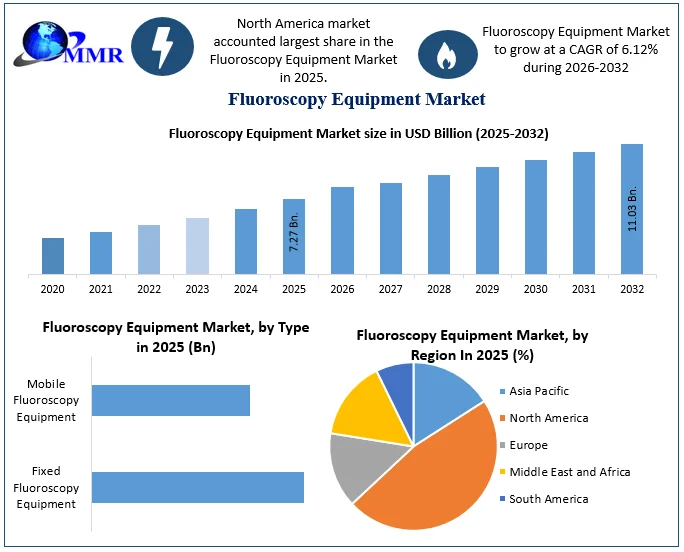
- Market value reached USD 7.27 billion in 2025.
- Revenue is expected to reach USD 11.03 billion by 2032.
- Market projected to grow at a CAGR of 6.12% during 2026–2032.
- North America remains the leading regional market.
- Mobile fluoroscopy equipment represents the dominant product segment.
- Digital fluoroscopy continues replacing conventional analog systems.
- Hospitals account for the largest end-user share.
- AI-powered imaging, predictive maintenance, and dose optimization are accelerating technology adoption.
Why This Matters Now
Healthcare systems worldwide are expanding access to minimally invasive treatments that require continuous, real-time imaging. Fluoroscopy has become essential across cardiology, orthopedics, vascular surgery, pain management, gastroenterology, and interventional radiology.
An aging population and the growing prevalence of cardiovascular disease, orthopedic disorders, abdominal conditions, and trauma cases are increasing procedure volumes. Every additional intervention strengthens demand for advanced imaging systems capable of delivering greater accuracy while lowering radiation exposure.
Healthcare providers also face pressure to improve efficiency without compromising patient safety. Modern digital fluoroscopy addresses both priorities through higher image quality, improved workflow, and enhanced radiation management.
Market Overview
The Fluoroscopy Equipment Market is moving through a technology replacement cycle. Healthcare organizations are upgrading legacy analog systems with digital platforms that deliver clearer imaging, faster processing, and lower radiation doses.
This transition is changing purchasing priorities. Hospitals are no longer evaluating equipment solely on imaging performance but also on workflow automation, interoperability, AI-assisted decision support, and long-term operating efficiency.
The expansion of healthcare infrastructure across emerging economies is creating additional opportunities. Governments and private healthcare providers are investing in advanced diagnostic capabilities to improve patient access while supporting increasingly sophisticated clinical services.
Growing adoption of image-guided procedures also strengthens demand. Physicians rely on real-time visualization to improve procedural precision, reduce complications, and shorten recovery times.
Key Trends Driving Growth
Digital fluoroscopy continues replacing conventional imaging systems because it delivers higher image resolution while reducing radiation exposure for both clinicians and patients. The technology also enables better visualization during increasingly complex interventions.
Artificial intelligence is beginning to influence imaging workflows. AI-assisted platforms help identify anatomical structures, support image interpretation, and improve procedural guidance, allowing clinicians to make faster decisions during interventions.
Predictive maintenance is becoming another competitive advantage. Smart monitoring systems can identify equipment issues before failures occur, reducing downtime and improving equipment utilization for hospitals.
Radiation dose optimization remains a major investment priority. Pulsed fluoroscopy and advanced dose management technologies help healthcare organizations comply with increasingly strict patient safety standards while maintaining diagnostic accuracy.
Healthcare providers are simultaneously expanding minimally invasive treatment programs. These procedures typically require continuous imaging guidance, increasing utilization rates for fluoroscopy equipment across multiple specialties.
Request a Sample Report to Explore Emerging Market Trends
Segment Insights
- Dominant Product Segment: Mobile Fluoroscopy Equipment, supported by flexibility, portability, and growing use across hospitals, ambulatory surgical centers, and multiple clinical specialties.
- Fastest-Growing Technology Segment: Digital Fluoroscopy, driven by superior image quality, reduced radiation exposure, and enhanced procedural efficiency.
- Dominant End User: Hospitals, benefiting from high procedural volumes and comprehensive interventional capabilities.
- Growing Clinical Opportunity: Expansion of minimally invasive procedures across cardiovascular, orthopedic, gastrointestinal, and pain management applications continues increasing equipment demand.
Regional Growth Story
North America maintains the largest market position due to substantial healthcare expenditure, advanced hospital infrastructure, strong technology adoption, and stringent patient safety regulations.
In the United States, providers continue investing in next-generation imaging systems to improve clinical outcomes while supporting value-based healthcare initiatives. Regulatory emphasis on radiation safety further accelerates replacement of older fluoroscopy equipment.
Germany and the United Kingdom continue strengthening advanced diagnostic capabilities through modernization of hospital imaging infrastructure and increasing adoption of minimally invasive procedures.
China and India are expanding healthcare infrastructure at a rapid pace. Growing hospital networks, increasing healthcare investments, and rising patient volumes create favorable conditions for advanced imaging equipment adoption.
Japan continues benefiting from one of the world’s oldest populations, increasing demand for diagnostic imaging and interventional procedures. South Korea remains an innovation-focused healthcare market with strong adoption of advanced digital medical technologies.
Competitive Landscape
Competition is shifting beyond hardware performance toward integrated clinical solutions.
Leading manufacturers are investing in AI-assisted imaging, intelligent workflow automation, predictive maintenance capabilities, and radiation reduction technologies. These innovations strengthen hospital purchasing decisions by improving operational efficiency alongside clinical performance.
Companies are also expanding software capabilities that integrate imaging data into broader digital healthcare ecosystems. This creates recurring value beyond initial equipment sales while strengthening long-term customer relationships.
Strategic investments increasingly signal confidence in intelligent imaging rather than conventional hardware competition alone. Vendors able to combine imaging precision with software innovation are better positioned to capture future hospital procurement programs.
Recent Developments
- AI-powered real-time imaging enhancements are improving procedural guidance and diagnostic confidence.
- Predictive maintenance technologies are reducing unexpected equipment downtime.
- Pulsed fluoroscopy adoption continues expanding to support lower radiation exposure.
- Digital imaging platforms are replacing analog systems across hospitals worldwide.
- Healthcare infrastructure investments in emerging markets are creating new opportunities for equipment manufacturers.
Strategic Implications
Healthcare providers must balance rising procedure volumes with growing pressure to improve efficiency and patient safety. Investment decisions increasingly favor intelligent imaging platforms capable of delivering measurable operational improvements.
Medical device manufacturers that combine AI, digital imaging, workflow automation, and radiation management into integrated solutions are likely to strengthen competitive positioning.
For investors, the market presents steady long-term opportunities supported by demographic shifts, chronic disease prevalence, hospital modernization, and sustained demand for minimally invasive procedures.
Governments and healthcare systems also benefit through improved diagnostic capabilities that can contribute to earlier intervention and better patient outcomes while optimizing healthcare resources.
Future Outlook
Digital transformation will continue redefining fluoroscopy from a conventional imaging modality into an intelligent clinical platform. As AI capabilities mature and minimally invasive care expands across healthcare systems, demand for advanced fluoroscopy solutions is expected to accelerate. The companies that combine imaging excellence with software intelligence, workflow integration, and patient safety will define the next generation of market leadership.
Analyst Perspective
“The Fluoroscopy Equipment Market is entering a technology-driven growth phase where digital imaging, AI-assisted clinical workflows, and expanding minimally invasive procedures are reshaping purchasing priorities. Organizations that invest in innovation while improving patient safety and operational efficiency will be best positioned to capitalize on long-term market expansion.” — Komal Patil, Analyst
About Maximize Market Research
Maximize Market Research Pvt. Ltd. (MMR) is a global market research and consulting company that provides reliable, data-focused, and practical business insights. The firm serves a wide range of industries, including healthcare, pharmaceuticals, technology, automotive, electronics, chemicals, personal care, and consumer goods. Through market forecasts, competitive analysis, strategic consulting, and industry impact assessments, MMR helps organizations understand changing market conditions, identify growth opportunities, and make informed business decisions for long-term success.
Contact Us
2nd Floor, Navale IT Park Phase 3
Pune Banglore Highway, Narhe
Pune, Maharashtra 411041, India
+91 9607365656
sales@maximizemarketresearch.com
