Key Highlights
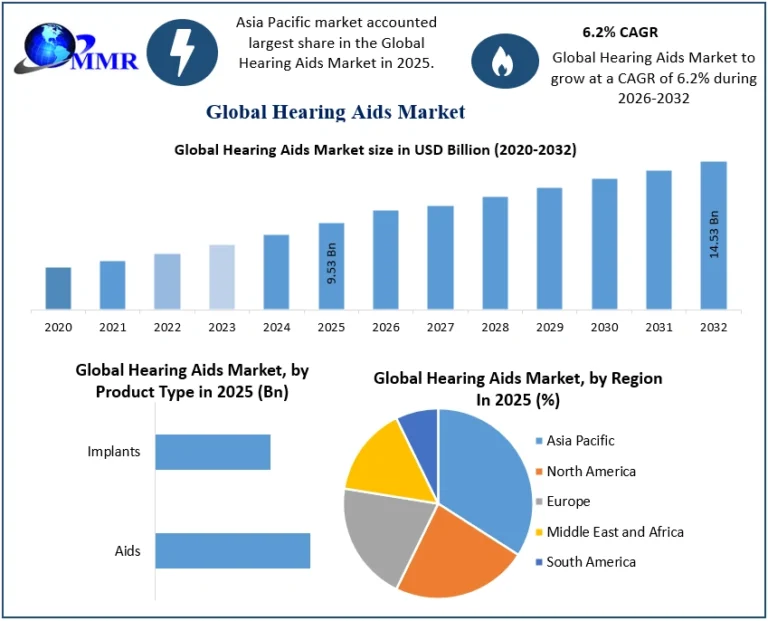
- Global market valued at USD 9.53 billion in 2025.
- Market projected to reach USD 14.53 billion by 2032.
- CAGR stands at 6.2% during 2026–2032.
- Asia Pacific remains the largest regional market.
- Sensorineural hearing loss dominates product demand.
- AI, Bluetooth connectivity, and rechargeable technologies are accelerating premium product adoption.
- Aging populations continue to create sustained long-term demand.
- High device costs remain the industry’s primary adoption barrier.
Why This Matters Now
The hearing aids industry is shifting from conventional amplification devices toward intelligent healthcare wearables. Manufacturers are competing through artificial intelligence, wireless connectivity, and digital personalization rather than hardware alone. At the same time, demographic aging and growing awareness of untreated hearing loss are expanding the addressable customer base. Companies that combine technological leadership with broader affordability are positioned to capture the strongest market gains.
Market Overview
The Hearing Aids Market serves individuals experiencing partial or severe hearing impairment through a broad portfolio of hearing assistance devices, including behind-the-ear, in-the-ear, receiver-in-the-ear, and implant-based solutions. The industry increasingly integrates digital electronics, artificial intelligence, wireless communication, and software-based sound optimization into everyday hearing care.
Demand is primarily supported by the rising incidence of age-related hearing loss, increasing diagnosis rates, and stronger public awareness regarding hearing rehabilitation. According to the report, approximately 2.5 billion people experience some degree of hearing loss globally, while nearly 700 million individuals are expected to require hearing rehabilitation by 2050. Growing exposure to unsafe listening practices among younger populations is also expanding the future patient base.
Supply-side competition is becoming technology-driven. Manufacturers continue investing in digital signal processing, rechargeable batteries, Bluetooth integration, and personalized programming to improve speech recognition and user comfort. These innovations increase product differentiation while creating higher-value premium segments.
Healthcare reimbursement programs, expanding audiology services, and greater access to specialized clinics further support market expansion. However, affordability remains a structural challenge because advanced hearing aids require significant investment in research, customization, and regulatory compliance.
Key Trends Driving Growth
Artificial intelligence has become a major competitive differentiator. Manufacturers are deploying real-time speech enhancement, adaptive noise filtering, and automated environmental optimization to improve hearing performance in complex listening environments.
Digital signal processing continues replacing traditional analog technologies. Improved speech clarity and personalized sound adjustment increase patient satisfaction while supporting higher replacement rates among existing users.
Miniaturization is improving consumer acceptance. Smaller, nearly invisible devices reduce social stigma while expanding adoption among younger and first-time users.
Bluetooth connectivity is transforming hearing aids into connected healthcare devices. Direct integration with smartphones, televisions, and digital ecosystems creates additional consumer value beyond hearing correction.
Government awareness initiatives and hearing rehabilitation programs continue supporting diagnosis and treatment, particularly among aging populations.
Despite technological progress, pricing remains a significant market restraint. Limited insurance reimbursement and high device costs continue restricting adoption in price-sensitive markets, encouraging manufacturers to pursue more cost-efficient product platforms.
Explore detailed analysis, insights, and growth opportunities
Segment Insights
Dominant Segment: Sensorineural Hearing Loss
Sensorineural hearing loss represented the largest hearing loss segment in 2025 due to its widespread prevalence among aging populations and individuals exposed to prolonged occupational or recreational noise.
Unlike conductive hearing loss, sensorineural damage is generally irreversible, making long-term hearing aid adoption the primary treatment pathway. This creates recurring demand for replacement devices, software upgrades, and continuous hearing care services.
For manufacturers, the segment provides stable long-term revenue opportunities because patients typically require ongoing technological upgrades as hearing conditions evolve.
Fastest-Growing Segment: Digital Hearing Aid Technology
Digital hearing aids are emerging as the industry’s fastest-evolving technology category due to superior sound processing capabilities and personalized hearing optimization.
Advanced digital platforms deliver clearer speech recognition, adaptive environmental adjustment, and seamless wireless connectivity. These features improve everyday usability while encouraging consumers to upgrade from older analog devices.
The transition toward software-enabled hearing solutions also creates opportunities for manufacturers to introduce premium product tiers with higher profit margins.
Additional Segment Insights
Behind-the-Ear (BTE), Receiver-in-the-Ear (RITE), and other compact device formats continue benefiting from improved comfort, discreet appearance, and enhanced battery performance.
Adult users remain the largest application segment because age-related hearing impairment accounts for the majority of diagnosed hearing loss. Hospitals, ENT clinics, and ambulatory surgical centers continue strengthening distribution by expanding early diagnosis and treatment pathways.
Regional Growth Story
Asia Pacific maintained the largest share of the Hearing Aids Market in 2025 through a combination of favorable demographics, expanding healthcare infrastructure, and rising disposable incomes.
Rapid population aging across major regional economies is increasing hearing impairment prevalence, while government healthcare initiatives improve patient access to hearing rehabilitation. Manufacturers also benefit from expanding retail distribution and stronger penetration across emerging urban markets.
North America continues representing a technologically advanced market where premium digital devices, reimbursement support, and established audiology networks encourage early adoption of innovative hearing solutions.
Europe remains a center of industry innovation, supported by several leading manufacturers investing heavily in research, AI-enabled hearing platforms, and retail expansion. Strategic acquisitions continue strengthening regional distribution networks.
Emerging markets across South America and the Middle East & Africa offer longer-term opportunities as healthcare accessibility improves and hearing health awareness expands.
Competitive Landscape
Competition increasingly centers on technological leadership, retail expansion, and portfolio diversification rather than price alone.
Leading manufacturers are strengthening their competitive positions through artificial intelligence, digital sound processing, and strategic acquisitions that expand distribution capabilities.
Sonova Holding AG reinforced its premium positioning through AI-enabled product innovation, enhancing speech recognition performance in challenging listening environments.
Demant A/S significantly expanded its retail presence through the acquisition of KIND Group, strengthening its position in Germany while improving revenue scale and operational efficiency.
GN Store Nord A/S chose portfolio restructuring by divesting its hearing business to Amplifon, enabling greater strategic focus while substantially expanding Amplifon’s manufacturing and retail footprint.
Companies including WS Audiology, Starkey Hearing Technologies, Cochlear Limited, Advanced Bionics, MED-EL, Widex, ReSound, and Amplifon continue competing through innovation, specialized hearing solutions, and expanding global distribution networks.
Industry competition is steadily shifting toward integrated hearing ecosystems that combine advanced hardware, intelligent software, and connected digital services.
Recent Developments
- March 2026: GN Store Nord agreed to sell its hearing business to Amplifon for DKK 17.0 billion, expanding Amplifon’s manufacturing and retail presence.
- February 2026: Demant completed the acquisition of KIND Group and introduced cost-saving initiatives expected to strengthen profitability.
- October 2025: Sonova launched the Infinio Ultra Sphere platform featuring advanced AI-powered hearing capabilities.
- October 2025: Envoy Medical received FDA approval to advance the final stage of clinical trials for its fully implanted cochlear implant.
- August 2025: WS Audiology completed the global rollout of its Signia IX platform while optimizing its customer portfolio.
- May 2025: Hansaton introduced the Essenz platform featuring the ERA chip and universal Bluetooth connectivity.
Analyst Perspective — Komal Patil
The Hearing Aids Market is entering a technology-led transformation where competitive success depends less on conventional amplification and more on intelligent hearing ecosystems. Artificial intelligence, wireless integration, and personalized digital sound processing are rapidly redefining customer expectations. While aging populations provide predictable long-term demand, affordability remains the industry’s largest structural challenge. Companies capable of balancing premium innovation with broader accessibility will strengthen both market share and long-term profitability as hearing healthcare becomes increasingly integrated into connected medical technology.
About Maximize Market Research
Maximize Market Research Pvt. Ltd. (MMR) is a global market research and consulting company that provides reliable, data-focused, and practical business insights. The firm serves a wide range of industries, including healthcare, pharmaceuticals, technology, automotive, electronics, chemicals, personal care, and consumer goods. Through market forecasts, competitive analysis, strategic consulting, and industry impact assessments, MMR helps organizations understand changing market conditions, identify growth opportunities, and make informed business decisions for long-term success.
Contact Us :
2nd Floor, Navale IT Park Phase 3
Pune Banglore Highway, Narhe
Pune, Maharashtra 411041, India
+91 9607365656
sales@maximizemarketresearch.com
