Key Highlights
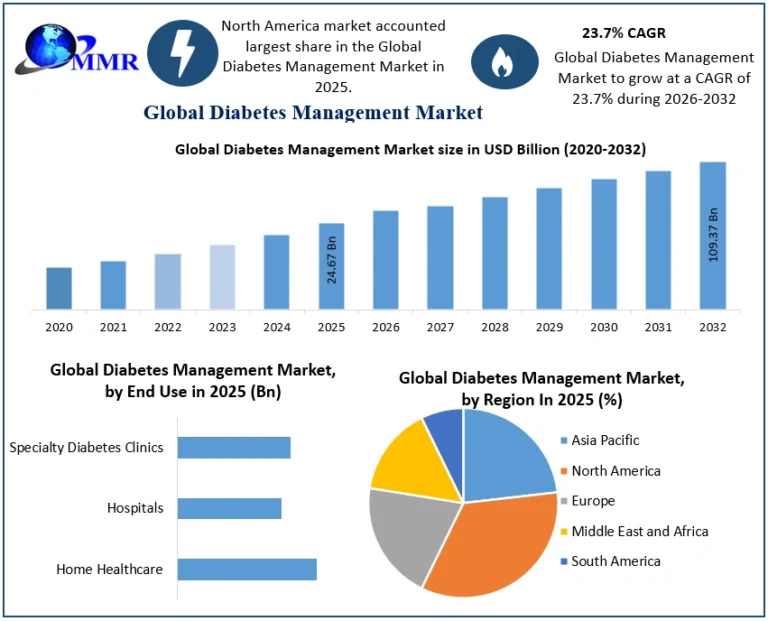
- Market size valued at USD 24.67 Billion in 2025
- Forecast to reach USD 109.37 Billion by 2032
- CAGR of 23.7% during 2025–2032
- Rapid expansion driven by digital glucose monitoring and connected care ecosystems
- Rising global diabetes burden accelerating demand for continuous management solutions
- Strong adoption across hospitals, homecare, and ambulatory settings
- Increasing integration of AI-based predictive analytics in disease tracking
- Expansion of reimbursement frameworks supporting digital therapeutics
Why This Matters Now
Healthcare systems are under pressure from a rising chronic disease load, with diabetes emerging as one of the most expensive and persistent conditions to manage. Providers are shifting from episodic treatment to continuous monitoring models, forcing rapid adoption of connected diabetes technologies.
For investors and medtech companies, the shift signals a structural transition in care delivery. Value is moving from standalone devices to integrated ecosystems combining diagnostics, software intelligence, and remote monitoring.
Market Overview
The Diabetes Management Market is evolving from traditional glucose testing toward fully integrated disease control platforms. The 2025 valuation of USD 24.67 billion reflects accelerating penetration of digital health tools and expanding patient access to real-time monitoring systems.
The projected rise to USD 109.37 billion by 2032 highlights a system-level shift in chronic care economics. Providers are increasingly incentivized to prevent complications rather than treat them, reducing long-term hospitalization costs and improving patient outcomes.
The market spans devices, software platforms, and service-based care models that support continuous tracking of glucose levels, insulin delivery optimization, and lifestyle monitoring. Hospitals and homecare settings are converging through telehealth integration, enabling real-time physician intervention.
Regulators and payers are also expanding coverage for digital diabetes tools, especially in developed economies where cost-of-care reduction is a policy priority. This is accelerating adoption across both high-income and emerging markets.
Key Trends Driving Growth
Digital transformation is redefining diabetes care delivery. Continuous glucose monitoring systems are replacing periodic testing, enabling predictive intervention rather than reactive treatment.
Artificial intelligence is increasingly embedded into diabetes platforms, helping clinicians identify risk patterns and adjust insulin dosage more precisely. This shift reduces complications such as hypoglycemia and long-term vascular damage.
Telehealth integration is expanding access to diabetes specialists, particularly in rural and underserved regions. This is reducing dependency on hospital visits and improving adherence to treatment protocols.
Pharma and biotech companies are aligning drug development with digital monitoring ecosystems. Drug efficacy is increasingly measured alongside real-world patient data collected through connected devices.
Precision medicine is also gaining traction, with treatment plans tailored to genetic, behavioral, and lifestyle factors. This is improving outcomes and reducing unnecessary medication adjustments.
Download a Sample Report with Comprehensive Market Intelligence
Segment Insights
- Dominant Segment: Not specified in the supplied MMR source
- Fastest-Growing Segment: Not specified in the supplied MMR source
The market broadly includes diabetes monitoring devices, insulin delivery systems, and supporting digital health platforms. Growth is being driven by the integration of connected technologies across all categories rather than a single dominant product line.
Device manufacturers are increasingly bundling hardware with analytics software, shifting revenue models toward subscription-based care platforms. This trend is reshaping competitive positioning across the industry.
Regional Growth Story
North America leads adoption due to advanced healthcare infrastructure, high diabetes prevalence, and strong reimbursement frameworks for digital monitoring systems. The region is also a hub for AI-driven healthcare innovation and medtech investment.
Europe, led by Germany and the UK, is expanding digital diabetes programs supported by national health systems focused on preventive care. Reimbursement reforms are encouraging broader use of continuous monitoring devices.
Asia Pacific, particularly China, Japan, South Korea, and India, is emerging as the fastest-expanding demand center. Rising urbanization, lifestyle changes, and increasing healthcare spending are driving rapid uptake of diabetes management solutions.
India is witnessing strong growth in digital health adoption through mobile-based monitoring platforms, while Japan and South Korea are advancing precision-based diabetes care models.
Competitive Landscape
The competitive environment is shifting from device-centric competition to ecosystem dominance. Companies are focusing on integrated solutions combining hardware, cloud analytics, and patient engagement platforms.
Strategic partnerships between medtech firms, pharmaceutical companies, and digital health startups are increasing. These collaborations aim to create end-to-end diabetes management ecosystems that improve patient adherence and clinical outcomes.
Competition is intensifying around data ownership and analytics capability. Firms that can generate actionable insights from patient data are gaining stronger market positioning than those focused solely on device sales.
Recent Developments
- Expansion of AI-enabled glucose monitoring platforms across developed healthcare systems
- Increased insurer support for digital diabetes management tools
- Rising integration of wearable health devices with hospital information systems
- Growth in telehealth-based diabetes consultation programs
- Pharma-medtech collaborations for data-driven insulin optimization solutions
Strategic Implications
The market is transitioning toward outcome-based healthcare models. Companies that fail to integrate digital intelligence into their offerings risk losing relevance as payers prioritize cost efficiency and measurable patient outcomes.
Hospitals are increasingly acting as coordination hubs rather than primary service providers. This decentralization of care is reshaping procurement strategies, with demand shifting toward interoperable platforms.
Pharmaceutical firms are now competing on ecosystem integration rather than drug efficacy alone, as real-world evidence becomes central to reimbursement decisions.
Future Outlook
The Diabetes Management Market is entering a phase where digital intelligence, predictive analytics, and continuous monitoring will define competitive advantage rather than standalone treatment tools.
Analyst Perspective
“Diabetes care is shifting from episodic intervention to continuous digital management. The next phase of growth will be led by platforms that integrate diagnostics, AI analytics, and real-time patient engagement,” said Komal Patil, Analyst.
About Maximize Market Research
Maximize Market Research Pvt. Ltd. (MMR) is a global market research and consulting company that provides reliable, data-focused, and practical business insights. The firm serves a wide range of industries, including healthcare, pharmaceuticals, technology, automotive, electronics, chemicals, personal care, and consumer goods. Through market forecasts, competitive analysis, strategic consulting, and industry impact assessments, MMR helps organizations understand changing market conditions, identify growth opportunities, and make informed business decisions for long-term success.
Contact Us
2nd Floor, Navale IT Park Phase 3
Pune Banglore Highway, Narhe
Pune, Maharashtra 411041, India
+91 9607365656
sales@maximizemarketresearch.com
