Key Highlights
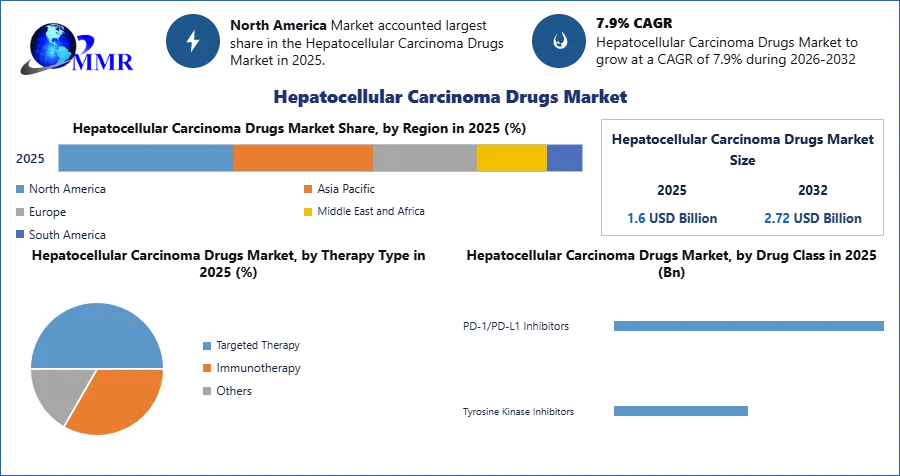
- Market projected to reach USD 1.6 Billion by 2032
- Expected CAGR of 7.9% during 2026–2032
- Growth driven by rising hepatocellular carcinoma burden globally
- Increasing adoption of targeted therapy and immunotherapy approaches
- Expansion of oncology infrastructure across emerging economies
- Strong pipeline activity in precision oncology drug development
- Rising focus on early diagnosis and treatment accessibility
Why This Matters Now
Hepatocellular carcinoma (HCC) remains one of the most challenging oncology segments due to late-stage diagnosis and limited curative options. Healthcare systems are under pressure as treatment demand rises faster than early detection rates.
Pharma companies are recalibrating oncology pipelines toward liver cancer therapies that can extend survival outcomes while meeting reimbursement thresholds. For payers, rising drug costs are forcing stricter value-based evaluation models. Investors are responding to accelerated clinical innovation cycles and expanding biologics portfolios targeting solid tumors.
Market Overview
The Hepatocellular Carcinoma Drugs Market is positioned within a rapidly advancing oncology ecosystem where therapeutic innovation is reshaping survival outcomes. The market is expected to reach USD 1.6 billion by 2032, expanding at a CAGR of 7.9% from 2026 to 2032, according to Maximize Market Research.
This growth reflects a shift from conventional chemotherapy toward targeted therapies and immuno-oncology regimens. Pharmaceutical companies are prioritizing mechanisms that address tumor heterogeneity and resistance pathways commonly associated with liver cancer progression.
Healthcare providers are increasingly integrating multidisciplinary care models, combining oncology, hepatology, and radiology expertise. This coordinated approach is improving patient stratification and optimizing treatment sequencing.
Key Trends Driving Growth
One of the most significant shifts is the rapid adoption of precision oncology. Biomarker-driven therapies are enabling clinicians to identify patients more likely to respond to specific drug classes, improving clinical outcomes and reducing ineffective treatment cycles.
Immunotherapy is also gaining momentum, particularly immune checkpoint inhibitors used in advanced-stage HCC. These therapies are redefining second-line and combination treatment protocols in major healthcare systems.
Digital health integration is improving disease monitoring and treatment adherence. Hospitals are leveraging AI-enabled imaging tools to detect liver lesions earlier, while tele-oncology platforms are expanding specialist access in underserved regions.
Regulatory agencies are accelerating oncology approvals under expedited pathways. This has shortened commercialization timelines for novel HCC therapies, strengthening competitive intensity among biotech and pharmaceutical firms.
Request a Free Sample Report for Comprehensive Market Insights
Segment Insights
- Dominant Segment: Not explicitly detailed in the provided Maximize Market Research report summary
- Fastest-Growing Segment: Not explicitly detailed in the provided Maximize Market Research report summary
- The market broadly spans drug classes such as targeted therapies, immunotherapies, and supportive care agents
- Treatment evolution is shifting toward combination regimens integrating immunotherapy and kinase inhibitors
- Pipeline focus remains heavily concentrated on advanced-stage hepatocellular carcinoma treatment options
Regional Growth Story
North America leads the Hepatocellular Carcinoma Drugs Market due to advanced oncology infrastructure, high treatment penetration, and strong reimbursement frameworks. The United States continues to drive clinical trial activity and early adoption of next-generation immunotherapies.
Europe, particularly Germany and the UK, is witnessing steady expansion supported by national cancer programs and structured reimbursement pathways. Health systems are emphasizing early screening initiatives to reduce late-stage diagnosis rates.
Asia Pacific is emerging as a high-growth region due to increasing liver cancer prevalence, especially in China and Japan. These markets are investing heavily in oncology infrastructure and domestic drug innovation ecosystems.
India and South Korea are strengthening their roles through expanded hospital networks and growing access to advanced oncology treatments. Cost-sensitive markets are increasingly adopting biosimilars and combination therapies to manage patient affordability.
Competitive Landscape
The competitive environment is defined by rapid innovation cycles and aggressive pipeline expansion in oncology therapeutics. Pharmaceutical and biotech firms are focusing on combination therapy development to enhance efficacy in advanced HCC cases.
Strategic collaborations between biotech innovators and large pharma companies are accelerating clinical development timelines. Licensing agreements are enabling broader global distribution of novel drug candidates.
Market competition is also shaped by real-world evidence generation. Companies are investing in post-market surveillance studies to demonstrate long-term survival benefits and secure reimbursement approvals across regulated markets.
Recent Developments
- Expansion of clinical trials focusing on combination immunotherapy regimens for advanced HCC
- Increased regulatory approvals under accelerated oncology pathways in major markets
- Strategic partnerships between biotech firms and global pharmaceutical companies for liver cancer pipelines
- Growing investment in biomarker research for patient stratification in hepatocellular carcinoma
- Integration of AI-based imaging tools in oncology diagnostics to support early detection
Strategic Implications
Pharmaceutical companies must prioritize differentiated mechanisms of action to remain competitive in a rapidly evolving oncology landscape. The shift toward precision medicine is reducing tolerance for marginal efficacy improvements.
Hospitals are under pressure to adopt value-based procurement models, linking drug adoption to measurable patient outcomes. This is reshaping reimbursement negotiations and pricing strategies across healthcare systems.
For biotech firms, early-stage innovation in immuno-oncology and targeted therapy combinations represents the most viable pathway for market entry and expansion. Investors are increasingly favoring platforms capable of generating multi-indication oncology pipelines.
Future Outlook
The Hepatocellular Carcinoma Drugs Market will increasingly be defined by combination therapies, precision diagnostics, and accelerated regulatory pathways, separating innovation leaders from incremental participants.
Analyst Perspective
“Growth in the hepatocellular carcinoma drugs market is being driven by a structural shift toward precision oncology and combination immunotherapy strategies, reshaping both treatment outcomes and competitive dynamics,” says Komal Patil, Analyst at Maximize Market Research.
About Maximize Market Research
Maximize Market Research Pvt. Ltd. (MMR) is a global market research and consulting company that provides reliable, data-focused, and practical business insights. The firm serves a wide range of industries, including healthcare, pharmaceuticals, technology, automotive, electronics, chemicals, personal care, and consumer goods. Through market forecasts, competitive analysis, strategic consulting, and industry impact assessments, MMR helps organizations understand changing market conditions, identify growth opportunities, and make informed business decisions for long-term success.
Contact Us
2nd Floor, Navale IT Park Phase 3
Pune Banglore Highway, Narhe
Pune, Maharashtra 411041, India
+91 9607365656
sales@maximizemarketresearch.com
