Key Highlights
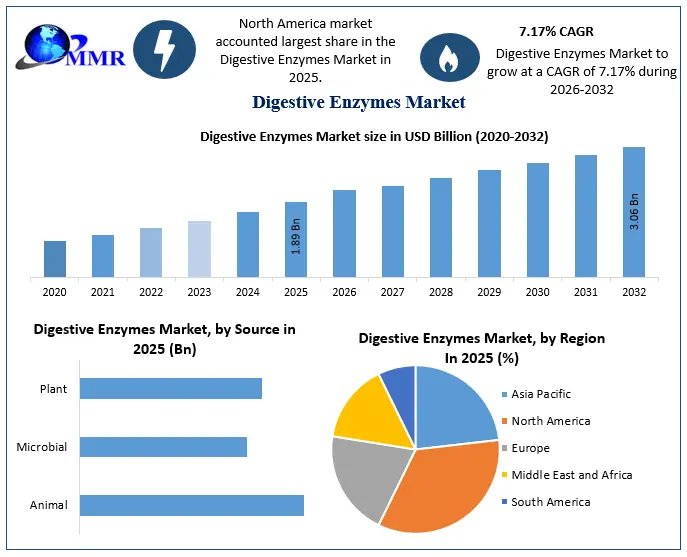
- Digestive Enzymes Market valued at USD 1.89 Billion in 2025
- Projected to reach USD 3.06 Billion by 2032
- Expected to expand at a 7.17% CAGR (2026–2032)
- Growth driven by rising gastrointestinal disorder prevalence and enzyme therapy adoption
- Increasing integration of preventive healthcare and digestive wellness solutions
- Expanding use in clinical nutrition, pharmaceuticals, and dietary supplements
- Rising awareness of gut health across aging populations and urban consumers
Why This Matters Now
Healthcare systems are facing a steady rise in digestive disorders linked to aging, dietary shifts, and chronic disease burden. Hospitals and clinics are reporting higher demand for enzyme-based therapies, especially in patients with pancreatic insufficiency and malabsorption conditions.
At the same time, consumers are shifting toward preventive digestive health solutions, pushing pharma companies and nutraceutical players to expand enzyme portfolios. For investors and payers, this signals a transition from symptomatic treatment to long-term digestive care management models.
Market Overview
The Digestive Enzymes Market is evolving from a niche therapeutic category into a mainstream healthcare and wellness segment. Valued at USD 1.89 Billion in 2025, the market is projected to reach USD 3.06 Billion by 2032, supported by steady clinical demand and expanding over-the-counter adoption.
Growth is closely tied to the increasing incidence of gastrointestinal conditions, including pancreatic insufficiency, lactose intolerance, and malabsorption syndromes. Healthcare providers are increasingly integrating enzyme-based interventions as part of broader digestive care protocols, improving nutrient absorption and patient outcomes.
Pharmaceutical and nutraceutical manufacturers are responding with expanded formulations targeting both prescription and preventive care markets. This dual-track expansion is reshaping competitive positioning across healthcare and consumer wellness ecosystems.
Key Trends Driving Growth
Rising global gastrointestinal disease burden is a primary growth catalyst. Hospitals are reporting increased cases of chronic digestive disorders, driving demand for enzyme replacement therapies. Aging populations in developed economies are particularly contributing to sustained clinical usage.
Preventive healthcare adoption is accelerating demand for enzyme supplements in dietary applications. Consumers are increasingly focused on gut microbiome balance, digestion efficiency, and nutrient absorption.
Pharmaceutical innovation is expanding enzyme stability, bioavailability, and targeted delivery systems. This is improving therapeutic outcomes and increasing physician confidence in enzyme-based treatment protocols.
Digital health platforms and telemedicine are also influencing prescribing behavior. Remote consultations are expanding access to digestive health treatments, particularly in urban and semi-urban markets.
Access a Detailed Sample Report with Industry Analysis
Segment Insights
- Dominant Segment: Clinical therapeutics and prescription-based enzyme therapies remain the core revenue driver due to high adoption in hospital and specialty care settings. These treatments are essential for managing pancreatic insufficiency and chronic malabsorption disorders.
- Fastest-Growing Segment: Nutraceutical and over-the-counter digestive enzyme supplements are expanding rapidly, driven by preventive healthcare trends, lifestyle changes, and rising consumer awareness of gut health.
Other segment classifications are referenced in the report framework, but detailed breakdowns are not specified in the provided source material.
Regional Growth Story
North America remains a leading market due to high diagnosis rates of gastrointestinal disorders, advanced healthcare infrastructure, and strong reimbursement frameworks for enzyme replacement therapies. Clinical adoption is reinforced by established treatment protocols.
Europe follows closely, with countries such as Germany and the UK emphasizing early diagnosis and structured digestive disorder management programs. Regulatory support for enzyme-based pharmaceuticals continues to strengthen adoption.
Asia-Pacific is emerging as a high-growth region, driven by expanding healthcare access in China and India. Rising urbanization, dietary transitions, and increasing awareness of digestive wellness are fueling demand. Japan and South Korea are focusing on precision nutrition and advanced gastrointestinal care models.
Competitive Landscape
The competitive environment is shaped by pharmaceutical manufacturers, specialty enzyme producers, and nutraceutical companies. Market players are focusing on formulation innovation, improved enzyme stability, and broader application across therapeutic and wellness categories.
Strategic positioning is increasingly defined by pipeline diversification and geographic expansion. Companies are targeting both prescription-based therapies and consumer health products to capture dual revenue streams.
Partnerships with healthcare providers and digital health platforms are enhancing patient reach and adherence. Competitive advantage is shifting toward companies that can integrate clinical efficacy with consumer accessibility.
Recent Developments
- Expansion of enzyme-based formulations targeting broader gastrointestinal indications
- Increased investment in digestive health-focused nutraceutical product lines
- Growing adoption of enzyme therapies in outpatient and homecare settings
- Integration of digestive health solutions into preventive care programs
- Rising collaboration between pharma and digital health platforms for patient engagement
Strategic Implications
For pharmaceutical companies, digestive enzymes represent a hybrid opportunity spanning clinical therapeutics and consumer wellness. Firms that can bridge this divide will capture higher lifetime patient value.
For healthcare providers, earlier intervention using enzyme therapies can reduce complications linked to malabsorption and chronic digestive disorders, lowering long-term treatment costs.
For investors, the market signals stable mid-term growth supported by structural healthcare demand rather than cyclical consumption patterns. However, differentiation will depend on formulation innovation and regulatory positioning.
Payers are increasingly evaluating enzyme therapies within value-based care frameworks, focusing on long-term cost reduction and patient quality-of-life improvements.
Future Outlook
The market is moving toward integrated digestive health management, where enzyme therapies, diagnostics, and preventive nutrition converge into unified care pathways that redefine gastrointestinal treatment standards.
Analyst Perspective
“The Digestive Enzymes Market is transitioning from symptom management to preventive and precision digestive care, reshaping both pharmaceutical pipelines and consumer health strategies,” said Komal Patil, Analyst.
About Maximize Market Research
Maximize Market Research Pvt. Ltd. (MMR) is a global market research and consulting company that provides reliable, data-focused, and practical business insights. The firm serves a wide range of industries, including healthcare, pharmaceuticals, technology, automotive, electronics, chemicals, personal care, and consumer goods. Through market forecasts, competitive analysis, strategic consulting, and industry impact assessments, MMR helps organizations understand changing market conditions, identify growth opportunities, and make informed business decisions for long-term success.
Contact Us
2nd Floor, Navale IT Park Phase 3
Pune Banglore Highway, Narhe
Pune, Maharashtra 411041, India
+91 9607365656
sales@maximizemarketresearch.com
