Key Highlights
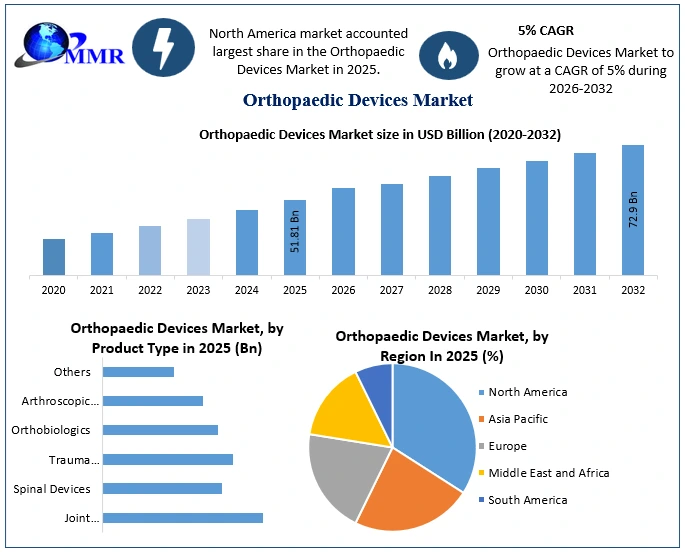
- Market size projected to rise from USD 51.81 Bn (2025) to USD 72.9 Bn (2032)
- CAGR expected at 5% during forecast period
- Rising burden of musculoskeletal disorders accelerating device adoption
- Expanding orthopedic surgical procedures across aging populations
- Increased demand for minimally invasive and implant-based treatments
- Growth supported by global healthcare infrastructure expansion
Why This Matters Now
Hospitals are under pressure as orthopedic case volumes rise faster than surgical capacity in many regions. Elective procedures delayed during earlier healthcare disruptions are now returning, creating backlog-driven demand across joint reconstruction and trauma care.
For manufacturers, this is not a replacement cycle—it is a volume expansion cycle. For payers, orthopedic procedures are becoming a long-term cost driver as aging populations increase lifetime intervention rates. For investors, the market signals sustained procedural demand rather than short-term correction.
Market Overview
The Orthopaedic Devices Market is anchored in the treatment of musculoskeletal conditions involving bones, joints, ligaments, and related structures. It spans implants, fixation devices, joint reconstruction systems, and trauma solutions used in surgical and post-trauma care pathways.
Between 2025 and 2032, the market is projected to expand from USD 51.81 billion to USD 72.9 billion at a CAGR of 5%, according to Maximize Market Research. The growth trajectory signals steady procedural expansion rather than episodic spikes, driven by demographic shifts and broader access to surgical care.
Healthcare systems across developed economies are facing sustained demand from aging populations, while emerging markets are expanding orthopedic infrastructure to meet rising injury and lifestyle disease burdens. This dual pressure is reshaping procurement strategies in hospitals and specialty clinics.
Key Trends Driving Growth
Rising prevalence of musculoskeletal disorders is increasing demand for surgical intervention, particularly in hip, knee, and spine conditions. Sedentary lifestyles, obesity, and sports-related injuries are expanding the patient pool in younger demographics as well.
Aging populations remain the most structurally important driver. Elderly patients require higher rates of joint reconstruction and fracture management, increasing lifetime orthopedic procedure frequency.
Healthcare infrastructure expansion in emerging economies is enabling wider access to orthopedic surgeries. This includes growth in tertiary hospitals and specialty orthopedic centers.
Technological improvements in implant design and surgical techniques are improving recovery outcomes, reducing hospital stays, and increasing procedure acceptance rates among patients and providers.
Download a Free Sample to Explore Market Growth Trends
Segment Insights
- Dominant Segment: Not specified in the provided Maximize Market Research report extract
- Fastest-Growing Segment: Not specified in the provided Maximize Market Research report extract
Across the broader market, orthopedic devices typically span joint reconstruction, spinal devices, trauma fixation, arthroscopy equipment, and other supportive systems. However, segment leadership and growth differentials are not detailed in the supplied report data and therefore are not attributed here.
Regional Growth Story
The report does not provide explicit regional segmentation data in the supplied extract. However, global demand patterns indicate that mature healthcare markets such as the US, Germany, the UK, Japan, and South Korea continue to account for high procedure volumes due to aging demographics and advanced surgical infrastructure.
China and India are emerging as high-growth regions due to expanding hospital networks, rising medical tourism, and increasing access to orthopedic care. Government investments in healthcare infrastructure are enabling broader adoption of implant-based treatments.
Across regions, reimbursement frameworks and hospital funding models remain key determinants of procedure uptake, particularly for high-cost joint reconstruction surgeries.
Competitive Landscape
The Orthopaedic Devices Market is characterized by competition driven by product innovation, surgical efficiency, and long-term implant performance. Manufacturers are increasingly focused on improving biomaterials, implant durability, and minimally invasive surgical compatibility.
Competitive positioning is influenced by hospital procurement agreements, surgeon preference, and regulatory approvals. Companies that integrate digital surgical planning tools and patient-specific implant solutions are strengthening their clinical adoption rates.
Consolidation trends continue as larger players acquire niche orthopedic technology firms to expand product portfolios and geographic reach.
Recent Developments
- Increasing adoption of minimally invasive orthopedic surgical techniques
- Growing integration of digital planning tools in orthopedic procedures
- Expansion of outpatient orthopedic surgery models in developed healthcare systems
- Rising investment in advanced implant material research and design
- Accelerated focus on reducing post-surgical recovery timelines
Strategic Implications
For device manufacturers, differentiation is shifting from hardware alone to integrated surgical ecosystems that combine implants, navigation systems, and post-operative monitoring.
Hospitals are prioritizing procurement models that reduce revision surgery rates and shorten patient recovery cycles, directly influencing vendor selection.
For investors, the market signals predictable procedural demand tied to demographics rather than cyclical healthcare spending. However, pricing pressure from reimbursement systems will intensify competition in commoditized implant categories.
Regulators are increasingly focused on long-term implant safety and clinical outcomes, which may extend approval timelines but improve overall patient confidence.
Future Outlook
The Orthopaedic Devices Market will increasingly reward companies that align surgical innovation with cost-efficient, outcome-driven care delivery models.
Analyst Perspective
“Orthopaedic devices are transitioning from standalone surgical tools to integrated care solutions, where clinical outcomes, procedural efficiency, and long-term durability define market leadership,” says Komal Patil, Analyst, Maximize Market Research.
About Maximize Market Research
Maximize Market Research Pvt. Ltd. (MMR) is a global market research and consulting company that provides reliable, data-focused, and practical business insights. The firm serves a wide range of industries, including healthcare, pharmaceuticals, technology, automotive, electronics, chemicals, personal care, and consumer goods. Through market forecasts, competitive analysis, strategic consulting, and industry impact assessments, MMR helps organizations understand changing market conditions, identify growth opportunities, and make informed business decisions for long-term success.
Contact Us
2nd Floor, Navale IT Park Phase 3
Pune Banglore Highway, Narhe
Pune, Maharashtra 411041, India
+91 9607365656
sales@maximizemarketresearch.com
