Healthcare systems are shifting resources toward age-related diseases as populations continue to age rapidly across developed and emerging economies. For pharmaceutical companies, nutrition providers, hospitals, and healthcare investors, sarcopenia has moved from an overlooked condition to a growing commercial and clinical priority.
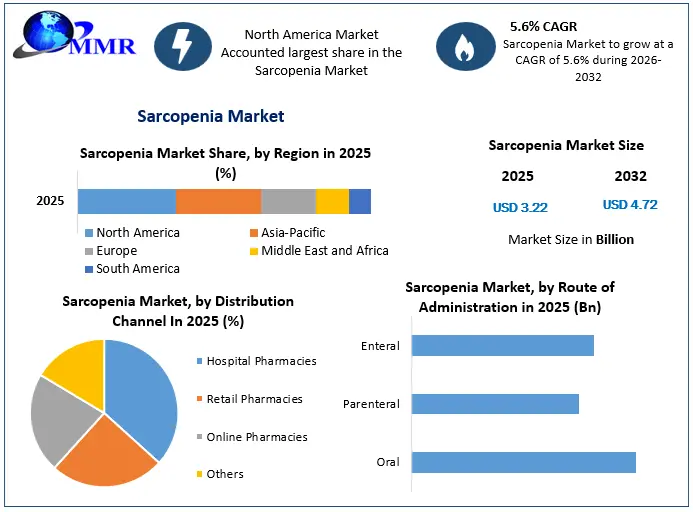
The Sarcopenia Market, valued at USD 3.22 billion in 2025, is projected to reach USD 4.72 billion by 2032, expanding at a 5.6% CAGR. The market is benefiting from higher healthcare expenditure, growing awareness of muscle loss disorders, increasing demand for preventive care, and expanding treatment options that improve quality of life.
Key Highlights
- Market size: USD 3.22 billion (2025)
- Forecast: USD 4.72 billion by 2032
- CAGR (2026–2032): 5.6%
- Leading region: North America
- Dominant segment: Treatment Type
- Growing geriatric population is expanding the patient pool
- Rising healthcare expenditure supports wider treatment adoption
- Increasing burden of musculoskeletal disorders strengthens long-term demand
- Hospitals remain central to diagnosis, treatment, and multidisciplinary care
Why This Matters Now
Sarcopenia is increasingly recognized as a major contributor to disability, falls, fractures, hospitalization, and declining independence among older adults. According to the report, approximately 1.71 billion people worldwide are affected by musculoskeletal conditions, creating sustained demand for therapies that preserve muscle strength and mobility.
For healthcare providers, earlier intervention can reduce costly complications. For payers, preventive treatment offers opportunities to lower long-term healthcare costs. For pharmaceutical and nutrition companies, expanding diagnosis rates create a broader addressable market for therapeutic and nutritional products.
Market Overview
Sarcopenia develops gradually with aging and accelerates among individuals living with chronic diseases or sedentary lifestyles. The condition typically begins during middle age and progresses over time, reducing muscle mass, physical performance, and overall quality of life.
While there is currently no definitive cure, multiple treatment approaches—including nutritional supplementation, exercise therapy, and pharmacotherapy—help slow disease progression and improve patient outcomes. The combination of aging demographics and greater clinical recognition is steadily expanding market demand.
Healthcare systems are also placing greater emphasis on preventive medicine rather than treating disability after it develops. This transition favors earlier diagnosis, nutritional intervention, and rehabilitation programs that delay disease progression.
Key Trends Driving Growth
Population aging remains the strongest structural driver. Countries including the United States, Germany, the UK, Japan, South Korea, and China continue to experience rising elderly populations that require long-term musculoskeletal care.
Healthcare expenditure is increasing alongside demand for chronic disease management. Hospitals and clinics are integrating nutritional support, rehabilitation, and exercise-based therapies into broader geriatric care pathways, creating additional commercial opportunities for healthcare providers.
Preventive healthcare is also gaining momentum. Rather than waiting until severe mobility loss occurs, clinicians are increasingly encouraging earlier intervention through nutrition, physical activity, and regular assessment of muscle function.
Innovation across pharmaceutical and biotechnology companies continues to support market development. Companies are expanding nutritional products, therapeutic research, and supportive care portfolios aimed at improving patient outcomes.
Digital health and artificial intelligence are receiving growing attention across musculoskeletal care. While the supplied report does not identify commercially adopted AI-based sarcopenia diagnostics or precision medicine solutions, broader digital monitoring and patient engagement technologies are expected to support future disease management. No specific regulatory approvals or reimbursement changes are detailed in the report and therefore cannot be confirmed.
𝐃𝐨𝐰𝐧𝐥𝐨𝐚𝐝 𝐏𝐃𝐅 𝐁𝐫𝐨𝐜𝐡𝐮𝐫𝐞 @https://www.maximizemarketresearch.com/request-sample/196035/
Segment Insights
- Dominant Segment: Treatment Type, according to the report, accounts for the leading share of the Sarcopenia Market. This includes protein supplements, vitamin B12 supplements, vitamin D and calcium supplements, exercise therapy, pharmacotherapy, and other treatment approaches.
- Fastest-Growing Segment: Not specified in the supplied report.
- Route of Administration: Oral, parenteral, and enteral formulations serve different patient requirements across clinical settings.
- Distribution Channels: Hospital pharmacies, retail pharmacies, online pharmacies, and other channels expand treatment accessibility.
- End Users: Hospitals, clinics, and homecare settings continue supporting long-term patient management.
Regional Growth Story
North America holds the largest market share in 2025, supported by advanced healthcare infrastructure, high healthcare spending, strong clinical awareness, and broad availability of nutritional and therapeutic interventions. The region also benefits from well-established hospital networks that facilitate diagnosis and long-term disease management.
Europe continues to benefit from expanding elderly populations and mature healthcare systems across countries including Germany and the UK, where preventive healthcare and rehabilitation services remain healthcare priorities.
Asia-Pacific presents substantial long-term opportunity. China, Japan, India, and South Korea are witnessing rapidly aging populations and increasing investment in healthcare infrastructure. Rising awareness of age-related disorders and improved access to healthcare services are expected to support future treatment adoption.
The report includes regional analysis covering North America, Europe, Asia-Pacific, South America, and the Middle East & Africa but does not specify country-level reimbursement policies or regulatory developments.
Competitive Landscape
Competition is shaped by established pharmaceutical companies alongside global nutrition and healthcare organizations expanding their presence in age-related care.
Major participants include Bayer AG, Zydus Cadila, GlaxoSmithKline plc, Nestlé Health Science, Sanofi S.A., Novartis AG, Pfizer Inc., AstaReal AB, Merck Sharp & Dohme Corp., AbbVie Inc., Abbott Laboratories, Amway Corporation, F. Hoffmann-La Roche, Amgen Inc., and Johnson & Johnson.
Competition increasingly centers on comprehensive patient management rather than standalone therapies. Companies with integrated nutrition, pharmaceutical, rehabilitation, and patient-support capabilities may strengthen their competitive positioning as healthcare systems prioritize healthy aging.
Recent Developments
- The supplied report identifies major industry participants but does not specify recent acquisitions, regulatory approvals, product launches, investments, or partnerships.
- The report highlights increasing healthcare expenditure and growing geriatric populations as primary market drivers.
- Growing awareness of musculoskeletal disorders continues expanding demand for diagnosis and treatment.
Strategic Implications
Healthcare executives are likely to increase investment in multidisciplinary care models combining nutrition, rehabilitation, and pharmacological support. Hospitals can improve patient outcomes by integrating sarcopenia screening into routine geriatric assessments.
For pharmaceutical companies, opportunities extend beyond drug development into nutritional products and supportive therapies. Nutrition companies can strengthen their position through clinically validated supplements that support muscle health.
Investors may view sarcopenia as part of the broader healthy-aging economy, where preventive care, rehabilitation, and chronic disease management continue attracting capital.
Future Outlook
The Sarcopenia Market will increasingly benefit from demographic change, expanding healthcare investment, and stronger clinical recognition of muscle loss as a treatable condition. Organizations that combine evidence-based therapies, nutritional innovation, and integrated patient management will be better positioned as healthcare systems shift toward preventive aging strategies. Future market leaders will be those that deliver measurable improvements in mobility, independence, and long-term patient outcomes rather than treatment alone.
Analyst Perspective
“The Sarcopenia Market is entering a phase where demographic trends and preventive healthcare are converging to create sustained demand. Organizations that invest in comprehensive treatment strategies and patient-centered care will be best positioned to capture long-term growth opportunities.” — Komal Patil
About Maximize Market Research
Maximize Market Research Pvt. Ltd. (MMR) is a global market research and consulting company that provides reliable, data-focused, and practical business insights. The firm serves a wide range of industries, including healthcare, pharmaceuticals, technology, automotive, electronics, chemicals, personal care, and consumer goods. Through market forecasts, competitive analysis, strategic consulting, and industry impact assessments, MMR helps organizations understand changing market conditions, identify growth opportunities, and make informed business decisions for long-term success.
2nd Floor, Navale IT Park Phase 3
Pune Banglore Highway, Narhe
Pune, Maharashtra 411041, India
+91 9607365656
sales@maximizemarketresearch.com
