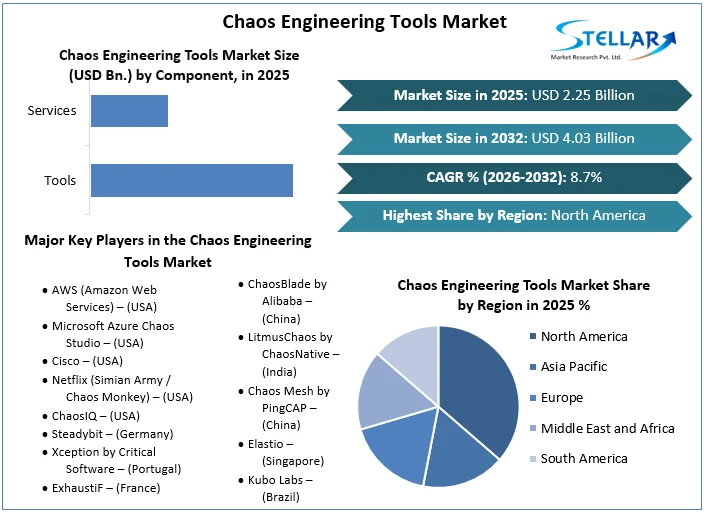
The Chaos Engineering Tools Market is experiencing substantial growth as organizations increasingly recognize the importance of building resilient and fault-tolerant IT systems. With businesses relying heavily on cloud computing, microservices, containers, and distributed architectures, ensuring application availability and minimizing downtime have become strategic priorities. Chaos engineering tools help organizations proactively identify weaknesses in their infrastructure by intentionally introducing controlled failures into production and testing environments, enabling teams to improve system reliability before real-world incidents occur.
As digital transformation accelerates across industries such as banking, healthcare, retail, telecommunications, and manufacturing, enterprises are adopting chaos engineering practices to strengthen business continuity and optimize operational performance. These tools allow DevOps, Site Reliability Engineering (SRE), and platform engineering teams to simulate network outages, server failures, latency spikes, and application crashes, ensuring systems remain operational under unpredictable conditions.
𝐃𝐨𝐰𝐧𝐥𝐨𝐚𝐝 𝐅𝐫𝐞𝐞 𝐏𝐃𝐅 𝐁𝐫𝐨𝐜𝐡𝐮𝐫𝐞: https://www.stellarmr.com/report/req_sample/chaos-engineering-tools-market/2650
Growing Adoption of Cloud-Native Applications
The rapid expansion of cloud-native development is one of the primary drivers of the Chaos Engineering Tools Market. Organizations are increasingly deploying applications using Kubernetes, containers, serverless computing, and microservices, creating complex environments where a single component failure can affect the entire application ecosystem.
Chaos engineering enables organizations to validate the resilience of these distributed systems by identifying hidden vulnerabilities that traditional testing methods often fail to detect. As cloud adoption continues to increase, enterprises are integrating chaos engineering into continuous integration and continuous deployment (CI/CD) pipelines to improve software quality and reduce operational risks.
The increasing popularity of hybrid and multi-cloud environments has further strengthened the need for automated resilience testing across diverse infrastructure platforms.
DevOps and Site Reliability Engineering Drive Market Growth
Modern software development practices emphasize rapid releases without compromising application stability. DevOps and Site Reliability Engineering (SRE) teams are increasingly adopting chaos engineering tools to ensure applications maintain high availability while supporting continuous innovation.
By conducting controlled experiments, organizations can evaluate how applications respond to infrastructure disruptions, database failures, service interruptions, and network congestion. This proactive approach minimizes unexpected outages, improves incident response strategies, and strengthens disaster recovery planning.
Enterprises are also integrating chaos engineering with observability platforms, allowing real-time monitoring of system behavior during fault injection experiments and accelerating root-cause analysis.
Artificial Intelligence Enhances Chaos Testing
Artificial intelligence and machine learning are transforming the capabilities of chaos engineering platforms. AI-powered tools can automatically identify high-risk infrastructure components, recommend optimal failure scenarios, and analyze experiment outcomes to generate actionable insights.
Predictive analytics helps organizations prioritize resilience improvements by forecasting potential failure points before they impact business operations. Intelligent automation also reduces the manual effort required to design, execute, and monitor complex chaos experiments.
As AI-driven operations (AIOps) gain momentum, vendors are incorporating intelligent automation into their platforms to improve testing accuracy, reduce operational complexity, and accelerate incident prevention.
Expansion Across Multiple Industry Verticals
The Chaos Engineering Tools Market is expanding beyond technology companies into industries where uninterrupted digital services are mission-critical. Financial institutions use chaos engineering to ensure secure online banking and payment systems remain operational during unexpected failures. Healthcare providers rely on resilient digital infrastructure to support electronic health records, telemedicine, and connected medical devices.
E-commerce platforms employ chaos testing to prepare for peak shopping periods, while telecommunications companies use these tools to strengthen network reliability and support expanding 5G infrastructure. Manufacturing organizations are also adopting resilience testing to protect industrial IoT systems and smart factory operations.
Government agencies and public sector organizations increasingly utilize chaos engineering to improve cybersecurity preparedness and ensure continuity of essential digital services.
Automation and Open-Source Adoption
Automation has become a defining trend within the market. Organizations are embedding chaos experiments directly into automated software development workflows, enabling resilience testing throughout the application lifecycle rather than after deployment.
Open-source frameworks have significantly increased awareness and adoption of chaos engineering principles, allowing organizations of all sizes to implement resilience testing with lower initial investment. Commercial vendors continue to build enterprise-grade platforms with advanced governance, security, compliance, reporting, and automation capabilities tailored for large-scale deployments.
This combination of open-source innovation and enterprise functionality continues to accelerate market expansion across organizations with varying levels of digital maturity.
𝐀𝐜𝐜𝐞𝐬𝐬 𝐭𝐡𝐞 𝐂𝐨𝐦𝐩𝐥𝐞𝐭𝐞 𝐑𝐞𝐩𝐨𝐫𝐭: https://www.stellarmr.com/report/chaos-engineering-tools-market/2650
Regional Market Dynamics
North America dominates the Chaos Engineering Tools Market due to the strong presence of cloud service providers, software companies, and early adopters of DevOps and cloud-native technologies. High investments in digital transformation, cybersecurity, and enterprise software continue to drive regional demand.
Europe represents a significant market, supported by increasing cloud adoption, stringent cybersecurity regulations, and growing investments in digital infrastructure modernization. Organizations across financial services, telecommunications, and manufacturing are strengthening operational resilience to meet evolving compliance requirements.
The Asia-Pacific region is projected to witness the fastest growth during the forecast period. Rapid cloud migration, expanding startup ecosystems, increasing enterprise digitalization, and government initiatives promoting digital economies are driving adoption across China, India, Japan, South Korea, Singapore, and Australia.
Latin America and the Middle East & Africa are also emerging as promising markets as organizations accelerate cloud adoption and prioritize resilient digital infrastructure.
Competitive Landscape
The market is characterized by continuous innovation, strategic partnerships, and platform integration. Vendors are enhancing their solutions with AI-driven analytics, automated experiment orchestration, multi-cloud compatibility, Kubernetes-native capabilities, and advanced security features.
Companies are expanding partnerships with cloud providers, observability platform vendors, and DevOps ecosystem partners to deliver comprehensive resilience engineering solutions. Investments in research and development continue to improve automation, scalability, compliance management, and enterprise governance capabilities.
Competition increasingly focuses on ease of deployment, seamless CI/CD integration, intelligent automation, and support for complex hybrid cloud environments.
Future Outlook
The future of the Chaos Engineering Tools Market remains highly promising as enterprises increasingly recognize resilience as a competitive advantage rather than simply an operational requirement. The continued growth of cloud-native applications, artificial intelligence, edge computing, 5G networks, and distributed architectures will create sustained demand for advanced resilience testing solutions.
Organizations are expected to integrate chaos engineering into broader digital resilience strategies alongside observability, cybersecurity, AIOps, and incident management platforms. As businesses continue modernizing mission-critical applications and adopting increasingly complex cloud environments, chaos engineering tools will play a vital role in improving service reliability, reducing downtime, and ensuring continuous digital operations across global enterprises.
Contact Stellar Market Research:
Stellar Market Research
Address: Phase 3, Navale IT Zone, S.No. 51/2A/2, Office No. 202, 2nd floor, Near, Navale Brg, Narhe, Pune, Maharashtra 411041
Website: http://stellarmr.com/
Email: sales@stellarmr.com
Mobile: +91 9607365656
