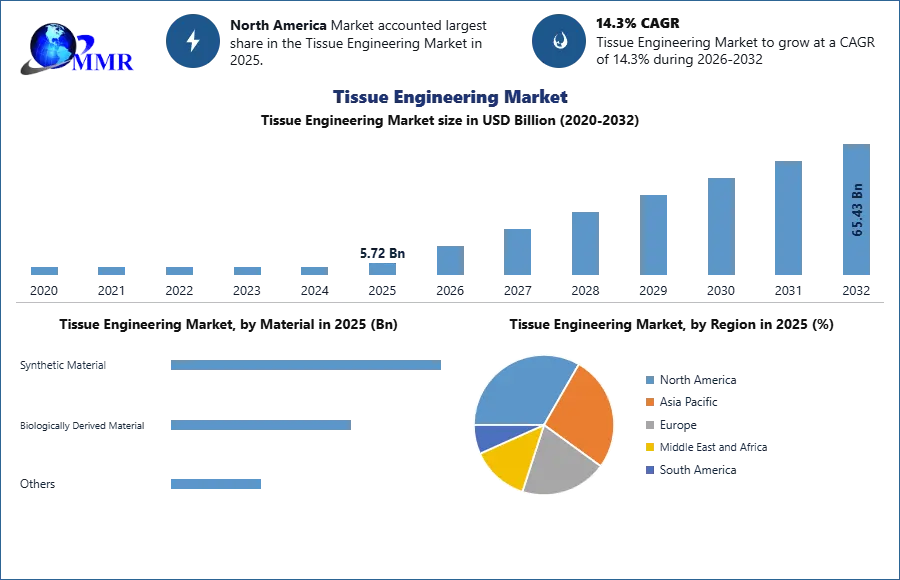
Healthcare providers and pharmaceutical executives are currently facing a critical inflection point where traditional organ transplantation and standard surgical interventions can no longer keep pace with rising chronic disease burdens. With the Global Tissue Engineering Market poised to surge from USD 5.72 billion in 2025 to USD 65.43 billion by 2032 at a CAGR of 14.3%, the window to pivot toward regenerative medicine is narrowing.
The fundamental shift in this sector is the transition from biological dependence—reliant on scarce donor organs—to synthetic and biomimetic scalability. For hospital networks and investors, this represents a move away from managing permanent patient decline toward curative, restorative interventions that fundamentally lower long-term treatment costs.
Why This Matters Now
The current medical infrastructure is strained by the dual pressures of an aging population and an epidemic of musculoskeletal, cardiovascular, and metabolic disorders. When a skin transplant costs between USD 18,000 and USD 28,000 compared to significantly more affordable tissue-engineered alternatives, the economic argument for adoption becomes undeniable. Payers are increasingly looking for value-based care pathways that favor tissue engineering to reduce prolonged hospital stays and high-cost revision surgeries.
This is not merely a research evolution; it is a market-driven necessity. As regulatory bodies formalize approval pathways for tissue-engineered products, those who invest in manufacturing standardization and biocompatibility today will capture the primary market share by 2032.
Market Overview
Tissue engineering serves as the bridge between biology, engineering, and medicine, focusing on building replacements that integrate with host tissue. The sector is currently transitioning from niche experimental status to a standardized therapeutic category. By replacing damaged tissues with bio-constructed equivalents, the industry is mitigating the chronic risks of immune rejection and organ failure. The projected growth to USD 65.43 billion by 2032 suggests a mass-market adoption phase, driven by the shift from autologous grafts to more uniform, mass-producible scaffolds and organoids.
Key Trends Driving Growth
The Donor Gap: The widening disparity between transplant demand and donor availability acts as a constant catalyst for innovation in organoid development and bioengineered substitutes.
Cost-Efficiency: As manufacturing processes stabilize, tissue engineering is proving to be a cost-effective alternative to traditional, high-expense surgical procedures.
Technological Convergence: The integration of stem cell research, advanced biomaterials, and high-precision tissue culture techniques is enabling the creation of complex tissue structures that were previously impossible to replicate.
Personalized Therapeutics: Advances in cellular microenvironment control allow for tailor-made solutions, significantly improving patient compliance and integration success.
𝐃𝐨𝐰𝐧𝐥𝐨𝐚𝐝 𝐏𝐃𝐅 𝐁𝐫𝐨𝐜𝐡𝐮𝐫𝐞 @https://www.maximizemarketresearch.com/request-sample/73928/
Segment Insights
Material Landscape: The market is divided between synthetic materials (polyethylene glycol, PLGA, etc.) favored for their mechanical strength and ease of manufacture, and biologically derived materials (collagen, gelatin, chitosan) which offer superior biomimetic properties for cell adhesion.
Dominant Segment: Orthopedics, musculoskeletal, and spine sectors currently dominate the market. High fracture incidence rates—including over 15 million cases annually globally—sustain a massive, consistent demand for bone replacement and repair scaffolds.
Fastest-Growing Segment: The cardiology and vascular segment is poised for the most rapid growth through 2032. The development of Engineered Heart Tissue (EHT) and 3D heart muscles represents a high-impact frontier that addresses the high prevalence of global cardiovascular disorders.
Regional Growth Story
North America currently holds the largest market share, anchored by high healthcare spending, a rapidly aging demographic, and an established infrastructure for stem cell and regenerative research. Conversely, the Asia Pacific region is expected to exhibit the fastest CAGR through 2032. Japan, in particular, is leading the regulatory and innovation charge, while rising cancer incidences and an expanding elderly population across the region are creating unprecedented demand for advanced tissue-based regenerative technologies.
Competitive Landscape
The market is currently characterized by intense competition between established life science corporations and specialized startups. Success in this environment requires more than just innovative research; it demands strategic alliances, robust intellectual property portfolios, and the ability to navigate complex regulatory landscapes. Market leaders are those who successfully integrate their tissue-engineered products with other therapeutic modalities, such as drug delivery systems, immunotherapy, and gene therapy, to target specific disease pathways more effectively.
Recent Developments
Innovation in Scaffolding: Continued refinement of decellularized extracellular matrix (ECM) scaffolds to enhance biocompatibility and reduce host immune response.
3D Bioprinting Breakthroughs: Development of advanced 3D bio-printing capabilities that allow for the construction of increasingly complex, patient-specific tissues.
Regulatory Alignment: Increased engagement between manufacturers and regulatory bodies has streamlined the path for tissue-engineered therapies to gain legitimate therapeutic status, shortening development lifecycles.
Strategic Implications
The shift toward tissue engineering requires a re-evaluation of current hospital infrastructure. Healthcare providers must invest in the technical capabilities required to store, handle, and deploy these new-age biologicals. For pharma and biotech, the opportunity lies in moving beyond simple material production into integrated systems that offer complete restorative solutions. Those who prioritize manufacturing standardization and scalability will define the next decade of medical intervention, leaving laggards to struggle with outdated, donor-dependent models.
Future Outlook
The next seven years will separate the pioneers who scale regenerative, cost-effective bio-solutions from the laggards tied to the high-cost, high-risk legacy of donor-dependent surgical care.
Analyst Perspective “The move toward tissue engineering is fundamentally a transition toward proactive, curative medicine. As the industry overcomes current manufacturing scalability hurdles, we are looking at a market that will redefine the boundaries of treatment for chronic and degenerative conditions,” says Komal Patil, Lead Analyst at Maximize Market Research.
About Maximize Market Research
Maximize Market Research Pvt. Ltd. (MMR) is a global market research and consulting company that provides reliable, data-focused, and practical business insights. The firm serves a wide range of industries, including healthcare, pharmaceuticals, technology, automotive, electronics, chemicals, personal care, and consumer goods. Through market forecasts, competitive analysis, strategic consulting, and industry impact assessments, MMR helps organizations understand changing market conditions, identify growth opportunities, and make informed business decisions for long-term success.
2nd Floor, Navale IT Park Phase 3
Pune Banglore Highway, Narhe
Pune, Maharashtra 411041, India
+91 9607365656
sales@maximizemarketresearch.com
