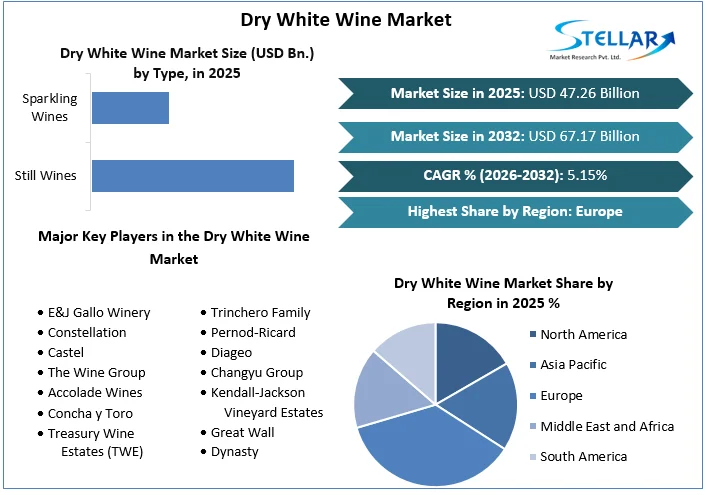
The Dry White Wine Market is experiencing steady growth as evolving consumer tastes, premiumization trends, and increasing interest in food pairing continue to strengthen global demand. Consumers are increasingly seeking crisp, refreshing, and aromatic wines that complement modern lifestyles and diverse cuisines. Dry white wines, known for their balanced acidity and low residual sugar content, have gained popularity among both experienced wine enthusiasts and younger consumers exploring premium alcoholic beverages.
The market is benefiting from rising disposable incomes, expanding wine tourism, and the growing availability of premium wine selections through retail stores, specialty wine shops, online platforms, and hospitality establishments. Producers are also responding to changing consumer expectations by introducing organic, vegan, and sustainably produced wines while investing in advanced vineyard management techniques and innovative packaging formats.
𝐃𝐨𝐰𝐧𝐥𝐨𝐚𝐝 𝐅𝐫𝐞𝐞 𝐏𝐃𝐅 𝐁𝐫𝐨𝐜𝐡𝐮𝐫𝐞: https://www.stellarmr.com/report/req_sample/Dry-White-Wine-Market/1507
Premiumization Continues to Shape Consumer Purchasing Decisions
One of the strongest growth drivers for the Dry White Wine Market is the global trend toward premium and super-premium wines. Consumers are increasingly prioritizing quality, authenticity, and regional heritage over volume, leading wineries to emphasize vineyard origin, grape variety, and production methods.
Premium dry white wines made from grape varieties such as Chardonnay, Sauvignon Blanc, Riesling, Pinot Grigio, Chenin Blanc, and Albariño continue to attract strong demand across restaurants, hotels, and specialty retailers. Limited-edition releases, estate-grown wines, and geographically protected appellations further enhance product value and consumer confidence.
Younger consumers, particularly millennials and Generation Z, are also demonstrating greater willingness to explore diverse wine styles, supporting product innovation and premium category expansion.
Rising Popularity of Food Pairing Culture
The increasing popularity of international cuisine and fine dining experiences has significantly contributed to market growth. Dry white wines are widely appreciated for their versatility, pairing well with seafood, poultry, salads, vegetarian dishes, and Mediterranean as well as Asian cuisines.
Restaurants, wine bars, and hospitality operators continue expanding curated wine menus to meet growing consumer interest in pairing beverages with specific culinary experiences. Wine education programs, tasting events, and digital wine recommendation platforms have further increased consumer awareness and purchasing confidence.
Home entertaining and casual dining trends have also encouraged consumers to purchase premium dry white wines for social gatherings and celebrations.
Sustainable Viticulture Gains Industry Momentum
Sustainability has become a major focus across the wine industry. Vineyard operators are increasingly implementing environmentally responsible practices such as water conservation, organic farming, biodiversity preservation, renewable energy utilization, and precision agriculture.
Consumers are showing growing preference for wines produced using sustainable and organic methods, prompting wineries to obtain environmental certifications and improve supply chain transparency. Lightweight glass bottles, recyclable packaging, and reduced carbon emissions throughout production and logistics are becoming important competitive differentiators.
Climate-smart viticulture practices are also helping producers adapt to changing weather patterns while maintaining grape quality and vineyard productivity.
Technology Enhances Vineyard Productivity
Technological advancements are transforming vineyard management and wine production. Precision agriculture tools, drones, satellite monitoring, weather forecasting systems, and artificial intelligence enable vineyard managers to optimize irrigation, monitor vine health, detect diseases early, and improve harvest timing.
Automation in wineries enhances fermentation control, quality monitoring, bottling efficiency, and inventory management while preserving product consistency. Digital traceability systems provide consumers with greater confidence regarding product origin, sustainability credentials, and production methods.
E-commerce platforms and direct-to-consumer sales channels are also expanding market reach by enabling wineries to connect with consumers more efficiently and personalize purchasing experiences.
Expanding Distribution Channels
Retail diversification continues to strengthen the Dry White Wine Market. Supermarkets, specialty liquor stores, wine boutiques, online retailers, and subscription wine clubs provide consumers with convenient access to a wide variety of domestic and imported wines.
The rapid growth of digital commerce has encouraged wineries to invest in online marketing, virtual wine tastings, and customer engagement initiatives. Direct-to-consumer distribution models enable producers to strengthen brand loyalty while offering exclusive product releases and personalized recommendations.
Duty-free retail, premium hospitality venues, and international tourism further contribute to global wine sales.
𝐀𝐜𝐜𝐞𝐬𝐬 𝐭𝐡𝐞 𝐂𝐨𝐦𝐩𝐥𝐞𝐭𝐞 𝐑𝐞𝐩𝐨𝐫𝐭: https://www.stellarmr.com/report/Dry-White-Wine-Market/1507
Regional Market Outlook
Europe remains the largest market for dry white wine, supported by centuries-old winemaking traditions, established wine cultures, and internationally recognized producing regions. Countries such as France, Italy, Germany, Spain, and Austria continue to lead production while maintaining strong domestic consumption and export performance.
North America represents another significant market, driven by growing premium wine consumption, expanding wine tourism, and increasing consumer interest in sustainable and organic wines. The United States remains one of the world’s largest wine-consuming markets, while Canada continues to witness rising demand for imported premium wines.
The Asia-Pacific region is expected to register the fastest growth during the forecast period. Rising disposable incomes, urbanization, expanding middle-class populations, and increasing exposure to Western dining cultures are driving wine consumption across China, Japan, South Korea, India, Australia, and Southeast Asia. Premium hospitality, luxury retail, and online wine platforms are supporting regional market expansion.
Latin America and the Middle East & Africa are gradually emerging as attractive markets as wine awareness increases and premium alcoholic beverage consumption continues to diversify.
Competitive Landscape
The Dry White Wine Market remains highly competitive, with global wineries and regional producers focusing on premium product portfolios, vineyard expansion, sustainable production, and international market penetration. Companies are investing in organic vineyards, climate-resilient grape varieties, advanced winemaking technologies, and innovative packaging to differentiate their offerings.
Strategic acquisitions, distribution partnerships, and expansion into emerging wine-consuming regions continue to strengthen competitive positioning. Many producers are leveraging digital marketing, wine tourism, and direct-to-consumer sales channels to enhance customer engagement and brand recognition.
Research and development efforts are also focused on improving grape quality, enhancing flavor profiles, and reducing environmental impact across the production process.
Future Outlook
The future of the Dry White Wine Market remains promising as premiumization, sustainability, and evolving consumer lifestyles continue to reshape global demand. Advances in vineyard technology, environmentally responsible production practices, expanding online retail channels, and increasing appreciation for premium wine experiences are expected to support long-term market growth.
Manufacturers that invest in sustainable viticulture, product innovation, premium branding, and digital consumer engagement will be well positioned to capitalize on changing market dynamics. As consumers increasingly seek authentic, high-quality, and environmentally responsible wine products, dry white wine is expected to remain a key segment within the global alcoholic beverage industry throughout the coming years.
About Stellar Market Research:
Stellar Market Research is a multifaceted market research and consulting company with professionals from several industries. Some industries we cover include medical devices, pharmaceutical manufacturers, science and engineering, electronic components, industrial equipment, technology and communication, cars and automobiles, chemical products and substances, general merchandise, beverages, personal care, and automated systems.
Contact Stellar Market Research:
Stellar Market Research
Address: Phase 3, Navale IT Zone, S.No. 51/2A/2, Office No. 202, 2nd floor, Near, Navale Brg, Narhe, Pune, Maharashtra 411041
Website: http://stellarmr.com/
Email: sales@stellarmr.com
Mobile: +91 9607365656
