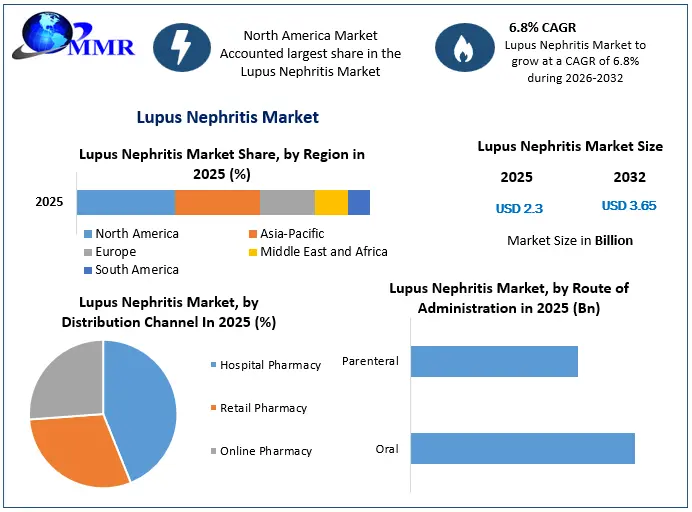
Healthcare providers and pharmaceutical executives are confronting a massive clinical gap where traditional immunosuppressive therapies are failing to halt long-term renal deterioration in lupus nephritis patients. With the Global Lupus Nephritis Market projected to expand from USD 2.3 billion in 2025 to USD 3.65 billion by 2032, the shift from blunt-force immunosuppression to targeted, precision-based biologic interventions is no longer elective—it is a competitive necessity.
The stakes for payers and hospital systems are clear: failure to adopt these emerging, more effective therapies results in higher long-term costs associated with end-stage renal disease (ESRD) and repeated hospitalizations. The move toward specialized biologics and monoclonal antibodies represents a fundamental decoupling of disease management from chronic decline, signaling a transition toward value-based, outcome-oriented care.
Why This Matters Now
Lupus nephritis—a severe kidney manifestation of systemic lupus erythematosus (SLE)—demands immediate, precise intervention to prevent irreversible organ damage. With five out of every ten kidney-affected patients presenting with lupus-related complications, the disease burden on hospital infrastructure is immense. Current market trends indicate that standard-of-care treatments, while historically necessary, carry a high metabolic and systemic cost burden, including increased infection risk and long-term morbidity. The arrival of next-generation monoclonal antibodies, such as the FDA-approved obinutuzumab, transforms the narrative from symptom suppression to disease modification.
Market Overview
The lupus nephritis market is undergoing a rapid maturation phase. While valued at USD 2.3 billion in 2025, the forecasted steady CAGR of 6.8% through 2032 illustrates a sector fueled by high unmet medical needs and a surge in clinical trial activity. The market structure is shifting toward high-efficacy biologics that target B-cell activation, moving beyond the legacy reliance on broad-spectrum corticosteroids. This trajectory suggests that drug developers focusing on high-precision mechanisms will capture significant market share as clinicians prioritize therapies that prevent progression to end-stage renal disease.
Key Trends Driving Growth
Precision Therapeutics: The adoption of monoclonal antibodies and small molecules signifies a move toward molecular-level control of the autoimmune response, rather than systemic immunosuppression.
Rising Clinical Awareness: Improved diagnostic frameworks are accelerating the identification of patients, particularly in high-prevalence regions like North America and Southern Europe, ensuring that treatment is initiated before irreparable kidney damage occurs.
Government-Led Infrastructure: Increased R&D funding from major economies, including China and the United States, is accelerating the movement of pipeline assets into late-stage clinical trials.
Targeted B-Cell Depletion: Advanced pharmacological agents are focusing on selective B-cell modulation, offering a higher efficacy profile for patients with proliferative lupus nephritis.
𝐃𝐨𝐰𝐧𝐥𝐨𝐚𝐝 𝐏𝐃𝐅 𝐁𝐫𝐨𝐜𝐡𝐮𝐫𝐞 @https://www.maximizemarketresearch.com/request-sample/187839/
Segment Insights
Drug Class Trends: While corticosteroids remain a standard, their market dominance is waning in favor of next-generation biologics like Belimumab and anti-CD20 monoclonal antibodies. These agents are specifically designed to reduce the reliance on toxic steroid dosages.
Dominant Segment: Hospitals currently serve as the primary distribution channel. Given the complexity of administration and the necessity for continuous clinical monitoring, hospital pharmacies command the largest share of drug fulfillment.
Fastest-Growing Segment: Biologic-based therapies represent the fastest-growing drug class. Their ability to deliver targeted immune suppression with a more favorable toxicity profile compared to traditional agents is driving rapid adoption in clinical practice.
Regional Growth Story
North America remains the dominant regional market, anchored by robust healthcare spending, sophisticated drug storage facilities, and an established patient registry for SLE and lupus nephritis. Europe follows as a major market, with strong regulatory pathways and significant clinical adoption in the UK and Germany. Meanwhile, Asia Pacific is the fastest-emerging theater of growth. India and China are scaling their R&D investments, fueled by a massive, high-unmet-need patient population and an aggressive push to localize advanced therapeutic production.
Competitive Landscape
The competitive environment is aggressive, moving from generic immunosuppressive landscapes to high-barrier-to-entry biologic domains. Major players are leveraging clinical trial outcomes to differentiate their offerings in a crowded market. Recent approvals, such as the FDA’s green light for obinutuzumab in 2025, signal a clear trend toward rewarding therapies that offer definitive disease depletion. For smaller biotech players, the path to market share lies in strategic partnerships with established pharma giants that possess the global infrastructure to scale distribution.
Recent Developments
Regulatory Milestone: The U.S. FDA’s approval of Gazyva (obinutuzumab) for active lupus nephritis sets a new benchmark for B-cell depletion therapy in patients undergoing standard immunosuppressive care.
Advanced Clinical Research: Companies like Fate Therapeutics are making headway with off-the-shelf therapeutic candidates, broadening the horizon beyond currently approved antibody treatments.
Strategic R&D Investment: Major pharma entities are increasing capital allocation for small-molecule inhibitors, aiming to address patient groups that fail to respond to traditional B-cell targeted therapies.
Strategic Implications
The economics of lupus nephritis management are changing. Healthcare providers must now align their procurement strategies with clinical outcomes rather than just initial drug costs. For biotech and pharma, the emphasis must shift toward demonstrating long-term renal preservation to secure reimbursement in a value-based care model. Facilities that fail to integrate these targeted therapies will find themselves managing the skyrocketing costs of dialysis and kidney transplant, which remain significantly more expensive than advanced pharmacological intervention.
Future Outlook
The market’s trajectory toward USD 3.65 billion will be defined by the successful integration of precision diagnostics and personalized biologic treatments, separating the high-performing innovators who stop organ failure from the legacy providers content with simple symptom suppression.
Analyst Perspective “The lupus nephritis market is no longer just about managing an autoimmune condition; it is about aggressively preserving renal function through high-precision biologic targeting. As we look toward 2032, companies that can prove durable, long-term disease modification—rather than temporary symptom relief—will command the market and set the standard for renal care.” — Komal Patil, Lead Analyst at Maximize Market Research.
About Maximize Market Research
Maximize Market Research Pvt. Ltd. (MMR) is a global market research and consulting company that provides reliable, data-focused, and practical business insights. The firm serves a wide range of industries, including healthcare, pharmaceuticals, technology, automotive, electronics, chemicals, personal care, and consumer goods. Through market forecasts, competitive analysis, strategic consulting, and industry impact assessments, MMR helps organizations understand changing market conditions, identify growth opportunities, and make informed business decisions for long-term success.
2nd Floor, Navale IT Park Phase 3
Pune Banglore Highway, Narhe
Pune, Maharashtra 411041, India
+91 9607365656
sales@maximizemarketresearch.com
