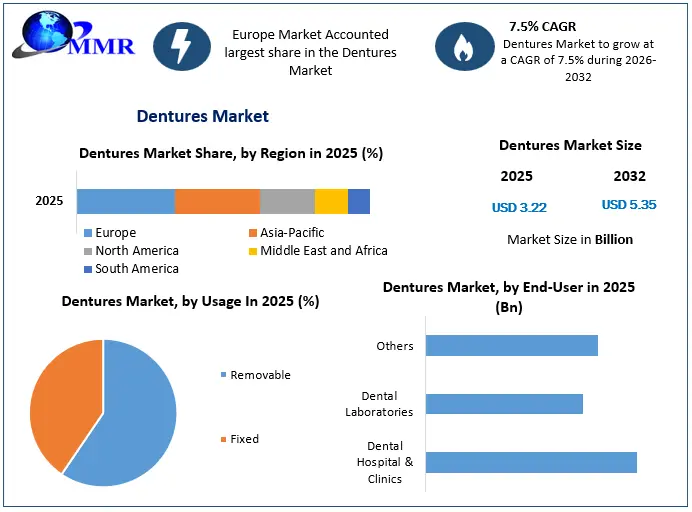
Healthcare providers and dental practice executives are facing a critical inflection point where the traditional “one-size-fits-all” denture model is failing to meet the expectations of an increasingly demanding, tech-savvy aging population. With the Global Dentures Market projected to surge from USD 3.22 billion in 2025 to USD 5.35 billion by 2032 at a CAGR of 7.5%, the industry is transitioning from a commodity-based supply model to a high-precision, digitized restorative ecosystem.
The economic reality is clear: failure to adopt digital workflows and high-performance materials in denture production results in prolonged treatment cycles and lower patient satisfaction, directly impacting clinical margins. For dental clinics and hospitals, the mandate is to pivot toward customized, durable, and aesthetically superior prosthetics that align with the high-growth expectations of a global demographic that views oral health as a fundamental component of quality-of-life, not merely a clinical necessity.
Why This Matters Now
The intersection of a rapidly aging global population and rising awareness of cosmetic dentistry has created a sustained, permanent demand for restorative prosthetics. Tooth loss, driven by periodontal disease, decay, and environmental factors, no longer signals a decline into functional impairment; patients now demand solutions that mimic the look and feel of natural teeth. As restorative options become more accessible through digital transformation, providers who maintain antiquated manual workflows risk being marginalized by clinics capable of delivering high-quality, chair-side, or lab-integrated digitized denture suites.
Market Overview
The dentures market is undergoing a structural shift toward automation. Valued at USD 3.22 billion in 2025, the sector’s 7.5% growth trajectory through 2032 is fueled by the widespread adoption of CAD/CAM and 3D printing technologies. These innovations have bridged the gap between expensive implants and traditional manual prosthetics, creating a “middle-market” of high-performance, cost-effective solutions. As manufacturers standardize these digital workflows, they are effectively lowering the barrier to entry for clinics, making high-end restorative care viable for a broader, cost-conscious patient base.
Key Trends Driving Growth
Digital Transformation: The shift from conventional molding to 3D-printed additive manufacturing and CAD/CAM milling is reducing production time while increasing the precision and durability of final prosthetics.
Aesthetic Prioritization: Millennials and Gen X, now entering middle age, are driving demand for prosthetics that prioritize natural color-matching and gum-integration, shifting the market away from generic, “one-look” solutions.
Geriatric Longevity: As life expectancy increases, the cumulative medical impact of long-term edentulism is driving stronger clinical guidelines for early, high-quality intervention to prevent secondary health issues.
Economic Accessibility: Technological efficiencies are enabling providers to deliver high-quality dentures at price points compatible with broader insurance and reimbursement frameworks, including Medicaid and similar public health programs.
𝐃𝐨𝐰𝐧𝐥𝐨𝐚𝐝 𝐏𝐃𝐅 𝐁𝐫𝐨𝐜𝐡𝐮𝐫𝐞 @https://www.maximizemarketresearch.com/request-sample/167397/
Segment Insights
Dominant Segment: Complete dentures currently command the largest market share, serving as the primary restorative solution for the elderly.
Fastest-Growing Segment: Fixed dentures—including implant-supported overdentures—are exhibiting the most rapid growth, as patients increasingly prefer the stability and comfort of fixed solutions over traditional removable options.
Material Shift: While acrylic resins remain the industry standard for their balance of cost and aesthetics, 3D-printed photopolymers are the fastest-advancing material category, promising superior fit and long-term structural integrity.
Regional Growth Story
North America and Europe retain the largest share of the market, anchored by robust healthcare infrastructure and high disposable income levels that fuel cosmetic and restorative dentistry. However, the Asia-Pacific region is emerging as the fastest-growing theater for market expansion. Rapidly increasing healthcare spending, a growing geriatric cohort in countries like Japan, China, and India, and a surge in medical tourism are positioning the region as a primary driver of long-term global revenue.
Competitive Landscape
The competitive landscape is transitioning from fragmented local laboratories to consolidated, tech-enabled dental networks. Established players are aggressively acquiring niche CAD/CAM developers and digital platform providers to create closed-loop production systems. For dental practices, this means that competitive differentiation is no longer found in the prosthetics alone, but in the efficiency and clinical precision of the technology stack utilized to deliver them.
Recent Developments
Digital Workflow Integration: Leading players have launched “two-visit” denture solutions that leverage intraoral scanning to replace labor-intensive manual impressions, drastically improving patient comfort and turnaround speed.
Monolithic Milling: The introduction of single-disc milling solutions that combine high-quality tooth and base materials into one monolithic piece has improved the structural durability of fixed denture hybrids.
Strategic Consolidation: Global dental chains are partnering with biotech-focused startups to create proprietary, AI-driven diagnostic platforms that ensure precise prosthetic fit on the first attempt.
Strategic Implications
The path to 2032 requires a rigorous focus on operational efficiency. Dental hospitals and clinics must treat denture production as a data-driven process rather than an artisanal one. For investors and stakeholders, the value proposition lies in the technology companies that control the software and material supply chain. Practices that fail to integrate these digital systems will see their margins compressed by the high cost of manual labor and the rising patient expectation for “same-day” or “low-visit” restorative success.
Future Outlook
The coming seven years will decisively favor clinics that scale digital restorative technology, while those anchored in manual legacy fabrication will struggle to compete on cost, quality, and clinical speed.
Analyst Perspective “The dentures market is being redefined by digital precision and the patient’s demand for life-like performance. As we approach 2032, the winners will be those who harness 3D printing and CAD/CAM to transform a historically slow restorative process into a rapid, high-margin, and highly accurate patient experience.” — Komal Patil, Lead Analyst at Maximize Market Research.
About Maximize Market Research
Maximize Market Research Pvt. Ltd. (MMR) is a global market research and consulting company that provides reliable, data-focused, and practical business insights. The firm serves a wide range of industries, including healthcare, pharmaceuticals, technology, automotive, electronics, chemicals, personal care, and consumer goods. Through market forecasts, competitive analysis, strategic consulting, and industry impact assessments, MMR helps organizations understand changing market conditions, identify growth opportunities, and make informed business decisions for long-term success.
2nd Floor, Navale IT Park Phase 3
Pune Banglore Highway, Narhe
Pune, Maharashtra 411041, India
+91 9607365656
sales@maximizemarketresearch.com
