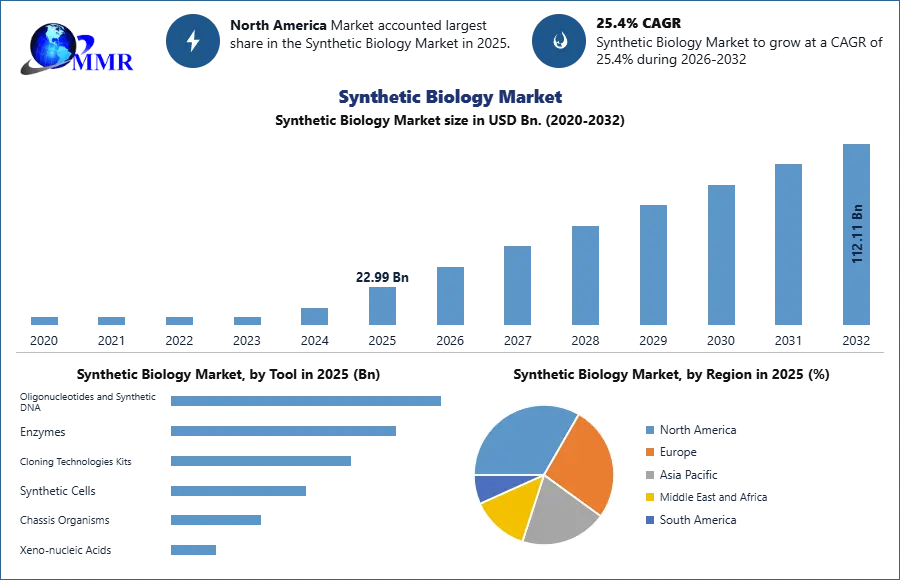
Healthcare providers and pharmaceutical executives are confronting a definitive shift in the drug discovery paradigm where traditional chemical synthesis is increasingly yielding to biological engineering. With the Global Synthetic Biology Market projected to surge from USD 22.99 billion in 2025 to USD 112.11 billion by 2032—expanding at a rapid 25.4% CAGR—the industry is transitioning from experimental research to a foundational engine for commercial biomanufacturing.
The economic mandate is clear: organizations that master the design-build-test-learn (DBTL) cycle at scale will define the next generation of therapeutic and industrial applications. For investors, payers, and biotech leaders, the current acceleration represents the end of the “bespoke” era in genetic engineering and the beginning of a high-throughput, AI-integrated commercial reality.
Why This Matters Now
The current pressure on healthcare systems to reduce drug development timelines and costs has moved synthetic biology from the laboratory bench to the boardroom. By utilizing engineered biological systems to manufacture complex molecules—ranging from novel biologics and personalized cell therapies to high-value specialty chemicals—firms are bypassing the inefficiencies of legacy synthesis. As government and private R&D funding continues to consolidate around these programmable platforms, early adopters are securing a massive competitive advantage in therapeutic discovery and sustainable manufacturing.
Market Overview
Synthetic biology represents the convergence of engineering principles with biological systems to create functional, predictable outputs. Valued at USD 22.99 billion in 2025, the market is scaling rapidly as AI-driven bioinformatics and automated genome engineering tools lower the barrier to entry. This growth trajectory is fueled by the sector’s ability to solve previously “un-druggable” biological targets and create carbon-efficient production methods for everything from vaccines to bio-based materials.
Key Trends Driving Growth
AI-Integrated Bio-design: Artificial intelligence and cloud-based modeling tools are drastically shortening development cycles by predicting genetic outcomes before a single culture is grown, shifting the industry from trial-and-error to data-driven design.
Precision Medicine Pipeline: Synthetic biology is becoming the backbone of personalized medicine, enabling the creation of precise, target-specific cell therapies that address complex diseases like cancer and autoimmune disorders.
Sustainable Biomanufacturing: Industries are increasingly pivoting to biological “cell factories” to produce materials and chemicals, driven by global ESG mandates and the need for resilient, non-petroleum-based supply chains.
Regulatory Maturation: As therapeutic applications of engineered organisms grow, regulatory frameworks are evolving to provide clearer pathways for approval, reducing the risk of multi-year development stalls.
𝐃𝐨𝐰𝐧𝐥𝐨𝐚𝐝 𝐏𝐃𝐅 𝐁𝐫𝐨𝐜𝐡𝐮𝐫𝐞 @https://www.maximizemarketresearch.com/request-sample/616/
Segment Insights
Dominant Segment: Pharmaceuticals and drug discovery currently lead market adoption. The ability of synthetic biology to optimize expression systems and accelerate lead molecule identification makes it indispensable for modern pharma pipelines.
Fastest-Growing Segment: Genome engineering technologies represent the fastest-growing frontier. Driven by advanced CRISPR-Cas systems and novel nucleases, this segment enables the precise editing of complex genomes, opening doors to curative gene therapies that were once theoretically impossible.
Enabling Products: Tools like synthetic DNA, oligonucleotide pools, and engineered enzymes continue to form the critical infrastructure that allows broader commercial adoption across diverse sectors.
Regional Growth Story
North America currently maintains the lead with roughly 40% of the global market, underpinned by deep capital reserves, a dense network of biotech innovation hubs, and favorable government initiatives that encourage aggressive R&D investment. Europe follows with a strong focus on regulatory-compliant biomanufacturing. However, the Asia Pacific region is expected to show the most aggressive expansion as China and India ramp up state-sponsored investment in synthetic biology infrastructure to localize advanced therapeutic production.
Competitive Landscape
The market is shifting from fragmented academic spinoffs to a field dominated by large-scale platforms. Strategic positioning now relies on controlling the full stack—from proprietary DNA synthesis libraries to automated biomanufacturing facilities. Recent market activity, such as massive investments in platform-based startups, signals that investors are prioritizing companies with scalable tech stacks over those with single-product pipelines. Success will accrue to firms that can commoditize the underlying engineering process, effectively becoming the “foundries” for the next century of medicine.
Recent Developments
Platform Expansion: Industry leaders are scaling cloud-based bio-design software to provide on-demand access to genetic modeling, drastically lowering the R&D hurdle for emerging biotech firms.
Therapeutic Breakthroughs: Ongoing clinical trials utilizing synthetic cells and optimized gene expression systems are demonstrating higher efficacy in treating previously refractory genetic disorders.
Strategic R&D Funding: A 22% increase in health science R&D investment between 2023 and 2024 has catalyzed a surge in new venture formation, specifically in the fields of synthetic genomics and metabolic pathway engineering.
Strategic Implications
The shift toward a USD 112.11 billion market forces a fundamental re-evaluation of current capital allocation. Hospital networks must prepare for a future defined by personalized, bio-manufactured therapies that will replace bulk chemical drugs. For pharma and biotech, the mandate is to move away from internal, siloed research toward open-platform collaborations. Those who fail to integrate automated bio-foundries into their development workflow will face unsustainable R&D costs and significantly slower speeds-to-market.
Future Outlook
The next seven years will separate the biological pioneers—who commoditize genetic design to unlock unprecedented therapeutic value—from the legacy players who struggle to remain relevant in a world where biology is the primary manufacturing engine.
Analyst Perspective
“Synthetic biology is no longer an emerging science; it is the infrastructure for a new industrial age. As we look to 2032, the firms that master the intersection of high-fidelity genome engineering and AI-driven predictive modeling will not just participate in the market—they will dictate the direction of global healthcare.” — Komal Patil, Lead Analyst at Maximize Market Research.
About Maximize Market Research
Maximize Market Research Pvt. Ltd. (MMR) is a global market research and consulting company that provides reliable, data-focused, and practical business insights. The firm serves a wide range of industries, including healthcare, pharmaceuticals, technology, automotive, electronics, chemicals, personal care, and consumer goods. Through market forecasts, competitive analysis, strategic consulting, and industry impact assessments, MMR helps organizations understand changing market conditions, identify growth opportunities, and make informed business decisions for long-term success.
2nd Floor, Navale IT Park Phase 3
Pune Banglore Highway, Narhe
Pune, Maharashtra 411041, India
+91 9607365656
sales@maximizemarketresearch.com
