The transition from traditional small-molecule drugs to Advanced Therapy Medicinal Products (ATMPs) represents the most significant structural change in pharmaceutical history. For healthcare providers, payers, and biotech investors, this shift mandates a complete realignment of clinical infrastructure and reimbursement models to accommodate treatments that fundamentally alter patient biology.
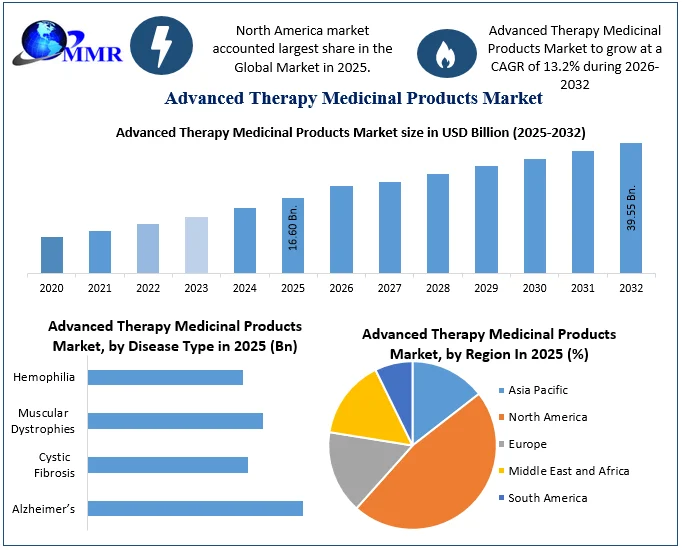
Valued at USD 16.60 billion in 2025, the global Advanced Therapy Medicinal Products Market is projected to reach USD 39.55 billion by 2032, expanding at a CAGR of 13.2%. This growth is not driven by incremental innovation, but by the commercialization of curative therapies for once-intractable genetic disorders and oncological conditions. Stakeholders who fail to adapt to the complexity of cell and gene therapy logistics will be excluded from a market that is rapidly becoming the gold standard for high-value patient care.
Why This Matters Now
The rise of ATMPs—including gene therapies, tissue-engineered products, and somatic-cell therapies—requires a move away from centralized, mass-production models. Because these therapies often rely on patient-specific genetic material, the “product” is inextricably linked to the “logistics chain.” Healthcare systems are now forced to integrate hospital pharmacies into the direct delivery loop, as these facilities currently command a 53% revenue share of the ATMP market. For investors, this creates new entry points in cold-chain logistics, decentralized manufacturing, and Contract Development and Manufacturing Organizations (CDMOs).
Market Overview
The ATMP market has reached a maturity point where successful clinical trial outcomes are translating into commercial authorizations. The efficacy of pioneer products like Kymriah and Zolgensma has set a new benchmark, forcing regulatory agencies and manufacturers to streamline the path from clinical development to patient administration. This industrialization process—moving from university-based bench research to full-scale commercial manufacturing—is the primary driver of the current revenue acceleration.
Key Trends Driving Growth
The CDMO Dependency: As the complexity of manufacturing increases, biotech developers are increasingly outsourcing production to specialized CDMOs to manage capacity, regulatory compliance, and safety standards.
Decentralized Delivery: The growth of retail and online pharmacies, alongside hospital-based administration, is expanding the accessibility of less complex ATMPs, broadening the patient base beyond specialized research centers.
Financial Innovation: Large-cap pharmaceutical companies are bypassing traditional R&D lag by acquiring CAR T-cell therapy developers, signaling a market preference for inorganic growth and platform-based IP acquisition.
𝐃𝐨𝐰𝐧𝐥𝐨𝐚𝐝 𝐏𝐃𝐅 𝐁𝐫𝐨𝐜𝐡𝐮𝐫𝐞 @https://www.maximizemarketresearch.com/request-sample/119588/
Segment Insights
Dominant Segment (Therapy Type): Tissue-Engineered Products. Holding a 39.0% revenue share, this segment remains the bedrock of functional recovery therapies. Ongoing R&D in 4D biomaterials and hydrogels ensures this segment maintains its leadership position in regenerative medicine.
Fastest-Growing Segment (Therapy Type): CAR-T Cell Therapy. Driven by high clinical success in hematological malignancies, this sector is scaling globally, with major players like Novartis and Gilead aggressively expanding commercial licenses across new jurisdictions.
Regional Growth Story
North America currently commands a 49% revenue share, largely due to its concentrated investment in clinical trials and a regulatory environment that incentivizes high-risk, high-reward innovation. However, the Asia-Pacific region is emerging as the critical engine for future manufacturing capacity, with Japan, China, and South Korea rapidly scaling their domestic ATMP production capabilities. Europe holds the second-largest share, anchored by a long-standing research tradition that continues to produce breakthrough gene therapy assets.
Competitive Landscape
The market is shifting from “trial-heavy” to “commercial-heavy” competitive positioning. Recent M&A activity underscores a strategic pivot toward RNA-based platforms and specialized cell therapy pipelines. Acquisitions are not just defensive—they are structural attempts to own the entire manufacturing and delivery lifecycle of curative medicines. Players who control the intellectual property alongside the specialized manufacturing infrastructure will dominate the coming decade.
Recent Developments
Eli Lilly and Company (February 2026): Acquired Orna Therapeutics, integrating proprietary RNA-based ATMP platforms to secure a pipeline for complex genetic and oncological disorders.
FUJIFILM Diosynth Biotechnologies (February 2026): Expanded UK manufacturing facilities to accelerate the transition from clinical trials to commercial-scale biologics, directly addressing industry-wide supply constraints.
Fondazione Telethon (May 2025): Secured dual FDA/EMA approval for Waskyra (etuvetidigene autotemcel), proving that non-profit models can successfully navigate the full commercial path for rare disease gene therapies.
Celyad Oncology (February 2026): Divested specialized catheter IP to refocus capital and research intensity on its core cell therapy pipeline, ensuring a longer operational runway for next-gen innovation.
Strategic Implications
The economic model for ATMPs is moving from “volume-based” to “value-based” reimbursement. As these therapies command premium prices, payers are demanding higher evidence thresholds for clinical outcomes. Providers and developers must prioritize digital health and AI integration to track long-term patient data, which will serve as the primary evidence for reimbursement negotiations. The future of the industry depends on the ability to translate technical laboratory success into consistent, replicable clinical administration.
Future Outlook
The transition toward scalable, personalized cell and gene therapies is irrevocable, and the winners will be those who master the delicate balance between high-cost innovation and manufacturing efficiency. Market laggards will be those who rely on legacy drug-delivery models and fail to invest in the specialized cold-chain and clinical infrastructure required for the ATMP era.
Analyst Perspective
“The ATMP market is rapidly maturing from a field of isolated successes to a cornerstone of modern medicine,” says Komal Patil, Senior Analyst at Maximize Market Research. “The focus has shifted from whether these therapies can work to how quickly we can manufacture and deliver them at scale to a global patient population.”
About Maximize Market Research
Maximize Market Research Pvt. Ltd. (MMR) is a global market research and consulting company that provides reliable, data-focused, and practical business insights. The firm serves a wide range of industries, including healthcare, pharmaceuticals, technology, automotive, electronics, chemicals, personal care, and consumer goods. Through market forecasts, competitive analysis, strategic consulting, and industry impact assessments, MMR helps organizations understand changing market conditions, identify growth opportunities, and make informed business decisions for long-term success.
2nd Floor, Navale IT Park Phase 3
Pune Banglore Highway, Narhe
Pune, Maharashtra 411041, India
+91 9607365656
sales@maximizemarketresearch.com
