The traditional reliance on two-dimensional cell cultures is rapidly becoming a high-risk liability for pharmaceutical and biotechnology companies. As drug development costs soar and failure rates in late-stage clinical trials persist, the shift toward 3D cell culture models is no longer an academic pursuit—it is an economic necessity for any firm prioritizing speed-to-market and predictive accuracy.
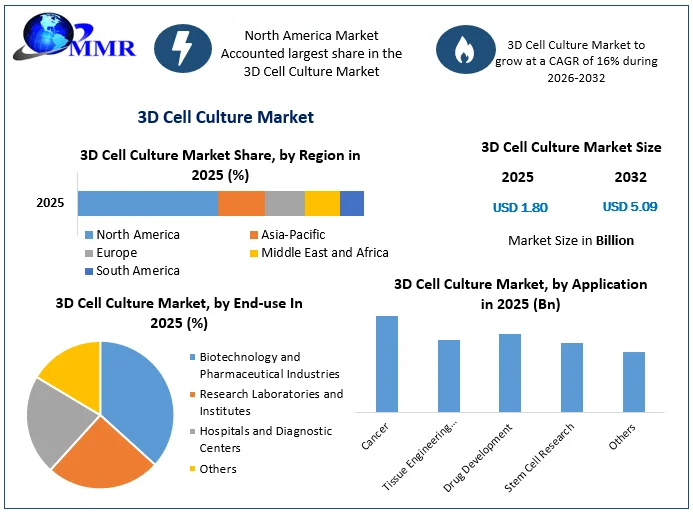
Valued at USD 1.80 billion in 2025, the global 3D Cell Culture Market is projected to expand at a CAGR of 16%, reaching USD 5.09 billion by 2032. This trajectory reflects a fundamental change in how industry leaders approach oncology, regenerative medicine, and toxicology. By moving away from flat, monolayer models that lack physiological complexity, the sector is embracing 3D platforms that offer more reliable insights into human biology, effectively de-risking the development of next-generation therapies.
Why This Matters Now
The cost of bringing a single drug to market is prohibitive, with late-stage attrition often driven by poor clinical translation from traditional in vitro models. 3D cell culture systems provide a more accurate representation of the tumor microenvironment and tissue structure, bridging the gap between bench-top research and human response. For biotech and pharma boards, adopting these systems is a strategic hedge against diagnostic errors and development stagnation, ensuring that preclinical investments lead to successful clinical outcomes.
Market Overview
The 3D cell culture industry is defined by the move from descriptive biology to functional modeling. Systems such as organoids, spheroids, and microfluidic “organ-on-a-chip” platforms enable researchers to simulate real-world drug interactions with unprecedented detail. As the market evolves, the integration of automation, AI-driven image analysis, and standardized bioreactors is transforming the laboratory from a manual environment into a high-throughput, data-rich diagnostic ecosystem.
Key Trends Driving Growth
The Predictive Mandate: Increased demand for physiologically relevant models is forcing the industry to abandon outdated animal testing methods, which are often poor predictors of human efficacy.
Automation and AI Integration: Scaling 3D models requires consistent, reproducible data. The incorporation of AI for real-time monitoring and liquid handling robotics for HTS (High-Throughput Screening) is removing the scalability bottlenecks that previously hindered 3D culture adoption.
Precision Medicine Expansion: As personalized therapy gains momentum, the ability to derive tumor organoids from individual patients to test drug sensitivity is revolutionizing oncology treatment strategies.
𝐃𝐨𝐰𝐧𝐥𝐨𝐚𝐝 𝐏𝐃𝐅 𝐁𝐫𝐨𝐜𝐡𝐮𝐫𝐞 @https://www.maximizemarketresearch.com/request-sample/337/
Segment Insights
Dominant Segment (Technology): Scaffold-based platforms. These remain the bedrock of the market, as they provide the structural extracellular matrix mimicry essential for long-term cell viability and morphological control.
Fastest-Growing Segment (Application): Cancer research. Driven by the urgent need for personalized oncology models and high-throughput drug screening, this segment leads the push for human-derived organoid adoption.
Regional Growth Story
North America maintains a dominant position, supported by a dense ecosystem of established biotech giants and heavy investment in preclinical R&D. However, the Asia-Pacific region is emerging as the fastest-growing hub. Rising government funding in biomedical science and an aggressive push to build robust biopharmaceutical infrastructures are positioning countries like China, Japan, and South Korea as major contributors to the next phase of 3D cell culture innovation.
Competitive Landscape
The market is shifting from fragmented, modular offerings to comprehensive, turnkey solutions. Leading firms are no longer just selling reagents or scaffolds; they are providing end-to-end platforms that integrate imaging, automation, and data analytics. Success is increasingly tied to the ability to provide standardized, validated models that meet the rigorous requirements of global regulatory bodies, effectively replacing the need for bespoke, difficult-to-replicate research protocols.
Recent Developments
REPROCELL (March 2026): Launched the BioThrust ComfyCell Incu bioreactor, designed to scale the production of sensitive cells like iPSCs and T cells, targeting the growing need for scalable regenerative medicine solutions.
Thermo Fisher Scientific (April 2025): Inaugurated its Advanced Therapies Collaboration Center in California to provide end-to-end manufacturing workflows, bridging the gap between research-scale 3D models and commercial production.
Fluidic Sciences (September 2025): Acquired Sphere Bio, creating an integrated suite for protein interaction discovery, signaling a consolidation trend aimed at faster, more precise drug target identification.
Strategic Implications
For investors and pharmaceutical executives, the primary hurdle to 3D culture adoption—high capital intensity and technical complexity—is being mitigated by the emergence of “as-a-service” models and standardized high-throughput platforms. The shift toward animal component-free (ACF) media and standardized bioreactor systems is further lowering the barrier to entry for smaller labs. Organizations that prioritize internalizing these technologies now will gain a decisive advantage in target validation accuracy and preclinical cycle times.
Future Outlook
The transition toward complex, human-mimetic 3D models is an irreversible step in the modernization of pharmaceutical research. The firms that successfully master the integration of AI-driven analytics with scalable 3D tissue models will define the next decade of therapeutic success, while those tethered to traditional 2D models will struggle with rising costs and diminished pipeline efficacy.
Analyst Perspective
“The move to 3D cell culture is a watershed moment for the life sciences sector,” says Komal Patil, Senior Analyst at Maximize Market Research. “We are moving from an era of approximation to an era of high-fidelity biological modeling, where the data generated in the lab will finally match the complexity of the patient.”
About Maximize Market Research
Maximize Market Research Pvt. Ltd. (MMR) is a global market research and consulting company that provides reliable, data-focused, and practical business insights. The firm serves a wide range of industries, including healthcare, pharmaceuticals, technology, automotive, electronics, chemicals, personal care, and consumer goods. Through market forecasts, competitive analysis, strategic consulting, and industry impact assessments, MMR helps organizations understand changing market conditions, identify growth opportunities, and make informed business decisions for long-term success.
2nd Floor, Navale IT Park Phase 3
Pune Banglore Highway, Narhe
Pune, Maharashtra 411041, India
+91 9607365656
sales@maximizemarketresearch.com
