Key Highlights
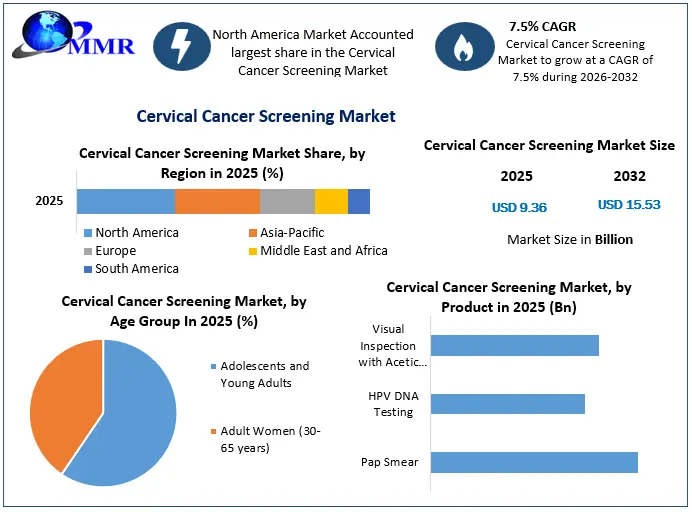
- The Cervical Cancer Screening Market was valued at USD 9.36 Billion in 2025 and is projected to reach USD 15.53 Billion by 2032, growing at a 7.5% CAGR.
- Rising cervical cancer incidence continues to expand demand for organized screening programs and earlier diagnosis.
- HPV DNA testing, AI-assisted diagnostics, and home-based screening are reshaping preventive care delivery.
- Governments are strengthening reimbursement policies and national screening initiatives to improve participation rates.
- Hospitals, diagnostic laboratories, and biotechnology companies are investing in faster, more accurate screening technologies.
Why This Matters Now
Healthcare systems are moving from treating advanced cervical cancer to preventing it through earlier detection. That shift changes where healthcare spending flows—from oncology treatment toward diagnostics, screening infrastructure, laboratory automation, and digital pathology.
For investors, healthcare providers, diagnostic manufacturers, and policymakers, screening capacity has become a strategic priority. Better detection improves patient outcomes while lowering long-term treatment costs, making preventive diagnostics an increasingly attractive healthcare investment.
Market Overview
The Cervical Cancer Screening Market is entering a period of sustained expansion as governments, hospital networks, and diagnostic companies intensify efforts to detect disease before invasive cancer develops. According to Maximize Market Research, the market was valued at USD 9.36 Billion in 2025 and is expected to reach USD 15.53 Billion by 2032, registering a CAGR of 7.5% during the forecast period.
The business case has strengthened considerably. Screening reduces expensive late-stage cancer treatment while improving survival rates through earlier intervention. As healthcare systems increasingly emphasize value-based care, preventive diagnostics are receiving greater funding, reimbursement support, and clinical adoption.
Growing awareness of HPV infection as the primary risk factor for cervical cancer continues to increase participation in screening programs. At the same time, molecular diagnostics, automated laboratory workflows, and digital pathology are improving test accuracy and operational efficiency.
Key Trends Driving Growth
Healthcare providers are steadily transitioning from conventional cytology toward HPV DNA testing and more advanced molecular diagnostics. These technologies improve sensitivity while supporting risk-based patient management and follow-up.
Artificial intelligence is becoming an important commercial differentiator. AI-assisted image analysis helps laboratories improve consistency, reduce manual workloads, and accelerate clinical decision-making. For diagnostic companies, AI integration creates opportunities to strengthen product portfolios while expanding recurring software and analytics revenue.
Home-based testing kits are emerging as another important growth opportunity. They can improve participation among women who face geographical, economic, or social barriers to traditional hospital-based screening, potentially increasing national screening coverage.
Precision medicine is also influencing screening strategies. More accurate identification of high-risk HPV infections enables clinicians to personalize follow-up intervals and treatment decisions, improving both clinical outcomes and healthcare resource allocation.
Government-supported awareness campaigns continue to expand patient participation. These initiatives help reduce diagnosis delays while increasing demand for laboratory services, diagnostic equipment, and molecular testing platforms.
Get a free sample:https://www.maximizemarketresearch.com/request-sample/31390/
Segment Insights
- Dominant Segment: Pap Smear remains the leading product segment due to its long-established clinical acceptance, broad availability, and integration into national screening programs.
- Fastest-Growing Segment: The MMR report identifies Home-Based Testing Kits within screening methods as an emerging high-growth opportunity driven by accessibility and patient convenience.
- Hospitals and clinics continue serving as primary screening providers because of integrated diagnostic capabilities.
- Diagnostic centers continue expanding capacity as screening volumes increase across organized healthcare systems.
Regional Growth Story
North America continues to lead the Cervical Cancer Screening Market through established reimbursement systems, advanced laboratory infrastructure, widespread HPV testing adoption, and continuous diagnostic innovation. Strong investment by biotechnology and diagnostic companies supports rapid commercialization of new technologies.
Germany and the UK continue strengthening organized screening programs while integrating molecular diagnostics into routine clinical practice. Public healthcare funding and standardized screening pathways encourage consistent adoption.
China is expanding cervical cancer prevention through broader healthcare investment and increasing access to HPV screening technologies. National public health initiatives continue supporting earlier diagnosis across larger patient populations.
Japan maintains high-quality diagnostic infrastructure while emphasizing precision diagnostics and laboratory automation to improve efficiency.
India represents one of the most significant long-term opportunities. Despite policy initiatives encouraging routine screening, participation remains relatively low, leaving substantial room for future market expansion as awareness, infrastructure, and public health investment improve.
South Korea continues advancing digital healthcare capabilities while adopting innovative diagnostic technologies supported by sophisticated healthcare infrastructure.
Competitive Landscape
Competition is increasingly shifting from standalone diagnostic products toward integrated screening ecosystems combining molecular diagnostics, AI software, laboratory automation, and clinical workflow solutions.
Leading companies are expanding beyond equipment sales by developing complete diagnostic platforms that combine HPV testing, digital pathology, software analytics, and clinical decision support. This strategy creates stronger customer retention while generating recurring service revenues.
Regulatory approvals and product launches increasingly signal more than commercial expansion. They demonstrate confidence in newer screening technologies, encourage broader reimbursement adoption, and accelerate healthcare provider investment decisions. Companies able to combine diagnostic accuracy with workflow efficiency are strengthening their competitive positioning as healthcare systems prioritize preventive care.
Recent Developments
- Expansion of HPV DNA testing technologies is improving diagnostic sensitivity and supporting earlier intervention.
- AI-assisted cervical cytology continues advancing laboratory efficiency and diagnostic consistency.
- Governments continue expanding organized screening initiatives to increase population coverage.
- Home-based screening solutions are gaining attention as healthcare providers seek to improve patient participation.
Strategic Implications
Healthcare providers should prioritize scalable screening infrastructure capable of supporting higher testing volumes while maintaining diagnostic quality.
Diagnostic manufacturers have opportunities to differentiate through AI-enabled software, molecular testing platforms, and integrated laboratory solutions rather than competing solely on individual testing products.
Pharmaceutical and biotechnology companies benefit from stronger screening participation because earlier diagnosis expands opportunities for preventive intervention, precision treatment selection, and long-term patient management.
For investors, preventive diagnostics remain one of the more attractive healthcare segments as governments continue directing funding toward early detection and population health management.
Future Outlook
The next phase of competition will center on AI-enabled diagnostics, expanded HPV testing, digital pathology, and broader screening accessibility. Organizations that combine technological innovation with scalable healthcare delivery will shape the next generation of women’s preventive healthcare, while slower adopters risk losing relevance as screening becomes increasingly data-driven.
Analyst Perspective
“The Cervical Cancer Screening Market is transitioning toward technology-enabled preventive care. Greater adoption of HPV testing, AI-assisted diagnostics, and expanded screening access will increasingly determine competitive advantage while improving clinical outcomes across global healthcare systems.” — Komal Patil, Analyst
About Maximize Market Research
Maximize Market Research Pvt. Ltd. (MMR) is a global market research and consulting company that provides reliable, data-focused, and practical business insights. The firm serves a wide range of industries, including healthcare, pharmaceuticals, technology, automotive, electronics, chemicals, personal care, and consumer goods. Through market forecasts, competitive analysis, strategic consulting, and industry impact assessments, MMR helps organizations understand changing market conditions, identify growth opportunities, and make informed business decisions for long-term success.
2nd Floor, Navale IT Park Phase 3
Pune Banglore Highway, Narhe
Pune, Maharashtra 411041, India
+91 9607365656
sales@maximizemarketresearch.com
