Key Highlights
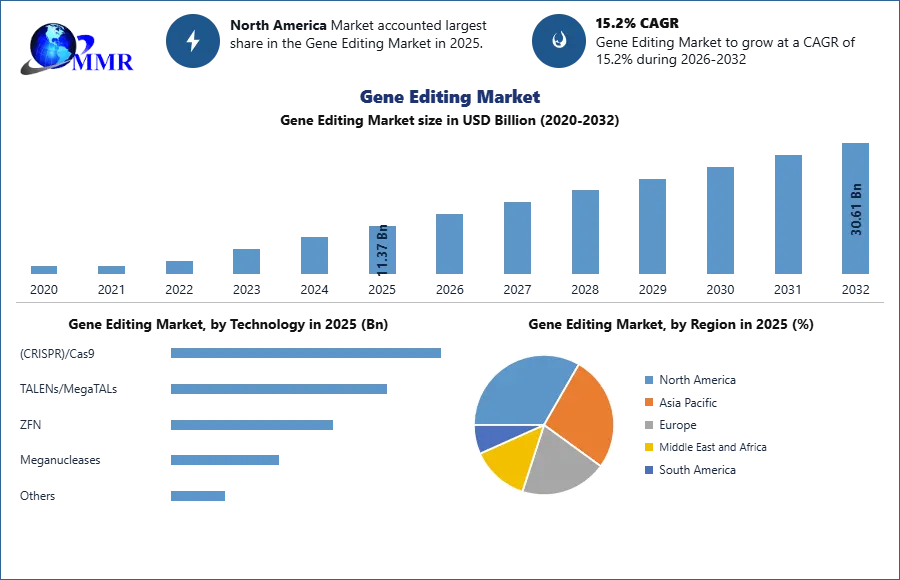
- Gene Editing Market is projected to expand at a 15.2% CAGR through 2032.
- CRISPR technology continues to attract substantial research and commercial investment.
- Rising prevalence of genetic disorders is increasing demand for precision therapies.
- Government funding and biotech collaborations are accelerating innovation.
- North America remains the leading regional market through strong R&D spending and advanced healthcare infrastructure.
- Precision medicine and AI-assisted genomics are broadening clinical applications.
Why This Matters Now
Healthcare systems are moving beyond symptom management toward therapies designed to correct disease at its genetic source. For pharmaceutical companies, biotechnology firms, hospital networks, investors, and regulators, gene editing has become a strategic priority rather than a long-term research ambition.
The Gene Editing Market size reached USD 113.37 billion in 2025 and is expected to grow at a 15.2% CAGR through the forecast period, according to Maximize Market Research. Although the supplied market values contain an apparent numerical inconsistency, the reported CAGR signals sustained investment momentum across research, therapeutics, and precision medicine. Every percentage point of growth translates into greater clinical adoption, expanding manufacturing capacity, and stronger competition among technology developers.
Market Overview
The Gene Editing Market enables scientists to insert, remove, or modify DNA with increasing speed and precision. Technologies such as CRISPR have transformed laboratory research while opening new therapeutic possibilities for cancer, inherited disorders, infectious diseases, and rare genetic conditions.
Market expansion is being driven by rising disease burden worldwide. According to the report, nearly 30 million Americans live with genetic diseases, while congenital abnormalities affect approximately 2–5% of newborns globally. These patient populations are creating sustained demand for therapies capable of addressing disease mechanisms rather than managing symptoms alone. Healthcare providers increasingly view gene editing as part of long-term precision medicine strategies rather than experimental science.
Governments are also expanding investments in genomics research. Public funding reduces early-stage development risk while encouraging universities, biotechnology companies, and pharmaceutical manufacturers to accelerate commercialization.
Key Trends Driving Growth
CRISPR continues to reshape competitive dynamics across biotechnology. Faster, more accurate genome modification enables companies to shorten research timelines and develop highly targeted therapies for oncology, diabetes, cystic fibrosis, and numerous inherited disorders. Each technological improvement improves clinical confidence while lowering development barriers.
Investment activity remains another defining trend. According to the report, genome editing companies secured more than USD 1.3 billion in investment during 2025, including numerous CRISPR-focused agreements. Capital inflows indicate that investors increasingly expect gene editing platforms to become foundational technologies across multiple therapeutic categories rather than niche research tools.
Strategic collaborations are also changing competitive positioning. Partnerships between biotechnology innovators and research institutions allow companies to combine genomic expertise with clinical development capabilities. These alliances reduce development timelines while strengthening intellectual property portfolios and expanding future product pipelines.
Artificial intelligence is becoming increasingly important throughout genomic research. AI assists target identification, guide RNA optimization, data interpretation, and biomarker discovery, helping researchers accelerate experimental design and precision medicine development.
Get a free sample:https://www.maximizemarketresearch.com/request-sample/2748/
Segment Insights
- Dominant Segment: CRISPR technology remains the leading technology platform due to its speed, precision, flexibility, and expanding therapeutic applications across research and clinical development.
- Fastest-Growing Segment: Therapeutic applications are expanding rapidly as gene editing progresses from laboratory research toward treatments for cancer, inherited disorders, infectious diseases, and rare diseases.
Regional Growth Story
The United States continues to lead the market through significant federal funding, advanced biotechnology ecosystems, and established pharmaceutical research infrastructure. NIH-backed genomics programs and strong venture capital participation continue supporting innovation across academic institutions and private companies.
Germany and the United Kingdom continue strengthening precision medicine initiatives while supporting translational genomic research through advanced healthcare systems and regulatory science.
China is expanding biotechnology investment, genomic sequencing capabilities, and clinical research infrastructure to strengthen domestic innovation and global competitiveness.
Japan is advancing regenerative medicine alongside genomic research, encouraging greater integration of precision medicine into healthcare delivery.
India continues increasing genomics research capacity through expanding biotechnology investment, academic collaboration, and pharmaceutical manufacturing capabilities, positioning itself as an emerging contributor to global clinical research.
South Korea is leveraging digital health infrastructure, biotechnology investment, and AI-enabled healthcare innovation to strengthen genomic medicine development.
Across regions, healthcare spending increasingly favors personalized therapies capable of improving patient outcomes while reducing long-term disease management costs.
Competitive Landscape
Competition increasingly centers on platform technology rather than individual products. Companies capable of demonstrating higher editing precision, improved delivery systems, scalable manufacturing, and stronger clinical evidence are building sustainable competitive advantages.
Collaborations have become strategic growth engines rather than simple research agreements. Partnerships between biotechnology firms, academic institutions, and pharmaceutical companies spread development risk while accelerating commercialization. Every collaboration also strengthens future reimbursement discussions by generating stronger clinical evidence for regulators and healthcare payers.
Growing investments in synthetic genes further diversify commercial opportunities beyond therapeutics into agriculture and biotechnology applications, expanding total addressable market potential.
Recent Developments
- Investment exceeding USD 1.3 billion flowed into genome editing companies during 2025, including multiple CRISPR-focused transactions.
- Government funding continues supporting genomics research programs and accelerating innovation across academic institutions.
- Strategic collaborations are expanding precision genetic medicine development through advanced base-editing and genome engineering technologies.
- Increasing applications in oncology, rare diseases, diabetes, and inherited disorders continue expanding clinical opportunities.
Strategic Implications
Healthcare executives should view gene editing as a long-term platform investment rather than an isolated therapeutic category. Companies that integrate AI, genomic analytics, molecular diagnostics, and precision medicine capabilities into clinical development will improve development efficiency while strengthening commercial differentiation.
Hospital networks should prepare for increasing adoption of genomic diagnostics, specialized treatment pathways, and multidisciplinary precision medicine programs. Pharmaceutical manufacturers must continue investing in scalable manufacturing, regulatory readiness, and reimbursement evidence to support broader commercialization.
For investors, sustained public funding and expanding biotechnology partnerships reduce technology risk while increasing long-term market opportunity. Regulatory agencies, meanwhile, face growing pressure to balance accelerated innovation with patient safety through adaptive approval pathways.
Future Outlook
Gene editing is transitioning from advanced research into mainstream precision healthcare, supported by biotechnology investment, AI-enabled discovery, regulatory progress, and expanding therapeutic evidence. Organizations that invest early in scalable genomic platforms, clinical validation, and strategic partnerships will define the next generation of precision medicine, while slower adopters risk losing both scientific and commercial leadership.
Analyst Perspective
“Gene editing is entering a commercialization phase where scientific breakthroughs, strategic partnerships, and sustained research funding are converging to accelerate precision medicine across multiple therapeutic areas. Organizations that translate genomic innovation into scalable clinical solutions will shape the next decade of healthcare.” — Komal Patil, Analyst
About Maximize Market Research
Maximize Market Research Pvt. Ltd. (MMR) is a global market research and consulting company that provides reliable, data-focused, and practical business insights. The firm serves a wide range of industries, including healthcare, pharmaceuticals, technology, automotive, electronics, chemicals, personal care, and consumer goods. Through market forecasts, competitive analysis, strategic consulting, and industry impact assessments, MMR helps organizations understand changing market conditions, identify growth opportunities, and make informed business decisions for long-term success.
2nd Floor, Navale IT Park Phase 3
Pune Banglore Highway, Narhe
Pune, Maharashtra 411041, India
+91 9607365656
sales@maximizemarketresearch.com
