Key Highlights
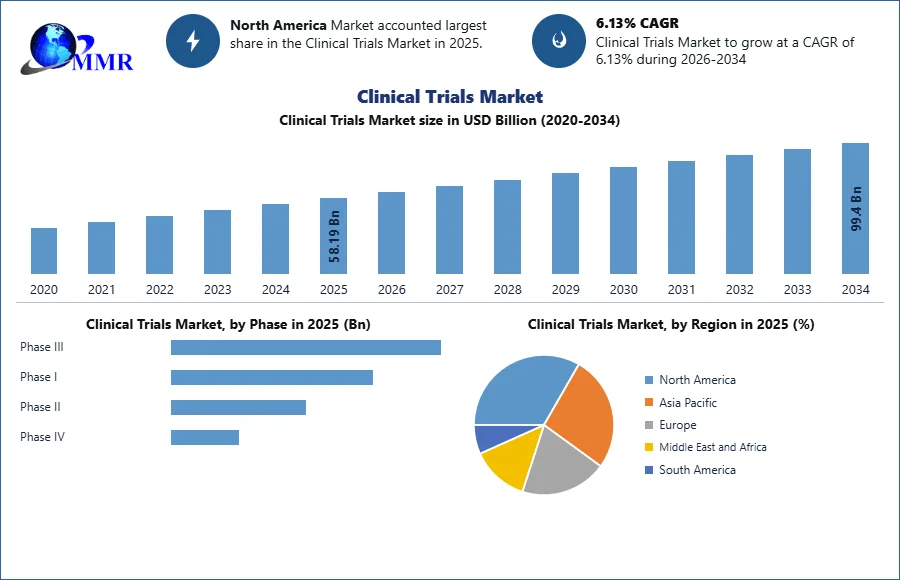
- Clinical Trials Market valued at USD 58.19 Billion in 2025 and projected to reach USD 99.4 Billion by 2034, growing at 6.13% CAGR.
- North America remains the leading regional market.
- Rising chronic disease prevalence continues to increase global clinical research demand.
- AI, decentralized trials, telemedicine, and real-world evidence are improving trial efficiency.
- Oncology remains the largest therapeutic focus for clinical development.
- Contract research organizations continue expanding digital capabilities and global trial networks.
Why This Matters Now
Healthcare companies are racing to shorten development timelines while controlling rising research costs. Every month saved in clinical development can accelerate market access, improve patient outcomes, and strengthen competitive positioning.
Clinical trials have become a strategic differentiator rather than a regulatory requirement alone. Pharmaceutical companies, biotechnology innovators, hospital systems, regulators, and investors are increasingly adopting AI, decentralized trial models, and digital patient engagement to improve recruitment, data quality, and operational efficiency. These shifts are redefining how therapies reach patients worldwide.
Market Overview
The Clinical Trials Market was valued at USD 58.19 Billion in 2025, with total revenue expected to grow at a CAGR of 6.13%, reaching nearly USD 99.4 Billion by 2034.
Clinical trials remain the foundation of modern drug development. Every new medicine, vaccine, biologic, medical device, and advanced therapy depends on rigorous clinical evaluation before regulatory approval. Growing pharmaceutical innovation, expanding biotechnology pipelines, and increasing investment in precision medicine continue to increase global demand for efficient clinical research infrastructure.
Disease burden is a major growth catalyst. Chronic diseases account for approximately 74% of deaths worldwide, while millions of patients require improved therapies for cancer, cardiovascular disorders, neurological diseases, autoimmune conditions, and infectious diseases. Rising patient populations directly translate into larger clinical development pipelines and greater investment in research programs.
Regulators are also encouraging innovation. Acceptance of real-world evidence, greater flexibility for decentralized trial models, and expanding digital health technologies are changing traditional clinical development pathways while maintaining safety standards. These changes help sponsors accelerate recruitment, improve patient retention, and reduce operational costs.
Key Trends Driving Growth
Artificial intelligence is becoming central to modern clinical research. Sponsors increasingly use AI for patient identification, protocol optimization, site selection, predictive analytics, and operational monitoring. These capabilities improve trial success rates while reducing delays caused by recruitment challenges.
Decentralized clinical trials continue gaining momentum. Remote monitoring, wearable devices, telemedicine consultations, and digital data collection allow broader patient participation while reducing travel burdens. This patient-centric model expands access to underserved populations and improves participant retention throughout lengthy studies.
Precision medicine is reshaping research priorities. Biomarker-driven therapies require highly targeted patient populations, increasing demand for sophisticated diagnostics, genomic testing, and adaptive trial designs. Oncology continues to lead this transformation as personalized cancer treatments dominate pharmaceutical innovation pipelines.
Biopharmaceutical R&D investment remains strong despite economic uncertainty. Companies increasingly collaborate with contract research organizations (CROs) to improve scalability, leverage specialized expertise, and expand global trial capacity.
However, growth is not without challenges. Regulatory complexity, patient recruitment delays, rising trial costs, cybersecurity requirements, and increasingly sophisticated study designs continue to pressure development timelines and budgets.
Get a free sample:https://www.maximizemarketresearch.com/request-sample/189646/
Segment Insights
- Dominant Segment: Oncology remains the leading indication due to continuous development of targeted therapies, immunotherapies, and precision oncology treatments.
- Fastest-Growing Segment: Decentralized Clinical Services, supported by telemedicine, remote monitoring, wearable technologies, and digital patient engagement platforms.
- Phase II and Phase III studies continue representing significant investment areas because they determine therapeutic efficacy and commercial viability before regulatory approval.
- AI-enabled recruitment platforms and real-world evidence integration are increasingly improving study execution across multiple therapeutic areas.
Regional Growth Story
North America continues to lead the Clinical Trials Market through extensive pharmaceutical R&D spending, mature CRO ecosystems, advanced healthcare infrastructure, and supportive regulatory frameworks. The United States hosts a substantial share of global clinical trials and continues investing heavily in AI-enabled research and accelerated drug development.
Germany and the UK remain Europe’s strongest research hubs, supported by sophisticated healthcare systems, academic partnerships, and regulatory harmonization across European markets.
China continues expanding clinical research capacity through substantial biotechnology investment and growing pharmaceutical innovation, although geopolitical scrutiny increasingly influences international research partnerships.
Japan and South Korea continue investing in precision medicine, regenerative therapies, and digital health integration, strengthening regional research competitiveness.
India is emerging as a strategic destination for global clinical research due to its diverse patient population, skilled investigators, and competitive operating costs. Industry leaders continue calling for regulatory modernization to improve patient recruitment and increase India’s global market share.
Competitive Landscape
Competition increasingly centers on technology rather than scale alone. Leading organizations including IQVIA, PPD, Parexel, ICON, Charles River Laboratories, LabCorp, Medpace, Medable, Science 37, TriNetX, and Deep 6 AI continue investing in AI-powered recruitment, decentralized trial platforms, advanced analytics, biomarker-driven research, and digital patient engagement.
Strategic partnerships between CROs, healthcare providers, biotechnology companies, and technology vendors are accelerating innovation while improving operational flexibility. Organizations capable of combining AI, decentralized operations, and real-world evidence generation are strengthening their competitive positioning as sponsors demand faster, more efficient development models.
Recent Developments
- AI and machine learning adoption continues expanding across patient recruitment and protocol optimization.
- Decentralized clinical trial platforms are becoming mainstream through telemedicine and wearable integration.
- Regulatory agencies continue increasing acceptance of real-world evidence to support clinical decision-making.
- Global pharmaceutical companies continue expanding digital partnerships with leading CROs to improve trial efficiency.
- India continues pursuing regulatory reforms to attract larger international clinical research investments.
Strategic Implications
Clinical development is rapidly becoming a technology-driven business. Companies investing in AI, digital health platforms, precision diagnostics, and decentralized infrastructure can improve recruitment speed, reduce development costs, and accelerate regulatory submissions.
Healthcare providers benefit through earlier access to innovative therapies and expanded research participation. Investors increasingly evaluate technology capabilities alongside therapeutic pipelines, while regulators continue balancing faster approvals with patient safety and data integrity.
For CROs, differentiation will depend less on geographic footprint and more on digital capabilities, data analytics, and integrated service delivery.
Future Outlook
The next decade will reward organizations capable of integrating AI, precision medicine, decentralized operations, and patient-centric research into scalable clinical development ecosystems. Companies that modernize research execution today will define tomorrow’s pharmaceutical innovation leadership, while slower adopters risk losing both development speed and market relevance.
Analyst Perspective
“Clinical research is entering a technology-first era where AI, decentralized trial models, precision medicine, and patient-centric design are reshaping development strategies. Organizations that combine scientific excellence with digital execution will accelerate innovation while improving patient access to next-generation therapies.” — Komal Patil, Analyst
About Maximize Market Research
Maximize Market Research Pvt. Ltd. (MMR) is a global market research and consulting company that provides reliable, data-focused, and practical business insights. The firm serves a wide range of industries, including healthcare, pharmaceuticals, technology, automotive, electronics, chemicals, personal care, and consumer goods. Through market forecasts, competitive analysis, strategic consulting, and industry impact assessments, MMR helps organizations understand changing market conditions, identify growth opportunities, and make informed business decisions for long-term success.
2nd Floor, Navale IT Park Phase 3
Pune Banglore Highway, Narhe
Pune, Maharashtra 411041, India
+91 9607365656
sales@maximizemarketresearch.com
