Key Highlights
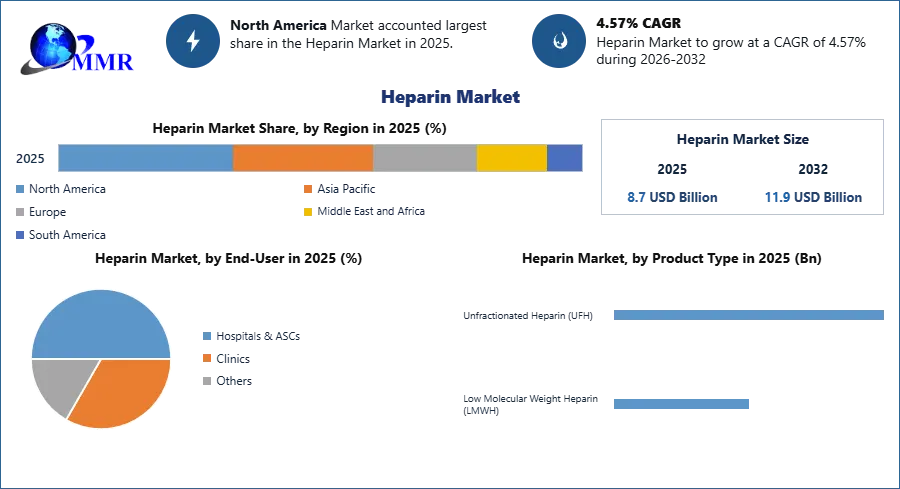
- Global Heparin Market valued at USD 8.7 billion in 2025.
- Market projected to expand at a 4.57% CAGR during the forecast period.
- Low Molecular Weight Heparin (LMWH) remains the leading product category.
- Hospitals and ambulatory surgical centers continue to dominate end-user demand.
- Rising cardiovascular disease and surgical procedures continue to increase anticoagulant utilization.
- Home-based anticoagulation and prefilled syringe adoption are expanding treatment accessibility.
- AI-supported anticoagulation management is emerging as a clinical decision-support opportunity.
- Asia-Pacific is becoming a strategic manufacturing and demand hub alongside established North American and European markets.
Why This Matters Now
Healthcare systems are treating larger numbers of cardiovascular patients while simultaneously managing aging populations and increasing surgical volumes. That combination makes reliable anticoagulation therapy a strategic clinical necessity rather than a routine pharmaceutical purchase.
For pharmaceutical manufacturers, hospital networks, investors, regulators, and payers, heparin has become central to both acute care and long-term thrombosis management. Companies capable of strengthening manufacturing reliability, improving safety profiles, and expanding patient access are positioned to capture sustained demand as healthcare infrastructure continues to expand worldwide.
Market Overview
The Heparin Market has valued at USD 8.7 billion in 2025. The market is estimated to grow at a CAGR of 4.57% during the forecast period.
Market expansion is being supported by increasing cases of cardiovascular disease, greater numbers of orthopedic and cardiovascular surgeries, wider use of thrombosis prevention protocols, and continued preference for injectable anticoagulants in hospitals. Healthcare providers are also increasing adoption of Low Molecular Weight Heparin because of predictable pharmacokinetics, convenient administration, and improved outpatient suitability.
The business landscape is also shifting beyond traditional hospital administration. Prefilled syringes, home-care treatment pathways, and outpatient anticoagulation programs are expanding the addressable market while improving patient convenience and reducing inpatient resource utilization. These developments create opportunities across pharmaceutical manufacturing, specialty distribution, digital monitoring, and clinical decision support.
Key Trends Driving Growth
The strongest commercial trend is the continued migration toward Low Molecular Weight Heparin. Clinicians increasingly favor LMWH because of simplified dosing, reduced monitoring requirements, and suitability across surgical prophylaxis and venous thromboembolism management. This shift supports premium product positioning while encouraging manufacturers to expand differentiated product portfolios.
Digital healthcare is also beginning to influence anticoagulation management. Predictive analytics and AI-assisted dosing models are being explored to improve treatment precision, minimize bleeding complications, and optimize hospital workflows. While adoption remains early, these technologies represent an important evolution in precision medicine for anticoagulant therapy.
Hospital infrastructure expansion across emerging markets continues to widen patient access. As healthcare investment increases in Asia-Pacific, more patients receive diagnosis and treatment for deep vein thrombosis, pulmonary embolism, and cardiovascular disorders requiring anticoagulation therapy. Improved reimbursement systems and expanding specialty care further strengthen long-term demand.
Biopharmaceutical innovation is another market catalyst. Manufacturers are investing in Ultra-Low Molecular Weight Heparin formulations and improved delivery systems designed to enhance pharmacokinetic performance and patient safety. These innovations support competitive differentiation while responding to growing regulatory expectations around treatment quality and manufacturing consistency.
Get a free sample:https://www.maximizemarketresearch.com/request-sample/103436/
Segment Insights
- Dominant Segment: Low Molecular Weight Heparin (LMWH) due to broad clinical adoption, predictable therapeutic performance, and widespread use in thrombosis prevention and postoperative care.
- Fastest-Growing Segment: Subcutaneous Injection, supported by home-care treatment, self-administration, and expanding outpatient anticoagulation programs.
- Leading End User: Hospitals & Ambulatory Surgical Centers, driven by cardiovascular interventions, orthopedic surgery, dialysis, and emergency anticoagulation requirements.
Regional Growth Story
North America maintains market leadership through advanced cardiovascular care, high healthcare expenditure, extensive surgical activity, and strong adoption of innovative anticoagulant therapies. Established reimbursement systems continue supporting widespread utilization across inpatient and outpatient settings.
Germany and the UK remain significant European contributors because of mature healthcare systems, strong regulatory oversight, and broad access to anticoagulation treatment within national healthcare programs. Continued emphasis on patient safety supports adoption of clinically validated anticoagulant therapies.
China and India are becoming increasingly important for both production capacity and patient demand. Expanding hospital infrastructure, rising cardiovascular disease prevalence, improving healthcare accessibility, and growing pharmaceutical manufacturing capabilities are strengthening regional competitiveness.
Japan and South Korea continue investing in advanced hospital care, precision medicine, and digital healthcare technologies. These markets offer opportunities for next-generation anticoagulation management supported by clinical innovation and aging demographics.
Competitive Landscape
Competition increasingly centers on manufacturing reliability, regulatory compliance, supply chain resilience, and product differentiation rather than pricing alone.
Leading companies continue expanding injectable anticoagulant portfolios while investing in biologics manufacturing and pharmaceutical-grade active pharmaceutical ingredient production. Vertical integration strengthens supply security, particularly for biologically derived heparin products, while regional manufacturing expansion improves responsiveness to hospital procurement requirements.
Strategically, companies introducing advanced LMWH formulations, strengthening global distribution, or improving manufacturing quality are positioning themselves for long-term leadership. These investments also support healthcare providers seeking uninterrupted anticoagulant availability amid increasing patient volumes.
Recent Developments
- Growing adoption of Low Molecular Weight Heparin across hospitals and outpatient settings.
- Expansion of home-care anticoagulation through prefilled syringes and self-administration solutions.
- Continued development of Ultra-Low Molecular Weight Heparin formulations with enhanced pharmacokinetic performance.
- Increased integration of AI-supported anticoagulation management to improve dosing precision and patient safety.
- Rising investment in Asia-Pacific healthcare infrastructure supporting broader treatment accessibility.
Strategic Implications
Healthcare providers should prepare for rising anticoagulation demand by strengthening clinical protocols, digital monitoring capabilities, and outpatient treatment pathways.
For pharmaceutical manufacturers, securing raw material supply, expanding differentiated LMWH portfolios, and investing in manufacturing quality will increasingly influence competitive positioning. Payers and regulators will continue emphasizing clinical value, treatment safety, and cost-efficient care delivery as healthcare systems balance growing cardiovascular disease burden with financial sustainability.
Investors should monitor companies successfully combining biologics manufacturing expertise with digital health integration and expanding presence across high-growth Asian healthcare markets.
Future Outlook
The next phase of market growth will depend on broader outpatient anticoagulation adoption, precision dosing technologies, expanded healthcare access across emerging economies, and continuous pharmaceutical innovation. Organizations that combine manufacturing resilience with digital-enabled patient management will define the industry’s next competitive benchmark, while slower adopters risk losing relevance in an increasingly value-driven healthcare environment.
Analyst Perspective
“The Heparin Market is entering a phase where clinical effectiveness alone is no longer sufficient for competitive advantage. Manufacturers that integrate product innovation, supply chain resilience, digital healthcare capabilities, and expanding global patient access will be best positioned to lead the next decade of anticoagulation therapy.” — Komal Patil, Analyst
About Maximize Market Research
Maximize Market Research Pvt. Ltd. (MMR) is a global market research and consulting company that provides reliable, data-focused, and practical business insights. The firm serves a wide range of industries, including healthcare, pharmaceuticals, technology, automotive, electronics, chemicals, personal care, and consumer goods. Through market forecasts, competitive analysis, strategic consulting, and industry impact assessments, MMR helps organizations understand changing market conditions, identify growth opportunities, and make informed business decisions for long-term success.
2nd Floor, Navale IT Park Phase 3
Pune Banglore Highway, Narhe
Pune, Maharashtra 411041, India
+91 9607365656
sales@maximizemarketresearch.com
