Key Highlights
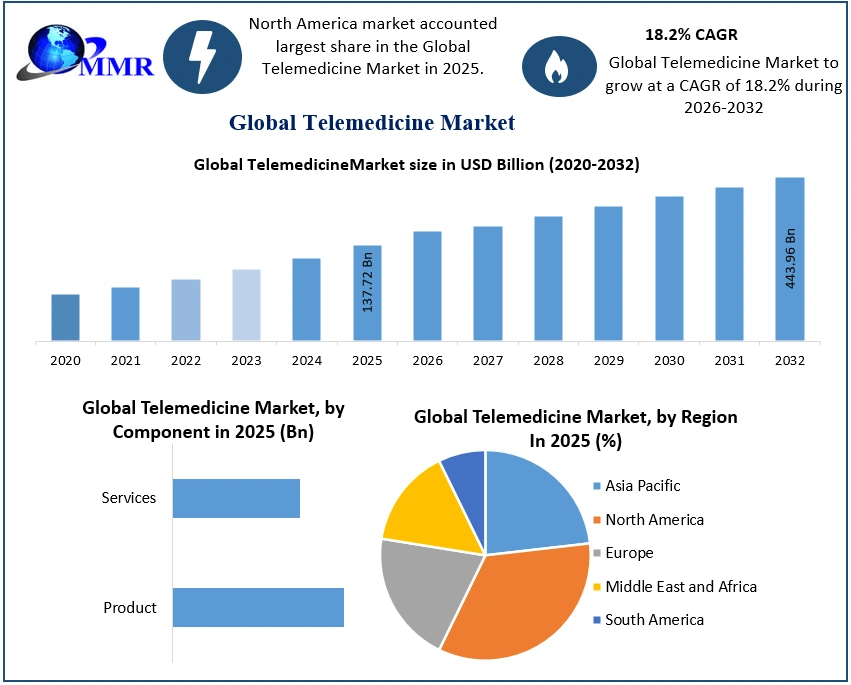
Market Trajectory: Expansion from USD 137.72 Billion in 2025 to USD 443.96 Billion by 2032.
Primary Drivers: Rising consumer demand for convenient care, supportive government reimbursement policies, and the urgent need to manage chronic disease populations.
Dominant Segments: The “Product” component and the “Teleradiology” application segment continue to lead market share due to hardware integration and AI-enhanced diagnostic workflows.
Key Barriers: Implementation costs, data privacy concerns, and practitioner reluctance to adopt digital-first clinical workflows.
Why This Matters Now
Healthcare delivery is experiencing a permanent shift, moving from centralized, facility-based care to a decentralized, virtual-first model. For health systems, payers, and investors, the rapid scaling of telemedicine represents more than a clinical trend; it is a fundamental survival strategy to manage escalating chronic disease burdens while curbing ballooning operational costs. Organizations that fail to institutionalize virtual care capabilities today will lose their competitive edge as the market moves toward a high-volume, tech-integrated, and value-based delivery architecture.
Market Overview
Telemedicine—the provision of remote clinical services via real-time audio and visual communication—is no longer a peripheral service; it is a core component of modern medical practice. Valued at USD 137.72 billion in 2025, the Global Telemedicine Market is projected to reach USD 443.96 billion by 2032, maintaining an aggressive 18.2% CAGR. This trajectory is supported by policy alignment, where governments globally are formalizing reimbursement mechanisms to incentivize virtual consultations, thereby easing the load on traditional, capacity-constrained hospitals.
Key Trends Driving Growth
The shift toward “tele-homecare” is perhaps the most significant structural change. By utilizing the latest telecommunications technology to monitor patients remotely, institutions can prevent emergency admissions and manage chronic diseases like cardiac conditions with unprecedented precision. Furthermore, the integration of AI and machine learning into telemedicine platforms is turning passive video calls into active diagnostic encounters. AI algorithms are now capable of analyzing massive datasets to identify clinical patterns, allowing providers to move from reactive care to proactive, personalized medicine.
𝐃𝐨𝐰𝐧𝐥𝐨𝐚𝐝 𝐏𝐃𝐅 𝐁𝐫𝐨𝐜𝐡𝐮𝐫𝐞 @https://www.maximizemarketresearch.com/request-sample/63151/
Segment Insights
Dominant Component Segment: The Product segment holds the largest market share. This includes the essential hardware (carts, tablets, bedside monitors) and software kits that enable the digital interface between patient and provider.
Dominant Application Segment: Teleradiology remains the dominant application. Its leadership is cemented by the widespread adoption of Picture Archiving and Communication Systems (PACS) and the seamless integration of AI to assist in rapid image interpretation.
Fastest-Growing Opportunities: The field of In-patient Telemedicine is emerging as a critical growth area. By deploying mobile specialist carts into hospital wards, health systems are effectively extending their clinical reach without the need for physical specialist relocation.
Regional Growth Story
North America continues to set the pace for global telemedicine adoption, driven by high-speed internet infrastructure and a high concentration of digital health innovation. In the U.S. alone, the potential shift of USD 250 billion in healthcare spending toward virtual or virtually-enabled care serves as a powerful market catalyst. Asia-Pacific and Europe are following suit, with rapid investment in national tele-homecare programs and regulatory frameworks that prioritize interoperability between Electronic Health Records (EHR) and virtual care platforms.
Competitive Landscape
The entry of Big Tech giants into the telemedicine space has permanently altered the competitive landscape. Through partnerships and the development of specialized virtual care tools—such as enhanced search functionalities for finding virtual providers—tech firms are forcing traditional healthcare players to innovate at a faster velocity. The market is shifting away from simple video conferencing toward specialized, proprietary platforms that prioritize data integrity and workflow integration via blockchain and cloud-based delivery models.
Recent Developments
Clinical Expansion: Major cardiac institutes have successfully scaled telephone monitoring, allowing patients in multiple geographies to access specialized care without transit.
Tech-Enabled Care: Increased adoption of cloud-based delivery modes, which significantly reduce the barrier to entry for smaller clinical practices.
Collaborative Innovation: Strategic alliances between healthcare institutions and technology providers are creating more robust interfaces for managing secure health records and interoperability.
Strategic Implications
For hospital networks, the objective is no longer just “having a platform” but achieving full clinical integration. Executives must prioritize the seamless embedding of telemedicine into existing EHR systems to ensure data continuity. Payers must accelerate the standardization of reimbursement for remote monitoring to capture the long-term cost savings associated with reduced hospitalizations. For biotech and pharmaceutical firms, the virtual care landscape offers a direct, low-friction channel to improve patient adherence through remote monitoring and education.
Future Outlook
The next seven years will be defined by the consolidation of virtual care into the standard care pathway, as regulatory barriers fall and clinical confidence grows. The providers who succeed will be those who treat virtual channels as a primary diagnostic tool rather than a secondary convenience, ultimately creating a future where high-quality care is truly ubiquitous.
Analyst Perspective
“The telemedicine market has transcended its origins as an emergency response tool to become the backbone of modern, efficient healthcare,” states Komal Patil, Lead Analyst. “The scale we are witnessing today is a direct response to the global necessity for improved accessibility. As AI diagnostics and remote monitoring become standard, the distinction between ‘in-person’ and ‘virtual’ care will blur, shifting the focus entirely to patient outcomes and system-wide efficiency.”
About Maximize Market Research
Maximize Market Research Pvt. Ltd. (MMR) is a global market research and consulting company that provides reliable, data-focused, and practical business insights. The firm serves a wide range of industries, including healthcare, pharmaceuticals, technology, automotive, electronics, chemicals, personal care, and consumer goods. Through market forecasts, competitive analysis, strategic consulting, and industry impact assessments, MMR helps organizations understand changing market conditions, identify growth opportunities, and make informed business decisions for long-term success.
2nd Floor, Navale IT Park Phase 3
Pune Banglore Highway, Narhe
Pune, Maharashtra 411041, India
+91 9607365656
sales@maximizemarketresearch.com
