Key Highlights
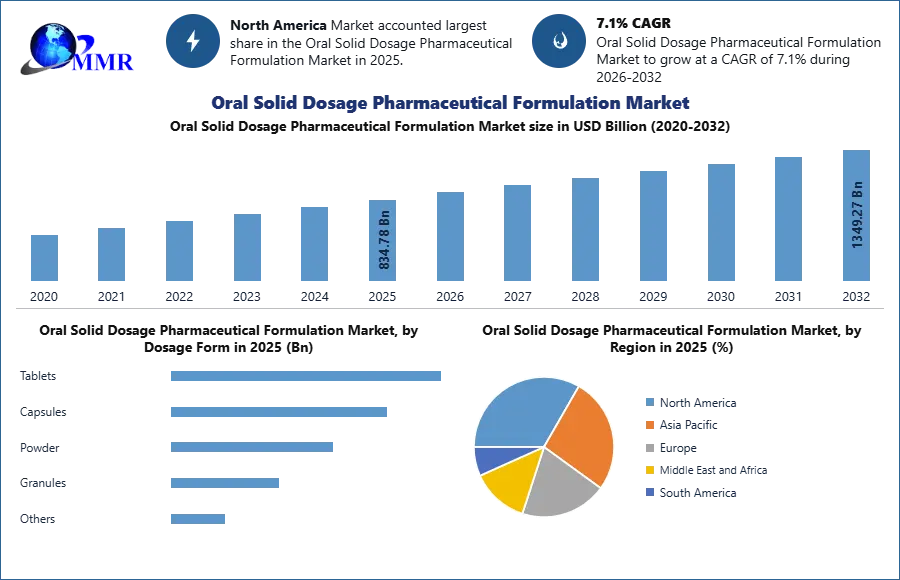
Market valued at USD 834.78 billion in 2025.
Expected to reach USD 1,349.27 billion by 2032.
Projected CAGR of 7.1% during 2026–2032.
Tablets remain the largest oral solid dosage format.
Asia-Pacific is emerging as the fastest-growing manufacturing hub.
Growth is driven by chronic disease treatment demand, generic drug expansion, and patient-friendly formulations.
Why This Matters Now
Pharmaceutical manufacturers are racing to expand oral solid dosage capacity as healthcare systems confront rising chronic disease burdens and cost pressures. Companies that secure efficient manufacturing, regulatory approvals, and patient-centric formulations will capture a disproportionate share of prescription and over-the-counter drug growth.
The market’s scale is becoming impossible to ignore. The Oral Solid Dosage Pharmaceutical Formulation Market was valued at USD 834.78 billion in 2025 and is expected to reach USD 1,349.27 billion by 2032, growing at a 7.1% CAGR. That trajectory signals sustained demand for tablets, capsules, powders, and granules across therapeutic categories.
Market Overview
The Oral Solid Dosage Pharmaceutical Formulation Market formulations remain the backbone of global pharmaceutical delivery. Tablets and capsules dominate because they are cost-effective to manufacture, stable during storage, easy to transport, and familiar to patients. These advantages matter as healthcare systems seek scalable treatment solutions for diabetes, cardiovascular disease, hypertension, infectious diseases, and other long-term conditions.
What changed is the combination of demographic pressure and healthcare access expansion. Aging populations in developed markets are consuming more chronic medications, while emerging economies are increasing access to prescription therapies through broader healthcare coverage and rising incomes.
Why now? Pharmaceutical companies are investing heavily in manufacturing modernization, quality systems, and formulation technologies to improve bioavailability, adherence, and product differentiation. The beneficiaries include contract manufacturers, generic drug producers, branded pharmaceutical companies, and healthcare providers seeking reliable medication supply.
Key Trends Driving Growth
Chronic disease treatment is expanding.
Demand for long-term oral therapies continues to rise across diabetes, cardiovascular disorders, hypertension, and other chronic conditions. This creates recurring prescription volumes and strengthens the business case for high-capacity oral dosage manufacturing.
Generic drug adoption is accelerating.
Governments and insurers are pushing lower-cost treatment options to manage healthcare spending. Generic manufacturers with efficient formulation and production capabilities are positioned to gain share.
Patient-centric formulations are becoming a competitive advantage.
Pharmaceutical companies are developing easier-to-swallow tablets, modified-release formulations, and combination products to improve adherence. Better adherence can translate into improved clinical outcomes and stronger product loyalty.
Manufacturing modernization is gaining momentum.
Automation, continuous manufacturing, and digital quality systems are helping companies reduce costs and improve consistency. Firms that modernize fastest can protect margins while meeting stricter regulatory expectations.
Get a free sample:https://www.maximizemarketresearch.com/request-sample/121388/
Segment Insights
Dominant Segment: Tablets remain the leading oral solid dosage format due to manufacturing efficiency, dosing accuracy, patient familiarity, and broad therapeutic applicability.
Fastest-Growing Segment: Capsule formulations are gaining momentum as manufacturers use them for complex formulations, improved patient experience, and differentiated drug delivery.
Therapeutic Demand: Chronic disease medications continue to represent a major share of oral solid dosage consumption.
Opportunity Area: Modified-release and combination formulations offer higher-value growth opportunities than standard immediate-release products.
Regional Growth Story
North America remains the largest market, supported by high healthcare spending, strong pharmaceutical innovation, and extensive use of prescription medications. The United States continues to lead in branded and specialty oral formulations.
Germany and the UK benefit from mature healthcare systems and strong generic drug penetration. Cost-containment policies are encouraging wider adoption of affordable oral therapies.
China is rapidly expanding pharmaceutical manufacturing capacity and improving domestic drug access. Regulatory reforms are supporting faster commercialization of new and generic medicines.
Japan remains a major market due to its aging population and high per-capita medicine consumption. Demand for chronic disease therapies is particularly strong.
India is emerging as a critical global manufacturing hub. Its large generic drug industry, skilled workforce, and export capabilities are attracting investment across the oral solid dosage value chain.
South Korea is strengthening its position through pharmaceutical innovation and advanced manufacturing capabilities, particularly in specialty formulations.
Competitive Landscape
Competition is intensifying across branded pharmaceutical companies, generic manufacturers, and contract development and manufacturing organizations (CDMOs). Scale, regulatory compliance, formulation expertise, and supply-chain reliability are becoming the key differentiators.
The market is also seeing greater emphasis on portfolio optimization. Companies are prioritizing high-volume chronic therapies, complex generics, and differentiated formulations that can command stronger margins.
Recent Developments
Pharmaceutical manufacturers are expanding oral solid dosage production capacity to meet rising global demand.
Investment in continuous manufacturing technologies is increasing across major production facilities.
Companies are developing modified-release and combination products to improve adherence and extend product lifecycles.
Generic drug producers are strengthening export-oriented manufacturing capabilities, particularly in Asia.
Digital quality management and automation initiatives are becoming more common across large-scale facilities.
Strategic Implications
For pharmaceutical executives, the message is clear: manufacturing excellence is becoming a strategic asset, not just an operational function. Companies that can deliver high-quality oral formulations at scale will be better positioned to win contracts, secure reimbursement, and expand globally.
For investors, the market offers exposure to several durable themes: aging populations, chronic disease growth, generic drug expansion, and pharmaceutical manufacturing modernization. The most attractive opportunities are likely to emerge in complex formulations and high-efficiency production platforms.
For healthcare systems and payers, broader availability of affordable oral therapies can help manage treatment costs while improving patient access. That creates a strong policy tailwind for efficient oral dosage manufacturers.
Future Outlook
The next phase of growth will be defined by companies that combine large-scale manufacturing, regulatory agility, and patient-focused formulation innovation. As healthcare systems demand both affordability and reliability, the winners will be those that can produce differentiated oral therapies efficiently across global markets.
Future leaders will be the manufacturers that pair scale with formulation innovation, while laggards will struggle with commoditization and rising compliance costs.
Analyst Perspective
“The oral solid dosage market is entering a phase where manufacturing efficiency and formulation differentiation will determine competitive advantage. Companies investing in advanced production technologies and patient-centric products are likely to capture the strongest long-term growth.”
— Komal Patil, Analyst
