Low-Carbon Hydrogen Market Accelerates as Net-Zero Commitments, Clean Energy Investments, and Industrial Decarbonization Drive Global Growth
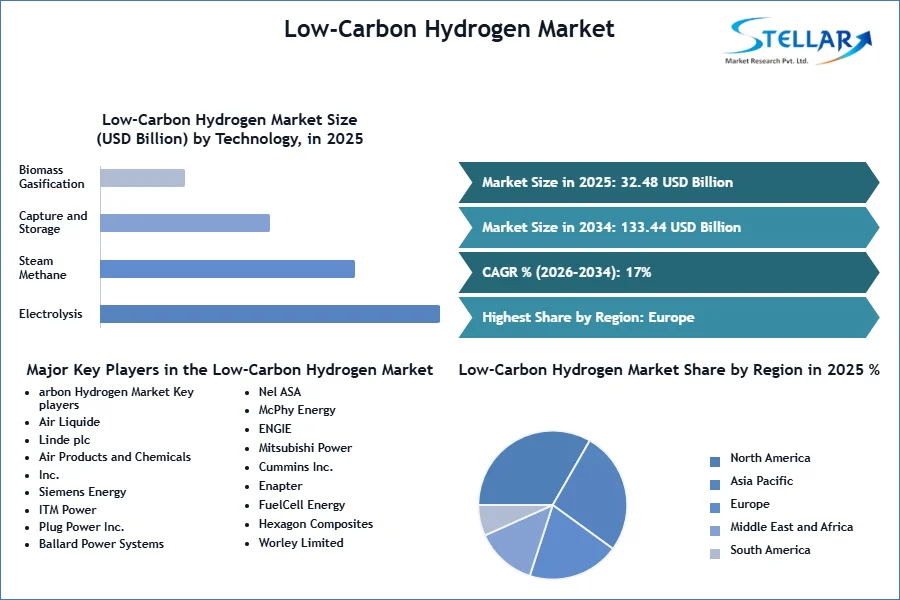
PUNE, India, July 1, 2026 – The Low-Carbon Hydrogen Market is experiencing significant expansion as governments and industries accelerate the transition toward sustainable energy systems. Low-carbon hydrogen, produced through technologies such as electrolysis using renewable electricity and steam methane reforming with carbon capture, is emerging as a critical solution for reducing greenhouse gas emissions across transportation, power generation, chemicals, steel manufacturing, and heavy industries. According to Stellar Market Research, the global Low-Carbon Hydrogen Market was valued at USD 32.48 billion in 2025 and is projected to reach nearly USD 133.44 billion by 2034, growing at a CAGR of 17% during the forecast period.
Global Energy Transition Accelerates Market Expansion
The Low-Carbon Hydrogen Market is gaining momentum as countries pursue ambitious net-zero emission targets and seek alternatives to fossil fuels for sectors that are difficult to electrify. Low-carbon hydrogen offers a clean energy carrier capable of supporting industrial heating, long-haul transportation, electricity generation, fertilizer production, and chemical manufacturing while significantly reducing carbon emissions.
Governments across North America, Europe, and Asia-Pacific are introducing hydrogen strategies, financial incentives, and infrastructure investments to accelerate commercialization. Increasing deployment of carbon capture and storage (CCS), renewable-powered electrolysis, and hydrogen transportation networks is further strengthening market growth. The rapid emergence of hydrogen hubs and international hydrogen trade agreements is also creating new opportunities for global market participants.
𝐃𝐨𝐰𝐧𝐥𝐨𝐚𝐝 𝐅𝐫𝐞𝐞 𝐏𝐃𝐅 𝐁𝐫𝐨𝐜𝐡𝐮𝐫𝐞: https://www.stellarmr.com/report/req_sample/Low-Carbon-Hydrogen-Market/2223
Key Findings from the Report
The global Low-Carbon Hydrogen Market was valued at USD 32.48 billion in 2025 and is projected to reach USD 133.44 billion by 2034, growing at a CAGR of 17%.
Electrolysis is emerging as one of the fastest-growing production technologies due to expanding renewable energy deployment.
Industrial applications, including chemicals, refining, steel, and fertilizers, account for a significant share of hydrogen demand.
Europe is expected to dominate the market, supported by aggressive climate policies and hydrogen investment programs.
Transportation, power generation, and industrial decarbonization remain key growth opportunities for low-carbon hydrogen adoption.
Expanding hydrogen infrastructure, including storage, pipelines, and fueling stations, is supporting long-term market development.
Market Drivers and Restraints
The Low-Carbon Hydrogen Market is primarily driven by global decarbonization initiatives, increasing renewable energy capacity, and rising investments in clean fuel technologies. Governments are providing grants, tax incentives, and policy support to encourage hydrogen production and accelerate the transition toward low-emission industrial processes.
Growing demand from steel manufacturing, heavy transportation, aviation, shipping, and power generation is expanding commercial opportunities for hydrogen producers. Technological improvements in electrolyzers, carbon capture systems, and hydrogen storage solutions are further enhancing production efficiency and reducing long-term operating costs.
However, the market faces challenges including high production costs, limited hydrogen transportation and storage infrastructure, significant capital investment requirements, and evolving regulatory frameworks. The availability of renewable electricity and large-scale carbon capture infrastructure also remains essential for widespread commercialization.
Technology, Sustainability, and Industry Trends
The industry is rapidly advancing through innovations in green hydrogen electrolysis, blue hydrogen with carbon capture, hydrogen storage technologies, and fuel cell systems. Manufacturers and energy companies are investing in large-scale electrolyzer projects, digital process optimization, and integrated hydrogen ecosystems to improve efficiency and reduce production costs.
Hydrogen hubs that combine renewable energy generation, production facilities, storage, transportation, and end-use applications are becoming a key industry trend. Digital monitoring, AI-driven plant optimization, and smart energy management systems are also improving operational performance.
Sustainability remains central to market growth as industries increasingly replace fossil fuels with low-carbon hydrogen to meet climate targets while reducing emissions across energy-intensive sectors.
Regional Insights
Europe leads the Low-Carbon Hydrogen Market due to ambitious climate policies, strong renewable energy deployment, and extensive public investment in hydrogen infrastructure. The European Union’s hydrogen strategy continues to support production capacity expansion and industrial adoption.
North America is witnessing strong growth through federal investments in regional hydrogen hubs and expanding clean energy initiatives. Asia-Pacific is expected to emerge as a major growth region, driven by increasing hydrogen production capacity, industrial demand, and government-backed clean energy programs in China, Japan, South Korea, and India. The Middle East is also investing heavily in green hydrogen production to become a global export hub.
𝐃𝐨𝐰𝐧𝐥𝐨𝐚𝐝 𝐅𝐫𝐞𝐞 𝐏𝐃𝐅 𝐁𝐫𝐨𝐜𝐡𝐮𝐫𝐞: https://www.stellarmr.com/report/req_sample/Low-Carbon-Hydrogen-Market/2223
Recent Industry Developments
Governments worldwide are investing billions of dollars in regional hydrogen hubs to accelerate commercialization and infrastructure development.
Energy companies continue expanding green hydrogen production projects powered by renewable electricity.
Investments in carbon capture and storage (CCS) technologies are supporting the growth of blue hydrogen production.
Industrial manufacturers are increasing hydrogen adoption to decarbonize steel, chemicals, fertilizers, and heavy transportation sectors.
Advancements in hydrogen storage, pipeline infrastructure, and fuel cell technologies continue to strengthen the global hydrogen value chain.
Analyst Commentary
“Low-carbon hydrogen is becoming one of the most important pillars of the global clean energy transition. As production technologies mature and governments continue supporting hydrogen infrastructure, the market is expected to play a central role in decarbonizing industries that cannot be easily electrified,” said a Senior Research Analyst at Stellar Market Research.
Future Outlook
The Low-Carbon Hydrogen Market is expected to maintain exceptional growth through 2034 as countries intensify efforts to achieve carbon neutrality and diversify energy sources. Continued investments in renewable energy, carbon capture, electrolyzer manufacturing, and hydrogen transportation infrastructure will create significant opportunities across the global energy ecosystem.
Over the forecast period, technological advancements, declining production costs, and expanding industrial adoption are expected to position low-carbon hydrogen as a critical component of future sustainable energy systems while supporting long-term economic and environmental objectives.
About Stellar Market Research
Stellar Market Research is a global market intelligence and consulting firm specializing in energy, chemicals, industrial manufacturing, infrastructure, sustainability, and emerging technologies. The company provides data-driven market intelligence, forecasting models, and strategic research reports that help organizations, investors, and policymakers understand evolving industry dynamics and identify high-growth opportunities across global markets.
Media Contact
Stellar Market Research
Website: https://www.stellarmr.com
Email: sales@stellarmr.com
