Key Highlights
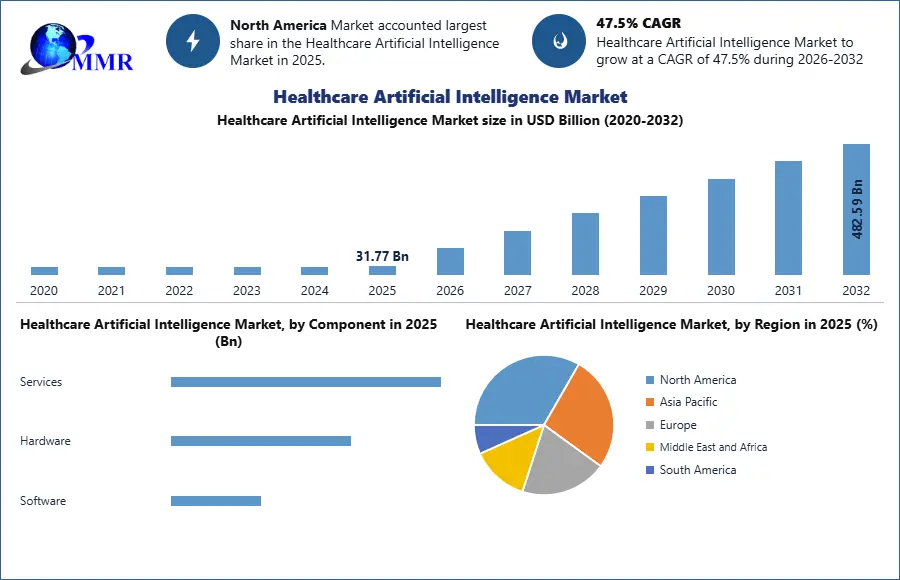
- Healthcare Artificial Intelligence Market valued at USD 31.77 Billion in 2025.
- Market projected to reach USD 482.59 Billion by 2032.
- Expected CAGR of 47.5% during 2025–2032.
- North America maintains leadership through advanced digital healthcare adoption.
- AI-powered diagnostics, predictive analytics, and clinical decision support remain major growth engines.
- Precision medicine and hospital workflow automation continue expanding enterprise AI investments.
- Pharmaceutical companies increasingly deploy AI to accelerate drug discovery and clinical research.
- Emerging economies are strengthening healthcare infrastructure with AI-enabled digital transformation.
Why This Matters Now
Healthcare systems are facing rising patient volumes, workforce shortages, and increasing treatment costs at the same time. Artificial intelligence is moving from pilot programs to enterprise-wide deployment because healthcare providers need measurable improvements in clinical efficiency and patient outcomes.
For pharmaceutical companies, hospitals, insurers, and technology providers, the pace of AI adoption has become a competitive differentiator rather than a future investment. The Healthcare Artificial Intelligence Market, valued at USD 31.77 Billion in 2025, is expected to reach USD 482.59 Billion by 2032, growing at a remarkable 47.5% CAGR. That trajectory signals a structural transformation across diagnosis, treatment planning, hospital operations, medical research, and personalized healthcare.
Market Overview
The Healthcare Artificial Intelligence Market is redefining healthcare by enabling faster diagnosis, improving clinical decision-making, reducing administrative workloads, and supporting personalized treatment strategies. Machine learning, natural language processing, computer vision, and predictive analytics are now integrated across healthcare delivery, medical imaging, electronic health records, and pharmaceutical research.
Healthcare organizations increasingly view AI as a strategic investment rather than an experimental technology. Hospital administrators seek operational efficiency. Clinicians require better diagnostic support. Pharmaceutical companies accelerate research timelines. Insurers pursue improved risk assessment and value-based care models.
The market is also benefiting from expanding digital health ecosystems, increasing healthcare data availability, cloud computing adoption, and stronger investments in healthcare IT infrastructure. Regulatory agencies across major economies are gradually establishing frameworks that encourage responsible AI deployment while maintaining patient safety.
Key Trends Driving Growth
Medical imaging remains one of the strongest areas for AI deployment. Deep learning algorithms assist radiologists by identifying abnormalities earlier, improving diagnostic accuracy, and reducing interpretation time. Faster diagnosis directly influences treatment outcomes while helping healthcare providers manage increasing imaging volumes.
Predictive analytics has become equally important. Hospitals increasingly rely on AI models to identify high-risk patients, optimize resource allocation, reduce hospital readmissions, and improve care coordination. These capabilities generate measurable financial returns while supporting better clinical performance.
Precision medicine continues gaining momentum as healthcare providers leverage AI to analyze genomic, clinical, and lifestyle data. Personalized treatment recommendations enable more targeted therapies, particularly in oncology and rare diseases.
Pharmaceutical and biotechnology companies are expanding AI investments to shorten drug discovery cycles, improve clinical trial efficiency, identify new therapeutic targets, and reduce development costs. As research complexity increases, AI becomes a competitive necessity across the life sciences industry.
Digital health adoption is further strengthening market growth. Remote patient monitoring, telehealth platforms, wearable health technologies, and connected healthcare ecosystems generate massive datasets that enhance AI model performance and support continuous patient management.
Healthcare reimbursement models are also evolving. Value-based care encourages providers to improve outcomes while controlling costs, making AI-powered clinical decision support and operational optimization increasingly attractive investments.
Get a free sample:https://www.maximizemarketresearch.com/request-sample/9847/
Segment Insights
- Dominant Segment: Software solutions continue to account for the largest market share as healthcare providers prioritize scalable AI platforms for diagnostics, workflow automation, predictive analytics, and clinical decision support.
- Fastest-Growing Segment: AI applications in medical imaging and diagnostics are experiencing rapid expansion as providers seek earlier disease detection, faster reporting, and improved diagnostic confidence.
- AI-enabled clinical decision support systems help physicians make evidence-based treatment decisions using real-time patient information.
- Predictive analytics solutions improve patient management by identifying disease progression risks before complications occur.
- AI-powered drug discovery platforms reduce research timelines while improving candidate molecule identification for pharmaceutical companies.
- Cloud-based healthcare AI deployments continue increasing due to lower infrastructure costs and improved scalability.
Regional Growth Story
North America continues leading the Healthcare Artificial Intelligence Market due to advanced healthcare infrastructure, substantial healthcare expenditure, mature digital health ecosystems, and strong investment from technology companies, hospitals, and pharmaceutical manufacturers. The United States remains at the center of AI innovation, supported by active regulatory development and widespread enterprise adoption.
Germany and the UK continue expanding AI implementation across diagnostics, hospital management, and precision medicine. Public healthcare modernization programs and increasing digital health investments are accelerating adoption while strengthening research collaborations between healthcare institutions and technology developers.
China has become one of the fastest-expanding AI healthcare markets through substantial government support, digital hospital initiatives, and growing healthcare technology investments. Large patient datasets also strengthen AI model development across diagnostics and clinical research.
Japan focuses on AI to address aging population challenges, workforce shortages, and chronic disease management. Healthcare providers increasingly integrate AI into hospital operations and diagnostic workflows to improve efficiency.
India is experiencing accelerating AI adoption through expanding digital health initiatives, improving healthcare infrastructure, and increasing investments in telemedicine and healthcare analytics. AI solutions help extend healthcare access while supporting resource optimization across urban and rural settings.
South Korea continues investing heavily in digital healthcare, smart hospitals, and biotechnology innovation, positioning itself as a regional leader in AI-enabled healthcare technologies.
Competitive Landscape
Competition is shifting beyond standalone AI software toward integrated healthcare ecosystems. Technology providers increasingly collaborate with hospitals, pharmaceutical companies, medical device manufacturers, and research institutions to deliver comprehensive AI-enabled healthcare solutions.
Companies are expanding product portfolios through acquisitions, strategic partnerships, cloud integration, and advanced analytics capabilities. Competitive advantage increasingly depends on clinical validation, interoperability with hospital information systems, regulatory compliance, cybersecurity, and demonstrated improvements in patient outcomes.
Investment activity also indicates growing confidence in AI’s long-term commercial potential. Organizations capable of combining high-quality healthcare data with scalable AI platforms are strengthening their market positions while creating barriers for new entrants.
Recent Developments
- AI integration continues expanding across hospital diagnostic workflows.
- Pharmaceutical companies are increasing AI investments to accelerate drug discovery and clinical development.
- Healthcare organizations continue adopting predictive analytics for population health management.
- Digital health platforms increasingly incorporate AI-enabled remote patient monitoring capabilities.
- Precision medicine initiatives continue driving investment in AI-powered genomic analytics.
- Cloud-based healthcare AI deployments are expanding across both developed and emerging healthcare markets.
Strategic Implications
Healthcare executives must evaluate AI investments beyond technology adoption. Successful implementation requires integration with existing clinical workflows, physician engagement, data governance, cybersecurity, and measurable outcome improvements.
Hospital networks that successfully deploy AI can improve operational efficiency, enhance diagnostic accuracy, reduce administrative burdens, and strengthen financial performance. Pharmaceutical companies benefit from accelerated research productivity and improved clinical trial success rates.
For investors, sustained market expansion highlights opportunities across healthcare software, digital diagnostics, medical imaging, cloud healthcare platforms, and AI-enabled biotechnology innovation. Regulatory clarity and reimbursement alignment will increasingly determine commercial success across major healthcare markets.
Future Outlook
Healthcare artificial intelligence is transitioning from operational support to becoming an essential clinical capability across diagnosis, treatment planning, drug development, and patient management. As healthcare systems continue digitizing and data availability expands, AI will increasingly influence every stage of care delivery. Organizations that combine trusted clinical evidence, scalable AI platforms, and strong regulatory compliance will define the next generation of healthcare leadership, while slower adopters risk losing both clinical and competitive advantage.
Analyst Perspective
“Artificial intelligence is rapidly becoming a strategic foundation for modern healthcare rather than an emerging technology. Organizations that integrate AI across diagnostics, clinical workflows, precision medicine, and pharmaceutical innovation will be better positioned to improve patient outcomes while achieving sustainable operational growth,” — Komal Patil, Analyst
About Maximize Market Research
Maximize Market Research Pvt. Ltd. (MMR) is a global market research and consulting company that provides reliable, data-focused, and practical business insights. The firm serves a wide range of industries, including healthcare, pharmaceuticals, technology, automotive, electronics, chemicals, personal care, and consumer goods. Through market forecasts, competitive analysis, strategic consulting, and industry impact assessments, MMR helps organizations understand changing market conditions, identify growth opportunities, and make informed business decisions for long-term success.
2nd Floor, Navale IT Park Phase 3
Pune Banglore Highway, Narhe
Pune, Maharashtra 411041, India
+91 9607365656
sales@maximizemarketresearch.com
