Key Highlights
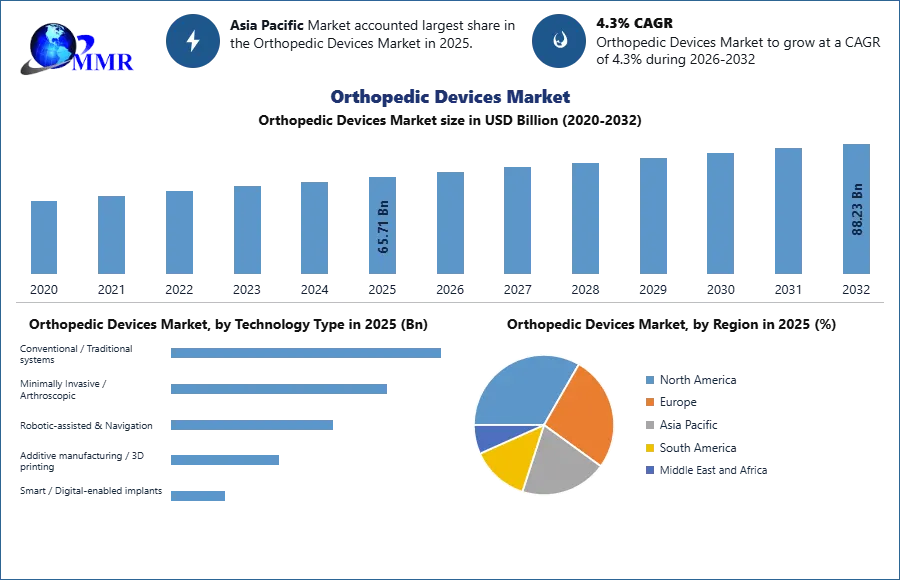
- Market valued at USD 60.84 Billion in 2025 and projected to reach USD 88.23 Billion by 2032
- CAGR of 4.3% during 2025–2032 indicates stable, procedure-driven expansion
- Growth tied to rising orthopedic surgical interventions and aging demographics
- Hospital infrastructure expansion strengthens device adoption rates
- Increasing focus on advanced surgical tools and implant precision
- Report sourced exclusively from Maximize Market Research (MMR)
Why This Matters Now
Orthopedic systems are facing sustained demand pressure as musculoskeletal disorders increase across aging populations and physically active younger cohorts. Hospitals are seeing higher case volumes for joint reconstruction, trauma repair, and spine-related conditions, forcing procurement cycles to accelerate.
At the same time, healthcare systems are under pressure to improve surgical outcomes while reducing recovery times. This is shifting purchasing behavior toward advanced orthopedic devices that support minimally invasive procedures, faster rehabilitation, and long-term implant durability. The USD 88.23 Billion projection signals predictable but structurally essential growth for medtech manufacturers and hospital networks.
Market Overview
The Orthopedic Devices Market is positioned as a core segment of global medical technology, anchored in surgical intervention and long-term mobility restoration. The market is valued at USD 60.84 Billion in 2025 and is projected to expand to USD 88.23 Billion by 2032, reflecting a 4.3% CAGR.
This trajectory indicates a stable demand environment rather than cyclical expansion. Orthopedic procedures are largely non-discretionary, driven by trauma incidents, degenerative diseases, and age-related joint deterioration. Hospitals remain the primary consumption hubs, with procurement closely tied to surgical volumes and reimbursement frameworks.
The MMR report emphasizes overall market growth without detailing granular segmentation or regional splits in the provided source. However, the structural direction points to increased adoption of advanced orthopedic solutions across established healthcare systems.
Key Trends Driving Growth
Healthcare systems are increasingly prioritizing surgical efficiency and long-term patient mobility outcomes. This is driving sustained investment in orthopedic infrastructure across hospitals and specialty surgical centers.
Rising surgical volumes are being influenced by aging populations and increasing prevalence of lifestyle-related musculoskeletal conditions. These dynamics are placing pressure on healthcare providers to expand orthopedic capacity, including operating room upgrades and implant procurement strategies.
In parallel, healthcare spending is shifting toward value-based care models. Providers are incentivized to reduce revision surgeries and improve recovery timelines, indirectly boosting demand for higher-quality orthopedic devices with longer functional lifespans.
Get a free sample:https://www.maximizemarketresearch.com/request-sample/66301/
Segment Insights
- Dominant Segment: Not specified in the provided MMR report source
- Fastest-Growing Segment: Not specified in the provided MMR report source
The report does not disclose segmented breakdowns in the available content. However, the overall market expansion indicates broad-based adoption across orthopedic applications linked to surgical intervention, trauma care, and degenerative disease management.
Hospitals remain the central adoption point due to high procedural throughput and reimbursement-linked procurement. Demand patterns are closely aligned with surgical specialties rather than isolated product categories.
Regional Growth Story
The MMR source does not provide a detailed regional breakdown in the supplied URL content. However, orthopedic device demand is typically concentrated in major healthcare economies with high surgical infrastructure capacity.
Healthcare systems with advanced hospital networks and high procedure volumes are expected to remain key consumption centers. Growth is also influenced by rising healthcare expenditure and expanding access to surgical care in emerging economies.
The strategic direction of the market suggests continued global diffusion of orthopedic procedures as medical infrastructure improves and elective surgery backlogs normalize post-system disruptions.
Competitive Landscape
The competitive environment in the Orthopedic Devices Market is shaped by innovation in implant design, surgical precision tools, and post-operative care integration. Companies operating in this space compete on durability, procedural efficiency, and clinical outcomes.
Procurement decisions are increasingly influenced by hospital networks and group purchasing organizations, which prioritize cost-effectiveness alongside performance outcomes. This is intensifying competition among established device manufacturers and emerging medtech firms.
The market structure favors players with strong regulatory compliance capabilities and established hospital distribution channels.
Recent Developments
- No specific product launches, approvals, or investments are detailed in the provided MMR report source
- Market expansion is primarily driven by procedural demand and healthcare infrastructure utilization
- Hospitals continue to upgrade surgical systems to support orthopedic procedure volumes
- Manufacturers are focusing on efficiency-driven device portfolios aligned with hospital needs
Strategic Implications
The steady CAGR signals predictable revenue streams for manufacturers but also intensifying competition in hospital procurement cycles. Companies that align with hospital efficiency goals and long-term patient outcomes will gain stronger positioning.
For healthcare providers, rising orthopedic demand requires expanded surgical capacity and improved device inventory planning. Payers are increasingly focused on cost containment, pushing adoption of devices that reduce revision surgeries and long-term complications.
For investors, the market represents stable medtech exposure with limited volatility but strong dependency on demographic and procedural growth trends.
Future Outlook
The Orthopedic Devices Market will increasingly be shaped by hospital efficiency pressures and long-term mobility outcomes rather than short-term product innovation cycles alone.
Analyst Perspective
“Orthopedic device demand is entering a structurally steady phase where growth is defined less by disruption and more by sustained surgical need and healthcare system capacity expansion,” says Komal Patil, Analyst, Maximize Market Research.
About Maximize Market Research
Maximize Market Research Pvt. Ltd. (MMR) is a global market research and consulting company that provides reliable, data-focused, and practical business insights. The firm serves a wide range of industries, including healthcare, pharmaceuticals, technology, automotive, electronics, chemicals, personal care, and consumer goods. Through market forecasts, competitive analysis, strategic consulting, and industry impact assessments, MMR helps organizations understand changing market conditions, identify growth opportunities, and make informed business decisions for long-term success.
2nd Floor, Navale IT Park Phase 3
Pune Banglore Highway, Narhe
Pune, Maharashtra 411041, India
+91 9607365656
sales@maximizemarketresearch.com
