Key Highlights
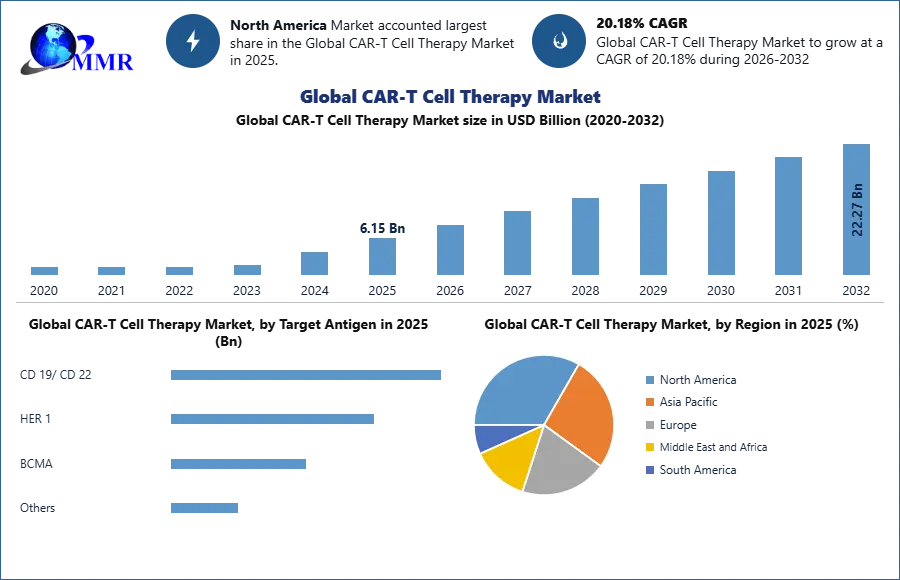
Market value: USD 6.15 billion in 2025
Forecast value: USD 22.27 billion by 2032
Forecast CAGR: 20.18% (2026–2032)
Rising global cancer incidence continues to increase demand for advanced immunotherapies.
Government funding and oncology research programs are expanding clinical development.
Hospitals remain central to CAR-T administration because of specialized treatment requirements.
Asia-Pacific is emerging as an important investment destination for manufacturing and clinical research.
Why This Matters Now
Cancer incidence continues to increase across major healthcare markets, creating sustained demand for therapies capable of treating patients who have exhausted conventional options. The report highlights that more than 1.7 million new cancer cases occur annually in the United States, while China records nearly 4.3 million new cases, reinforcing the need for innovative treatment approaches. Every increase in eligible patients expands opportunities for hospitals, manufacturers, diagnostic providers, and specialized treatment centers.
Healthcare spending is increasingly shifting toward high-value therapies capable of delivering improved clinical outcomes. Governments are simultaneously investing in oncology research and advanced healthcare infrastructure, creating conditions that support wider commercialization of CAR-T technologies despite their high cost.
Market Overview
CAR-T cell therapy has moved beyond being an experimental technology. It has become one of the most significant advances in personalized oncology by engineering a patient’s own immune cells to recognize and destroy cancer cells.
The market’s expansion is being driven by three structural forces. First, rising cancer prevalence increases the pool of eligible patients. Second, biotechnology companies continue improving cell engineering technologies and manufacturing capabilities. Third, governments are increasing financial support for cancer research programs designed to accelerate access to advanced therapies.
The report also identifies a major challenge. CAR-T therapies remain expensive, limiting accessibility across many healthcare systems and creating reimbursement pressures that influence commercial adoption. As manufacturers pursue manufacturing efficiencies and broader clinical experience accumulates, reducing overall treatment costs will remain central to market expansion.
Key Trends Driving Growth
Precision medicine continues to redefine oncology treatment strategies. Rather than relying solely on traditional chemotherapy, physicians increasingly seek therapies tailored to individual patients, positioning CAR-T among the most advanced personalized treatment options available.
Government funding represents another catalyst. The report highlights initiatives such as the U.S. Cancer Moonshot, supported by substantial investment to accelerate research and expand treatment availability. Such programs improve research capacity while encouraging collaboration between academia, hospitals, biotechnology companies, and pharmaceutical manufacturers.
Hospital infrastructure is also evolving. Delivering CAR-T therapy requires specialized clinical expertise, advanced laboratory capabilities, patient monitoring, and coordinated multidisciplinary care. Healthcare providers investing in these capabilities strengthen their competitive position within oncology services.
Pharmaceutical and biotechnology companies continue expanding research pipelines targeting additional cancers and novel target antigens. Each successful clinical advance broadens the commercial opportunity while improving long-term patient outcomes.
Request a Free Sample Copy or View Report Summary: https://www.maximizemarketresearch.com/request-sample/98045/
Segment Insights
Dominant Target Antigen: CD19/CD22 segment.
Dominant Therapeutic Application: Acute Lymphocytic Leukemia remains a major therapeutic application.
Dominant Disease Indication: Leukemia represents a leading disease indication.
Dominant End User: Hospitals account for the largest end-user segment because specialized infrastructure, multidisciplinary care teams, and intensive patient monitoring are required for CAR-T administration.
Fastest-Growing Segment: The report does not specify the fastest-growing segment.
Regional Growth Story
North America continues to lead global adoption through strong healthcare expenditure, advanced oncology centers, active biotechnology innovation, and supportive research funding. The United States benefits from substantial investment in cancer research and specialized hospital infrastructure, strengthening commercialization opportunities.
Germany and the United Kingdom continue expanding advanced oncology capabilities through established healthcare systems and increasing precision medicine adoption. Their reimbursement frameworks and clinical research ecosystems remain important for long-term market development.
China represents one of the largest patient populations worldwide, creating considerable demand for innovative therapies. Rising healthcare investment and expanding biotechnology research position the country as a major future growth engine.
Japan and South Korea continue advancing regenerative medicine and cell therapy innovation through strong pharmaceutical research and technology development.
India presents emerging opportunities through expanding oncology infrastructure, increasing healthcare investment, and growing biotechnology capabilities, although affordability remains a significant consideration for widespread adoption.
Competitive Landscape
Competition increasingly centers on manufacturing capability, clinical evidence, pipeline expansion, and commercialization expertise rather than product availability alone.
Leading companies including Gilead Sciences (Kite Pharma), Novartis, Bristol Myers Squibb, Johnson & Johnson, Takeda, Astellas Pharma, GSK, Eli Lilly, Autolus Therapeutics, Allogene Therapeutics, CARsgen Therapeutics, JW Therapeutics, and others are investing across research, clinical development, manufacturing, and strategic partnerships. These investments signal continued confidence in personalized oncology while positioning companies for broader indications and expanded geographic reach.
Competitive advantage will increasingly depend on shortening manufacturing timelines, improving treatment accessibility, expanding approved indications, and demonstrating value to healthcare payers.
Recent Developments
Government funding initiatives continue supporting cancer research and advanced cell therapy development.
Pharmaceutical and biotechnology companies are expanding research pipelines targeting additional cancer indications.
Healthcare providers are investing in specialized infrastructure required for CAR-T administration.
Asia-Pacific continues attracting research and investment activity as manufacturers pursue future expansion opportunities.
Strategic Implications
Healthcare executives should view CAR-T therapy as a long-term infrastructure investment rather than a standalone treatment offering. Hospitals capable of integrating specialized oncology services, advanced diagnostics, laboratory capabilities, and multidisciplinary care will be better positioned to capture future demand.
For biotechnology companies, sustained investment in manufacturing efficiency and clinical innovation will determine commercial leadership. For investors, companies demonstrating scalable production, broader pipelines, and stronger reimbursement positioning may secure competitive advantages as adoption expands globally.
Payers and regulators will increasingly influence market direction through reimbursement policies that balance innovation with healthcare affordability.
Future Outlook
CAR-T cell therapy is transitioning from a specialized oncology innovation toward a broader commercial platform for personalized cancer treatment. Continued investment in research, manufacturing, healthcare infrastructure, and clinical development is expected to expand patient access while supporting sustained market growth. The organizations that combine scientific innovation with scalable manufacturing, clinical evidence, and reimbursement readiness will define the next generation of leaders in precision oncology.
Analyst Perspective
“The CAR-T Cell Therapy Market is entering a period where scientific innovation and commercial scalability must advance together. Organizations that successfully combine research excellence, manufacturing efficiency, and patient accessibility will shape the future of personalized oncology,” — Komal Patil, Analyst.
About Maximize Market Research
Maximize Market Research Pvt. Ltd. (MMR) is a global market research and consulting company that provides reliable, data-focused, and practical business insights. The firm serves a wide range of industries, including healthcare, pharmaceuticals, technology, automotive, electronics, chemicals, personal care, and consumer goods. Through market forecasts, competitive analysis, strategic consulting, and industry impact assessments, MMR helps organizations understand changing market conditions, identify growth opportunities, and make informed business decisions for long-term success.
2nd Floor, Navale IT Park Phase 3
Pune Banglore Highway, Narhe
Pune, Maharashtra 411041, India
+91 9607365656
sales@maximizemarketresearch.com
