Key Highlights
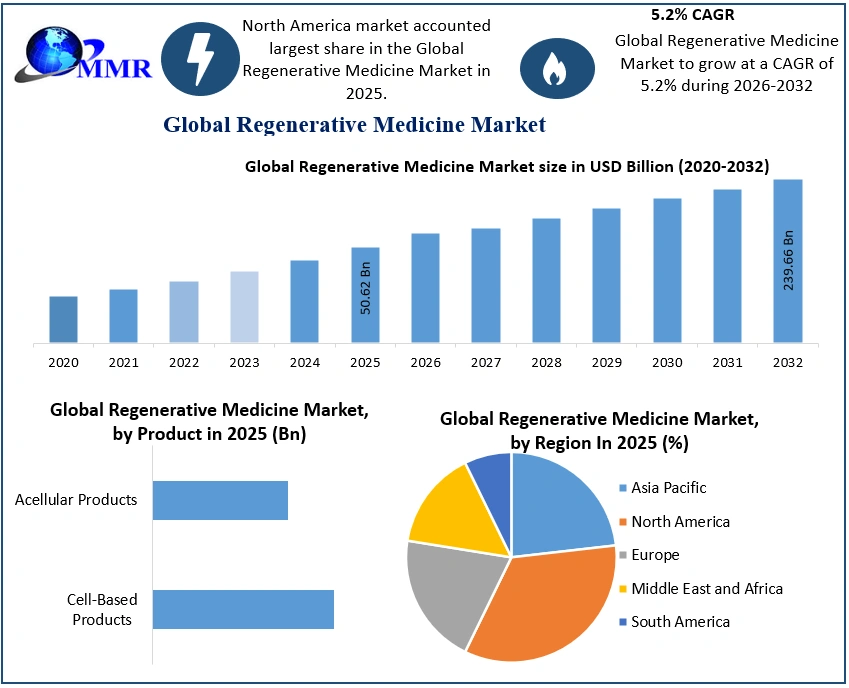
Market value (2025): USD 50.62 billion.
Forecast value (2032): USD 239.66 billion.
Forecast CAGR: 24.87% (2026–2032).
North America holds the largest regional market share.
Cell therapy, gene therapy, tissue engineering, and immunotherapy continue expanding clinical applications.
Rising chronic disease incidence and aging populations are increasing demand for regenerative treatments.
Government research funding and biotechnology investment continue accelerating innovation.
Why This Matters Now
Healthcare systems worldwide are moving beyond symptom management toward therapies designed to restore damaged tissues and improve long-term patient outcomes. As populations age and chronic diseases become more prevalent, regenerative medicine is becoming increasingly important for conditions where conventional treatment options remain limited.
The business implications extend well beyond pharmaceutical development. Hospitals require specialized infrastructure, biotechnology companies are scaling manufacturing capabilities, and investors are directing capital toward platforms capable of supporting multiple therapeutic applications. Every successful regenerative therapy expands opportunities across diagnostics, clinical care, advanced manufacturing, and value-based healthcare delivery.
Market Overview
Regenerative medicine combines cell-based products, gene therapy, tissue engineering, and immunotherapy to repair, replace, or regenerate damaged tissues and organs. The market has progressed from research-focused innovation toward commercial adoption across multiple disease areas.
Growth is supported by increasing healthcare expenditure, expanding clinical research, and technological advances in biotechnology. Healthcare providers are adopting regenerative approaches to improve outcomes while reducing the long-term burden associated with chronic disease management.
The market also benefits from greater collaboration between biotechnology companies, pharmaceutical manufacturers, academic institutions, and government research organizations. These partnerships shorten development timelines while expanding commercialization opportunities across global healthcare markets.
Key Trends Driving Growth
The transition toward precision medicine continues to reshape treatment strategies. Regenerative medicine enables therapies tailored to disease biology and individual patient characteristics, creating opportunities to improve clinical outcomes beyond conventional pharmaceuticals.
Biotechnology innovation remains a primary growth engine. Advances in cell engineering, tissue engineering, and gene therapy continue expanding therapeutic possibilities across oncology, cardiovascular disease, musculoskeletal disorders, dermatology, ophthalmology, and immunological conditions.
Hospital infrastructure is evolving alongside treatment complexity. Specialized laboratories, advanced manufacturing capabilities, multidisciplinary clinical teams, and integrated patient monitoring are becoming increasingly important as regenerative therapies move into routine clinical practice.
Pharmaceutical companies are expanding investments across regenerative medicine pipelines, while governments continue supporting research programs designed to accelerate commercialization. These investments improve scientific capability while strengthening competitive positioning in one of healthcare’s highest-growth segments.
Digital technologies also support research, manufacturing quality, and clinical workflow optimization. However, the report does not specifically identify AI integration, telehealth adoption, or reimbursement developments as major market segments and therefore no further assumptions are made.
Request a Free Sample Copy or View Report Summary: https://www.maximizemarketresearch.com/request-sample/35229/
Segment Insights
Dominant Product Segment: Cell-Based Products.
Dominant Therapy Segment: The report categorizes the market into Cell Therapy, Gene Therapy, Tissue Engineering, and Immunotherapy but does not specify the largest therapy segment.
Dominant End User: Commercial Industries.
Application Areas: Dermatology, Musculoskeletal, Immunology & Inflammation, Oncology, Cardiovascular, Ophthalmology, and Others.
Fastest-Growing Segment: Not specified in the report.
Regional Growth Story
North America remains the largest regional market, supported by advanced healthcare infrastructure, significant biotechnology investment, strong research capabilities, and early adoption of regenerative therapies. The United States continues to benefit from established pharmaceutical ecosystems and sustained investment in innovative therapeutics.
Germany and the United Kingdom strengthen Europe’s competitive position through advanced biomedical research, established healthcare systems, and pharmaceutical innovation. Both countries continue supporting clinical development across cell therapy and tissue engineering.
China is expanding rapidly through increased healthcare investment, biotechnology research, and manufacturing capabilities. Japan maintains leadership in regenerative medicine research supported by pharmaceutical innovation, while South Korea continues investing in advanced biotechnology and cell therapy development.
India represents an emerging opportunity as healthcare infrastructure expands and biotechnology capabilities continue improving. Increasing healthcare demand and research investment position the country for long-term market participation, although widespread commercial adoption will depend on affordability and infrastructure development.
Competitive Landscape
Competition increasingly centers on platform technologies rather than individual products. Companies capable of integrating cell therapy, gene therapy, tissue engineering, and scalable manufacturing are building durable competitive advantages.
Major participants include Integra LifeSciences, Osiris Therapeutics, Amgen, ThermoGenesis Holdings, U.S. Stem Cell, Bristol Myers Squibb, Eli Lilly, Organogenesis, Pfizer, Abbott, Baxter International, Astellas Pharma, Bayer, Merck KGaA, Boehringer Ingelheim, Novartis, Roche, GSK, AstraZeneca, Takara Bio, and Corline Biomedical. Their continued investment signals confidence that regenerative medicine will become an increasingly important component of future healthcare delivery rather than a niche therapeutic category.
Recent Developments
Pharmaceutical and biotechnology companies continue expanding regenerative medicine research portfolios.
Investment in cell therapy, gene therapy, and tissue engineering platforms is increasing globally.
Commercial organizations remain the leading end users, demonstrating expanding industrial adoption.
Government and academic institutions continue supporting translational research that advances commercialization.
Strategic Implications
Healthcare executives should view regenerative medicine as an infrastructure strategy rather than solely a therapeutic opportunity. Success increasingly depends on integrating advanced diagnostics, specialized laboratories, manufacturing capability, and multidisciplinary clinical expertise.
For pharmaceutical and biotechnology companies, competitive differentiation will depend on pipeline diversity, manufacturing scalability, and successful clinical translation. Investors are likely to favor organizations capable of demonstrating repeatable commercial platforms across multiple disease indications instead of isolated product successes.
Healthcare systems must also prepare for changing reimbursement discussions as regenerative therapies increasingly compete on long-term clinical outcomes and lifetime healthcare value.
Future Outlook
Regenerative medicine is transitioning from scientific promise to commercial reality, creating opportunities across pharmaceuticals, biotechnology, hospitals, diagnostics, and advanced manufacturing. Organizations that combine scalable innovation, clinical evidence, manufacturing excellence, and healthcare integration will lead the next phase of regenerative medicine, while those that fail to industrialize their platforms risk falling behind.
Analyst Perspective
“Regenerative medicine is moving beyond experimental science into mainstream healthcare investment. Companies that successfully integrate scientific innovation with commercial scalability will define the industry’s next growth cycle,” — Komal Patil, Analyst.
About Maximize Market Research
Maximize Market Research Pvt. Ltd. (MMR) is a global market research and consulting company that provides reliable, data-focused, and practical business insights. The firm serves a wide range of industries, including healthcare, pharmaceuticals, technology, automotive, electronics, chemicals, personal care, and consumer goods. Through market forecasts, competitive analysis, strategic consulting, and industry impact assessments, MMR helps organizations understand changing market conditions, identify growth opportunities, and make informed business decisions for long-term success.
2nd Floor, Navale IT Park Phase 3
Pune Banglore Highway, Narhe
Pune, Maharashtra 411041, India
+91 9607365656
sales@maximizemarketresearch.com
