Key Highlights
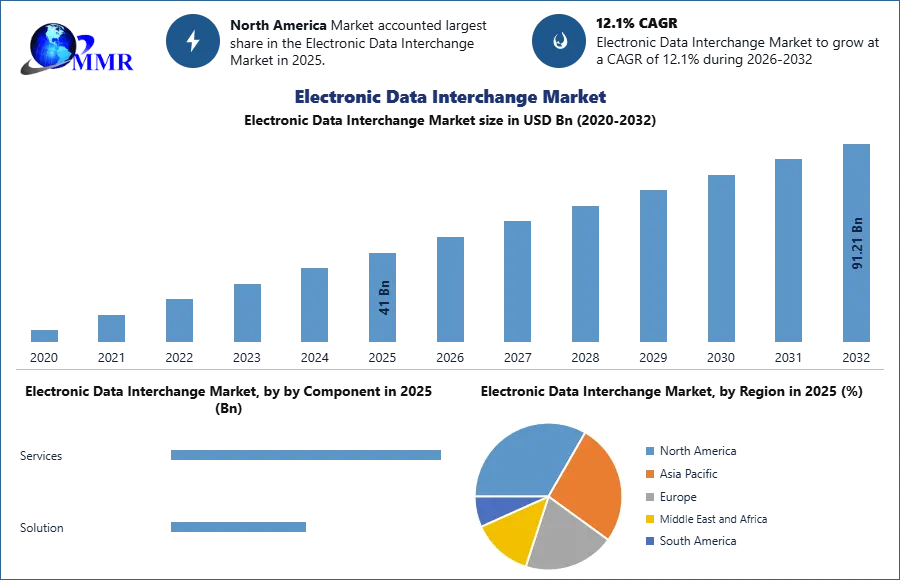
Global Electronic Data Interchange (EDI) Market valued at USD 41 Bn in 2025.
Market projected to reach USD 91.21 Bn by 2032.
Forecast CAGR stands at 12.1%.
Solution segment led the market by component.
Cloud-Based EDI dominated deployment.
North America remained the leading regional market.
AI, cloud computing, automation, and digital supply chain transformation continue to reshape enterprise adoption.
Why This Matters Now
Enterprise technology leaders are rebuilding digital supply chains around automation rather than manual processes. As AI, cloud computing, and real-time business connectivity become competitive necessities, Electronic Data Interchange (EDI) is evolving from a back-office integration tool into core digital infrastructure.
The market’s growth from USD 41 Bn in 2025 to USD 91.21 Bn by 2032 signals more than expanding software spending. It reflects accelerating enterprise investment in automated B2B transactions, cloud-native integration, and resilient global supply chains that can respond faster to changing business conditions.
Market Overview
Electronic Data Interchange continues to replace paper-based business communication with standardized digital transactions across procurement, logistics, manufacturing, retail, healthcare, and financial operations. Organizations increasingly view EDI as a strategic platform supporting enterprise modernization rather than simply an operational efficiency tool.
Digital transformation initiatives remain the principal catalyst. Enterprises are modernizing ERP environments, integrating suppliers into cloud ecosystems, and automating procurement workflows to improve visibility across increasingly complex global supply chains. These investments reduce manual intervention while enabling faster order processing, compliance, and partner collaboration.
Cloud migration is reshaping deployment strategies. Businesses increasingly prefer scalable cloud platforms that simplify implementation, reduce infrastructure costs, and enable real-time data exchange across distributed operations. This shift aligns closely with broader enterprise SaaS adoption and hybrid cloud strategies.
Key Trends Driving Growth
Artificial intelligence is beginning to redefine EDI platforms. The report highlights growing integration of AI technologies to automate business processes, strengthen data quality, enhance transaction monitoring, and generate operational insights. AI moves EDI beyond document exchange toward intelligent workflow orchestration.
Cloud computing continues to transform deployment economics. Organizations increasingly replace traditional on-premises infrastructure with cloud-based EDI platforms that offer scalability, flexibility, and lower implementation barriers. This particularly benefits enterprises expanding partner ecosystems across multiple geographies.
Supply chain digitization is another structural driver. Global businesses require standardized communication across suppliers, distributors, manufacturers, and logistics providers. EDI enables seamless integration while supporting inventory optimization and faster fulfillment.
Automation is becoming a competitive requirement rather than an operational improvement. Organizations seek fewer manual errors, faster transaction processing, and improved compliance as digital commerce volumes continue expanding.
Cybersecurity also gains strategic importance. The report notes that emerging technologies, including AI and blockchain integration, are strengthening platform security while supporting trusted business-to-business communications.
Request a Free Sample Copy or View Report Summary: https://www.maximizemarketresearch.com/request-sample/90413/
Segment Insights
Dominant Segment: Solution segment led the market by component. Within solutions, EDI Integration Software represented the leading sub-segment as enterprises prioritized workflow automation, trading partner integration, and standards compliance.
Dominant Deployment: Cloud-Based EDI dominated deployment mode due to lower upfront investment, rapid implementation, scalability, and support for secure real-time business communication.
Fastest-Growing Segment: Not specified in the supplied report.
Regional Growth Story
North America leads the global Electronic Data Interchange market because enterprises continue investing aggressively in operational efficiency, supply chain modernization, and digital commerce. Growing retail activity and expanding e-commerce ecosystems increase demand for automated exchange of purchase orders, invoices, shipping notifications, and inventory information.
The region also benefits from mature cloud adoption and advanced enterprise software implementation. Organizations increasingly deploy cloud-native EDI platforms that support distributed operations while reducing infrastructure complexity.
Beyond North America, globalization continues to expand opportunities. International supply chains require standardized communication across geographically dispersed trading partners, creating sustained demand for interoperable digital integration platforms. The report also identifies sustainability as an additional adoption driver, with enterprises reducing paper consumption through electronic document exchange.
Competitive Landscape
Competition increasingly centers on platform ecosystems rather than standalone EDI products. Companies including SAP SE, IBM Corporation, Oracle Corporation, SPS Commerce Inc., OpenText Corporation, Cleo Communications LLC, MuleSoft LLC, Boomi Inc., Software AG, Comarch SA, EDICOM, Descartes Systems Group Inc., Axway Inc., and Infor Inc. continue expanding enterprise integration capabilities.
Technology leadership is shifting toward vendors capable of combining cloud integration, AI-driven automation, enterprise APIs, compliance management, and multi-cloud connectivity into unified business platforms. This evolution increases switching costs while strengthening long-term customer relationships.
Platform ecosystems are becoming decisive competitive advantages. Vendors integrating EDI with ERP, CRM, supply chain management, and cloud integration services position themselves to capture broader enterprise digital transformation spending rather than isolated integration projects.
Recent Developments
Cloud-based EDI deployment continues replacing traditional on-premises implementations.
AI integration is expanding automation and operational intelligence across EDI platforms.
Blockchain technologies are being incorporated to strengthen secure business transactions.
Growing digital transformation initiatives are accelerating enterprise investment in integrated business communication platforms.
Strategic Implications
For CIOs, EDI is increasingly becoming part of enterprise digital architecture instead of an isolated integration layer. Cloud-native deployment enables faster onboarding of suppliers while supporting hybrid cloud operating models.
For CTOs, AI-enabled automation offers opportunities to reduce manual intervention, improve transaction accuracy, and increase operational visibility. Technology investments increasingly focus on intelligent business process automation rather than document exchange alone.
For investors, sustained enterprise demand for cloud integration, digital commerce, and supply chain resilience supports long-term market expansion. Vendors capable of combining integration, analytics, automation, and cybersecurity into unified platforms are positioned to capture greater enterprise spending.
Future Outlook
The next phase of Electronic Data Interchange will be defined by intelligent automation, AI-assisted decision-making, cloud-native integration, and increasingly autonomous digital supply chains. Organizations that modernize EDI as part of broader enterprise platforms will build faster, more resilient ecosystems, while those relying on fragmented legacy integration risk losing operational speed, ecosystem connectivity, and competitive advantage.
Analyst Perspective
“The Electronic Data Interchange market is entering a new phase where cloud deployment, AI-enabled automation, and enterprise integration platforms are transforming EDI from a transactional technology into a strategic foundation for digital business operations and global supply chain resilience.” — Yash Ghosalkar
About Maximize Market Research
Maximize Market Research Pvt. Ltd. (MMR) is a global market research and consulting company that provides reliable, data-focused, and practical business insights. The firm serves a wide range of industries, including healthcare, pharmaceuticals, technology, automotive, electronics, chemicals, personal care, and consumer goods. Through market forecasts, competitive analysis, strategic consulting, and industry impact assessments, MMR helps organizations understand changing market conditions, identify growth opportunities, and make informed business decisions for long-term success.
2nd Floor, Navale IT Park Phase 3
Pune Banglore Highway, Narhe
Pune, Maharashtra 411041, India
+91 9607365656
sales@maximizemarketresearch.com
