Key Highlights
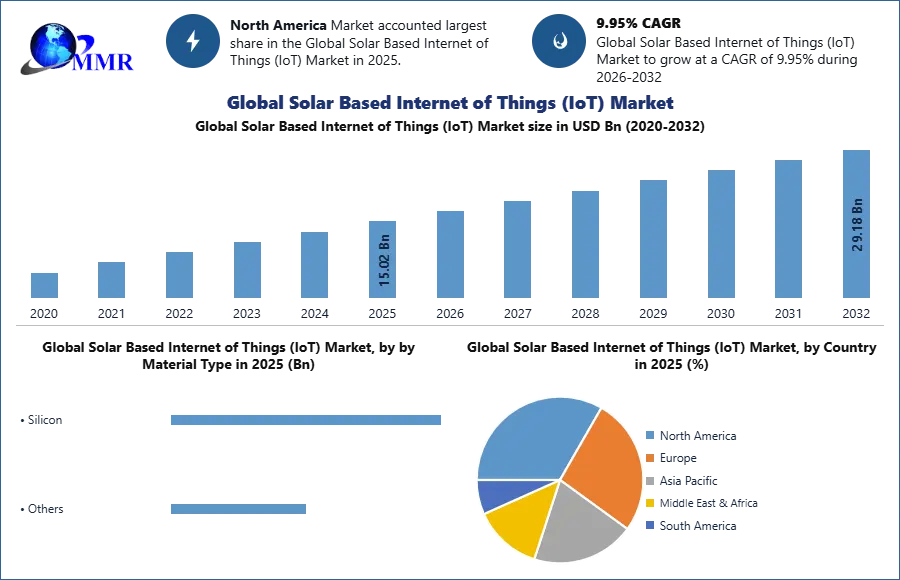
The Global Solar Based Internet of Things (IoT) Market was valued at USD 15.02 billion in 2025.
The market is projected to reach USD 29.18 billion by 2032.
The market is expected to expand at a CAGR of 9.95% during 2026–2032.
Growing deployment of renewable energy-powered connected devices is reshaping IoT infrastructure.
Smart city development, industrial automation, and remote monitoring applications continue expanding demand.
Digital transformation initiatives are increasing investments in energy-efficient IoT ecosystems.
Sustainable connectivity is becoming a strategic priority for enterprises and governments.
Why This Matters Now
The next wave of digital infrastructure is not only becoming smarter—it is becoming self-powered. As organizations expand connected device deployments across cities, industrial facilities, utilities, agriculture, and transportation, energy availability has become as critical as connectivity.
The Solar Based Internet of Things (IoT) Market, valued at USD 15.02 billion in 2025, is expected to reach USD 29.18 billion by 2032, growing at a 9.95% CAGR. That expansion reflects more than increasing IoT adoption. It signals a structural shift toward sustainable digital infrastructure capable of supporting billions of connected devices with reduced dependence on conventional power sources.
Market Overview
Solar-powered IoT solutions combine renewable energy generation with intelligent connected devices, enabling continuous operation in locations where grid access is limited, unreliable, or economically impractical. This capability is expanding deployment opportunities across industries pursuing digital transformation while reducing operational costs and environmental impact.
The market is evolving alongside broader enterprise modernization initiatives. Organizations increasingly require intelligent infrastructure capable of collecting, processing, and transmitting operational data without frequent battery replacement or extensive maintenance. Solar-powered IoT addresses both operational efficiency and sustainability objectives.
Rapid urbanization, smart infrastructure investments, and industrial digitization continue increasing demand for autonomous connected devices. These systems support environmental monitoring, asset tracking, precision agriculture, industrial automation, smart utilities, transportation networks, and public infrastructure management.
Key Trends Driving Growth
Digital transformation continues expanding the number of connected endpoints deployed across enterprise and public-sector environments. As IoT networks scale, organizations increasingly prioritize energy-efficient devices capable of long-term autonomous operation.
Artificial intelligence is strengthening the value proposition of solar-powered IoT ecosystems. AI-driven analytics transform sensor data into predictive insights supporting maintenance optimization, operational efficiency, resource management, and real-time decision-making. Although the report focuses primarily on market development rather than specific AI adoption metrics, AI increasingly enhances the business value delivered by connected infrastructure.
Cloud computing remains central to modern IoT architectures. Solar-powered sensors continuously collect operational data that is transmitted through cloud platforms for storage, analytics, visualization, and enterprise integration. Hybrid cloud environments enable organizations to scale connected infrastructure while maintaining operational flexibility across distributed assets.
Edge computing is also becoming increasingly important. Processing selected workloads closer to connected devices reduces latency, minimizes bandwidth consumption, and improves resilience for mission-critical applications operating in remote environments.
Telecommunications modernization further supports market expansion. Expanding wireless connectivity, LPWAN deployments, and ongoing 5G infrastructure investments improve communication between solar-powered devices and centralized enterprise platforms, enabling larger and more sophisticated IoT deployments.
Automation represents another structural trend. Intelligent sensors continuously monitor equipment, environmental conditions, infrastructure performance, and operational processes while reducing manual inspections and improving decision accuracy.
Request a Free Sample Copy or View Report Summary: https://www.maximizemarketresearch.com/request-sample/92188/
Segment Insights
Dominant Segment: The publicly available MMR report summary identifies segmentation by Component, Application, End User, and Region, but does not specify the dominant segment.
Fastest-Growing Segment: The publicly available report summary does not identify the fastest-growing segment among the reported categories.
Growing adoption across industrial monitoring, smart cities, agriculture, utilities, and environmental monitoring continues expanding market opportunities.
Renewable energy integration remains a defining characteristic across multiple application areas.
Regional Growth Story
North America continues benefiting from advanced digital infrastructure, growing enterprise IoT deployments, and increasing investment in smart infrastructure modernization. Organizations continue integrating renewable energy technologies into connected device strategies as sustainability becomes a business priority.
Asia-Pacific represents one of the market’s strongest long-term growth opportunities. Countries including China, India, Japan, and South Korea continue investing in smart cities, industrial automation, digital infrastructure, renewable energy, and connected public services. These initiatives create favorable conditions for large-scale deployment of solar-powered IoT solutions.
Europe maintains strong momentum through sustainability initiatives, renewable energy adoption, industrial digitalization, and smart infrastructure development. Regulatory emphasis on energy efficiency and environmental performance supports continued investment in solar-powered connected technologies.
Across all major markets, governments increasingly recognize connected renewable infrastructure as a strategic asset supporting digital competitiveness and environmental objectives.
Competitive Landscape
Competition increasingly centers on integrated technology ecosystems rather than standalone hardware. Companies including Cisco Systems, Huawei Technologies, ABB, Siemens, Schneider Electric, Bosch, Honeywell, Intel Corporation, Qualcomm Technologies, and STMicroelectronics compete by combining connectivity platforms, intelligent sensors, semiconductor technologies, industrial automation, cloud integration, and energy-efficient system design.
The competitive landscape signals broader convergence between telecommunications, renewable energy, industrial automation, and enterprise software markets. Organizations capable of integrating solar energy generation, IoT connectivity, AI-powered analytics, cloud platforms, and cybersecurity capabilities strengthen long-term competitive positioning.
Technology leadership increasingly depends on platform interoperability. Customers seek scalable ecosystems capable of integrating thousands of connected devices across diverse operating environments while maintaining centralized visibility and operational security.
Pricing power is also shifting toward providers delivering complete digital solutions rather than individual hardware products. Platform economics increasingly reward organizations capable of combining connectivity, analytics, device management, automation, and renewable energy technologies into unified offerings.
Recent Developments
Continued deployment of renewable energy-powered IoT infrastructure.
Rising adoption of connected devices supporting smart city initiatives.
Expansion of industrial IoT applications using autonomous energy sources.
Growing integration of cloud-based IoT management platforms.
Increasing enterprise investment in remote monitoring and predictive maintenance solutions.
Continued advancement of energy-efficient connected device technologies.
Strategic Implications
The Solar Based Internet of Things (IoT) Market extends beyond renewable energy adoption. It represents foundational infrastructure supporting enterprise digital transformation, industrial automation, telecommunications modernization, and intelligent public services.
Cloud providers benefit from increasing IoT-generated data requiring scalable analytics platforms. Telecom operators gain from expanding device connectivity across distributed environments. Enterprise technology leaders improve operational efficiency while reducing maintenance costs associated with battery-powered infrastructure.
Investors also benefit from exposure to multiple long-term technology trends including renewable energy, IoT expansion, AI-enabled automation, smart infrastructure, cloud computing, and edge intelligence.
Future Outlook
Solar-powered IoT will increasingly become part of next-generation digital infrastructure as enterprises deploy larger connected ecosystems requiring autonomous operation, intelligent analytics, and sustainable energy management. Organizations capable of integrating renewable power, AI-driven analytics, cloud-native platforms, secure connectivity, and scalable automation will establish lasting competitive advantage, while those relying on conventional infrastructure risk falling behind in the emerging intelligent, low-carbon digital economy.
Related Reports
Global Cloud GIS Market https://www.maximizemarketresearch.com/market-report/global-cloud-gis-market/25382/
Global Rapid Application Development Market https://www.maximizemarketresearch.com/market-report/global-rapid-application-development-market/28403/
Data Catalog Market https://www.maximizemarketresearch.com/market-report/global-data-catalog-market/1472/
Analyst Perspective
“The convergence of renewable energy and connected technologies is creating a new generation of intelligent infrastructure. Organizations that combine solar-powered IoT deployments with scalable digital platforms will be better positioned to support long-term digital transformation, operational resilience, and sustainable growth.” — Yash Ghosalkar
About Maximize Market Research
Maximize Market Research Pvt. Ltd. (MMR) is a global market research and consulting company that provides reliable, data-focused, and practical business insights. The firm serves a wide range of industries, including healthcare, pharmaceuticals, technology, automotive, electronics, chemicals, personal care, and consumer goods. Through market forecasts, competitive analysis, strategic consulting, and industry impact assessments, MMR helps organizations understand changing market conditions, identify growth opportunities, and make informed business decisions for long-term success.
2nd Floor, Navale IT Park Phase 3
Pune Banglore Highway, Narhe
Pune, Maharashtra 411041, India
+91 9607365656
sales@maximizemarketresearch.com
