Key Highlights
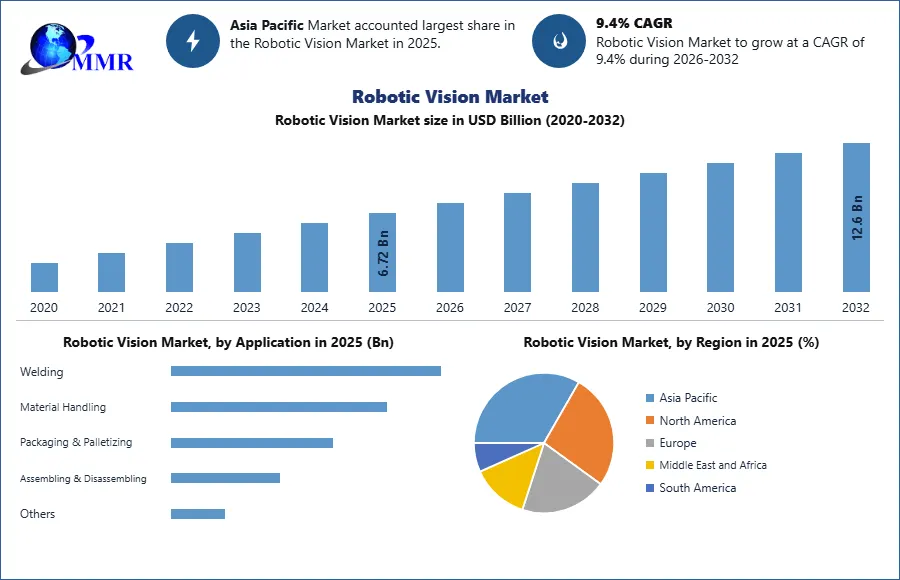
The Robotic Vision Market was valued at USD 6.72 billion in 2025.
The market is projected to reach USD 12.6 billion by 2032.
The market is expected to grow at a CAGR of 9.4% from 2025 to 2032.
AI-powered vision systems are expanding robotic capabilities across manufacturing environments.
Industry 4.0 initiatives continue driving investment in intelligent automation.
Machine vision technologies are improving inspection accuracy, quality control, and production efficiency.
Industrial digital transformation is increasing enterprise demand for vision-guided robotics.
Why This Matters Now
Industrial automation is entering a new phase where robots are expected not only to perform tasks but also to interpret their surroundings, identify defects, and make intelligent operational decisions. Vision has become one of the most valuable capabilities in modern robotics, transforming automation from repetitive execution into adaptive manufacturing.
The Robotic Vision Market, valued at USD 6.72 billion in 2025, is forecast to reach USD 12.6 billion by 2032, expanding at a 9.4% CAGR. That growth reflects rising investment in AI-powered machine vision, intelligent robotics, and digital manufacturing platforms as enterprises modernize production environments to improve quality, flexibility, and operational efficiency.
Market Overview
Robotic vision systems combine cameras, sensors, image processing, and intelligent software to enable robots to recognize objects, inspect products, navigate environments, and perform precision manufacturing tasks. These capabilities are becoming essential as manufacturers pursue higher automation levels while maintaining product quality and production flexibility.
The market is expanding alongside broader Industry 4.0 transformation initiatives. Manufacturers increasingly integrate robotic vision into automated production lines to improve productivity, reduce errors, minimize waste, and support real-time operational intelligence.
Robotic vision also strengthens enterprise competitiveness beyond manufacturing. Logistics, electronics, automotive, healthcare, food processing, and semiconductor industries increasingly deploy intelligent vision systems to automate complex inspection and material handling tasks that previously required manual intervention.
Key Trends Driving Growth
Artificial intelligence has fundamentally changed machine vision capabilities. AI-powered image recognition enables robotic systems to identify objects, detect production defects, classify products, and adapt to changing manufacturing conditions with significantly greater accuracy than conventional rule-based inspection systems.
Machine learning continues improving robotic decision-making by enabling systems to learn from production data rather than relying solely on predefined programming. This allows manufacturers to improve quality assurance while reducing downtime and operational variability.
Cloud computing increasingly supports robotic vision deployments by enabling centralized data management, production analytics, software updates, and enterprise-wide visibility across multiple manufacturing locations. Hybrid cloud architectures allow manufacturers to combine local operational control with enterprise-scale analytics and digital manufacturing management.
Edge computing complements cloud platforms by processing image data directly within production environments. Real-time image processing reduces latency, improves operational responsiveness, and enables robots to make immediate production decisions without depending on continuous cloud connectivity.
Industrial IoT integration is expanding robotic vision capabilities. Connected sensors, intelligent robots, automation platforms, and manufacturing execution systems increasingly share operational data, creating digital production environments capable of continuous optimization.
Enterprise software modernization further accelerates adoption. Robotic vision increasingly integrates with manufacturing execution systems, enterprise resource planning platforms, digital twins, predictive maintenance applications, and quality management software, creating unified digital manufacturing ecosystems.
Automation also extends beyond manufacturing. Warehousing, logistics, pharmaceutical production, consumer electronics assembly, and medical device manufacturing increasingly rely on robotic vision systems for precision handling, sorting, packaging, and inspection.
Request a Free Sample Copy or View Report Summary: https://www.maximizemarketresearch.com/request-sample/54764/
Segment Insights
Dominant Segment: The MMR report segments the market by Component, Robot Type, Application, End User, and Region, but the publicly available report summary does not specify the dominant segment.
Fastest-Growing Segment: The publicly available report summary does not identify the fastest-growing segment among the reported market categories.
Manufacturing remains a major application area for robotic vision systems supporting quality inspection and intelligent automation.
Growing deployment across automotive, electronics, logistics, food processing, and healthcare continues expanding market opportunities.
Regional Growth Story
North America continues maintaining a significant market position through advanced manufacturing capabilities, strong industrial automation adoption, and continued investment in AI-enabled production technologies. Manufacturers increasingly integrate robotic vision into smart factory initiatives supporting higher productivity and operational resilience.
Asia-Pacific represents one of the fastest-growing regional opportunities. China, Japan, South Korea, and India continue expanding industrial automation, semiconductor manufacturing, consumer electronics production, and advanced manufacturing investments. These developments continue driving demand for intelligent robotic vision solutions capable of supporting large-scale automated production.
Europe maintains strong momentum through Industry 4.0 initiatives, advanced manufacturing programs, industrial digitization, and precision engineering leadership. Manufacturers increasingly deploy robotic vision systems to strengthen product quality, operational flexibility, and sustainable manufacturing performance.
Across global markets, governments increasingly support advanced manufacturing modernization through policies encouraging industrial automation, digital transformation, and technology innovation.
Competitive Landscape
Competition increasingly focuses on intelligent automation ecosystems rather than standalone vision hardware. Companies including Cognex Corporation, Keyence Corporation, Basler AG, Omron Corporation, FANUC Corporation, ABB Ltd., Siemens AG, Intel Corporation, NVIDIA Corporation, and SICK AG continue expanding capabilities across AI-powered image processing, industrial robotics, edge computing, industrial software, and intelligent automation platforms.
The competitive landscape reflects growing convergence between robotics, artificial intelligence, industrial software, semiconductor technologies, and cloud computing. Customers increasingly seek integrated solutions combining cameras, sensors, AI software, robotic controllers, analytics platforms, and enterprise manufacturing applications.
Artificial intelligence has become a primary technology differentiator. Vendors capable of delivering higher image recognition accuracy, adaptive learning, predictive analytics, and simplified deployment strengthen long-term competitive positioning while improving customer productivity.
Platform integration increasingly influences purchasing decisions. Manufacturers prioritize vendors capable of integrating robotic vision with industrial IoT platforms, digital twins, manufacturing execution systems, and enterprise software environments, reducing operational complexity while improving scalability.
As manufacturing becomes increasingly software-defined, competitive advantage continues shifting toward companies offering complete intelligent automation platforms rather than isolated machine vision products.
Recent Developments
Continued deployment of AI-powered robotic vision systems.
Growing adoption of Industry 4.0 manufacturing initiatives.
Increased integration of machine vision with industrial automation platforms.
Rising investment in intelligent quality inspection technologies.
Expansion of cloud-connected manufacturing analytics.
Increasing adoption of robotic vision across logistics and warehouse automation.
Strategic Implications
Robotic vision has evolved into a strategic enabler of digital manufacturing rather than simply an inspection technology. Manufacturers improve productivity, reduce quality defects, and strengthen operational agility while addressing skilled labor shortages through intelligent automation.
Enterprise software providers benefit from increasing integration opportunities between robotic vision, manufacturing analytics, AI platforms, and industrial IoT systems. Cloud providers gain additional industrial workloads supporting manufacturing intelligence and predictive analytics.
For investors, robotic vision represents one of the most important technology segments within industrial automation, benefiting from structural demand driven by AI adoption, smart factories, enterprise modernization, and digital manufacturing transformation.
Future Outlook
The next generation of robotic vision will combine artificial intelligence, edge computing, industrial IoT, cloud-native manufacturing platforms, and autonomous robotics into intelligent production ecosystems capable of continuous learning and real-time optimization. Manufacturers that invest early in AI-driven robotic vision platforms will define the next era of digital industrial competitiveness, while those delaying intelligent automation risk falling behind in an increasingly software-defined manufacturing economy.
Related Reports
North America Virtual Data Room Market https://www.maximizemarketresearch.com/market-report/north-america-virtual-data-room-market/2443/
Global Industrial Networking Solutions Market https://www.maximizemarketresearch.com/market-report/industrial-networking-solutions-market/2933/
Transaction Monitoring Market https://www.maximizemarketresearch.com/market-report/global-transaction-monitoring-market/28094/
Analyst Perspective
“Robotic vision is becoming a core technology for intelligent manufacturing by combining artificial intelligence, automation, and advanced image processing. Organizations that integrate robotic vision into broader digital manufacturing strategies will be best positioned to improve productivity, quality, and long-term operational resilience.” — Yash Ghosalkar
About Maximize Market Research
Maximize Market Research Pvt. Ltd. (MMR) is a global market research and consulting company that provides reliable, data-focused, and practical business insights. The firm serves a wide range of industries, including healthcare, pharmaceuticals, technology, automotive, electronics, chemicals, personal care, and consumer goods. Through market forecasts, competitive analysis, strategic consulting, and industry impact assessments, MMR helps organizations understand changing market conditions, identify growth opportunities, and make informed business decisions for long-term success.
2nd Floor, Navale IT Park Phase 3
Pune Banglore Highway, Narhe
Pune, Maharashtra 411041, India
+91 9607365656
sales@maximizemarketresearch.com
