Key Highlights
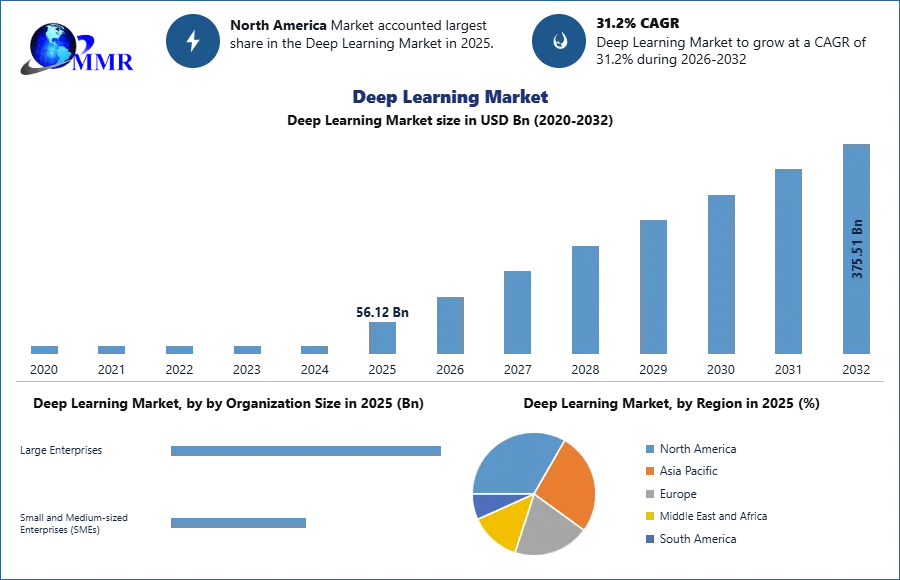
The Global Deep Learning Market was valued at USD 56.12 billion in 2025.
The market is projected to reach USD 375.51 billion by 2032.
The market is expected to grow at a CAGR of 31.2% during the forecast period.
Enterprise AI adoption continues accelerating investment in deep learning technologies.
Cloud computing and digital transformation remain primary growth enablers.
AI-powered automation is reshaping enterprise software, analytics, and customer experience.
Growing deployment of intelligent applications is expanding demand for scalable AI infrastructure.
Why This Matters Now
Artificial intelligence has moved beyond experimentation and into enterprise operations. Deep learning models are becoming the intelligence layer powering customer interactions, cybersecurity, enterprise software, industrial automation, healthcare diagnostics, financial services, and next-generation digital platforms.
The Deep Learning Market, valued at USD 56.12 billion in 2025, is projected to reach USD 375.51 billion by 2032, expanding at a 31.2% CAGR. That acceleration signals a structural shift in enterprise technology spending as organizations invest in AI platforms capable of transforming data into business intelligence, automation, and competitive advantage.
Market Overview
Deep learning has evolved into one of the most influential technologies driving digital transformation across global industries. Built on advanced neural network architectures, deep learning enables intelligent systems to recognize patterns, analyze complex datasets, understand language, process images, and automate increasingly sophisticated business decisions.
Organizations no longer deploy deep learning solely within research environments. Enterprises increasingly integrate AI into operational workflows, customer engagement platforms, cybersecurity systems, financial analytics, healthcare applications, manufacturing automation, and enterprise software modernization initiatives.
The technology’s rapid adoption reflects a broader enterprise objective: transforming data into real-time decision intelligence. Deep learning platforms enable organizations to improve productivity, accelerate innovation, optimize operations, and deliver increasingly personalized digital experiences.
Key Trends Driving Growth
Generative AI has become the most visible application of deep learning, dramatically expanding enterprise interest in AI-powered automation. Organizations increasingly deploy large-scale neural networks to generate content, automate workflows, improve customer service, accelerate software development, and enhance business decision-making.
Cloud computing remains the primary infrastructure enabling enterprise AI deployment. Cloud-native AI platforms provide scalable computing resources required for model development, training, deployment, and continuous optimization. Hybrid cloud strategies allow organizations to balance computational performance, regulatory requirements, and operational flexibility while supporting enterprise AI initiatives.
Artificial intelligence adoption also continues expanding across enterprise software environments. Deep learning enhances customer relationship management, enterprise resource planning, cybersecurity operations, predictive maintenance, fraud detection, intelligent document processing, and digital collaboration platforms.
Edge computing is emerging as an important complement to centralized AI infrastructure. Processing AI workloads closer to connected devices improves response times, reduces network latency, and enables intelligent decision-making across industrial automation, healthcare devices, autonomous systems, and smart infrastructure.
Telecommunications modernization strengthens market expansion as 5G networks improve connectivity between intelligent applications, cloud platforms, and distributed AI workloads. Higher network capacity supports increasingly sophisticated real-time AI applications requiring continuous data exchange across connected ecosystems.
Automation remains another defining trend. Deep learning enables enterprises to automate repetitive processes while improving operational accuracy, resource allocation, and customer engagement. Organizations increasingly combine AI with robotic process automation, analytics platforms, and intelligent enterprise software to create autonomous digital workflows.
Cybersecurity applications continue expanding as well. Deep learning improves threat detection, anomaly identification, behavioral analytics, and automated incident response by analyzing complex security data faster than conventional rule-based approaches.
Request a Free Sample Copy or View Report Summary: https://www.maximizemarketresearch.com/request-sample/25018/
Segment Insights
Dominant Segment: The MMR report segments the market by Component, Application, End User, and Region, but the publicly available report summary does not specify the dominant segment.
Fastest-Growing Segment: The publicly available report summary does not identify the fastest-growing segment across the reported market categories.
Enterprise adoption continues expanding across healthcare, financial services, retail, manufacturing, telecommunications, and automotive industries.
AI-enabled analytics and intelligent automation remain central enterprise adoption priorities.
Regional Growth Story
North America continues leading the Deep Learning Market through advanced cloud infrastructure, strong AI research capabilities, enterprise technology investment, and widespread digital transformation initiatives. Organizations continue expanding AI deployment across software development, financial services, healthcare, cybersecurity, and enterprise automation.
Asia-Pacific represents one of the industry’s strongest long-term growth opportunities. China, India, Japan, and South Korea continue investing in artificial intelligence, cloud computing, semiconductor technologies, digital infrastructure, and intelligent manufacturing. These initiatives strengthen regional AI competitiveness while supporting expanding enterprise adoption.
Europe continues advancing AI deployment through digital innovation initiatives, enterprise modernization, industrial automation, and responsible AI development. Organizations increasingly integrate deep learning into manufacturing, automotive technologies, healthcare, and financial services while balancing technological advancement with regulatory compliance.
Across major technology markets, governments increasingly recognize artificial intelligence as strategic national infrastructure supporting economic competitiveness, digital sovereignty, and long-term innovation.
Competitive Landscape
Competition increasingly revolves around AI ecosystems rather than standalone software products. Companies including NVIDIA Corporation, Microsoft, Google, IBM, Intel Corporation, Amazon Web Services, Meta Platforms, Oracle Corporation, Qualcomm Technologies, and Baidu continue investing in AI infrastructure, cloud platforms, semiconductor technologies, enterprise software, and deep learning frameworks.
The competitive landscape signals continued convergence between cloud computing, semiconductor innovation, enterprise software, cybersecurity, and telecommunications. Organizations capable of integrating AI hardware, cloud infrastructure, foundation models, developer platforms, and enterprise applications strengthen long-term competitive positioning.
Cloud providers increasingly compete through comprehensive AI platforms combining scalable infrastructure, development tools, data management, model deployment, and enterprise integration. Platform economics increasingly favor vendors capable of supporting complete AI lifecycles rather than isolated development environments.
Artificial intelligence infrastructure also becomes a competitive differentiator. High-performance computing platforms, specialized AI accelerators, optimized software frameworks, and cloud-native deployment capabilities increasingly determine enterprise adoption and pricing power.
As enterprises seek integrated AI ecosystems rather than fragmented technologies, platform interoperability, developer productivity, and enterprise scalability become defining competitive advantages.
Recent Developments
Continued expansion of enterprise generative AI deployments.
Growing investment in cloud-native AI infrastructure.
Increasing adoption of intelligent automation platforms.
Rising deployment of AI-enabled analytics across enterprise applications.
Expansion of edge AI capabilities supporting real-time decision-making.
Continued integration of deep learning into cybersecurity, manufacturing, and customer experience solutions.
Strategic Implications
Deep learning has become foundational digital infrastructure supporting enterprise competitiveness rather than an emerging technology category. CIOs increasingly prioritize AI platforms capable of accelerating digital transformation while improving productivity, operational efficiency, and customer engagement.
Cloud providers benefit from growing computational workloads supporting AI model development and deployment. Enterprise software vendors integrate intelligent capabilities throughout existing platforms, while telecommunications providers strengthen connectivity supporting distributed AI applications and edge computing environments.
Investors increasingly recognize deep learning as a structural technology opportunity spanning cloud infrastructure, semiconductors, enterprise software, cybersecurity, healthcare, financial services, and industrial automation rather than a single software market.
Future Outlook
The next phase of the Deep Learning Market will be defined by enterprise-scale generative AI, multimodal neural networks, edge intelligence, cloud-native AI platforms, and autonomous business operations that integrate intelligence into every digital workflow. Organizations that build AI-first operating models supported by scalable deep learning infrastructure will emerge as the digital leaders of the next decade, while those delaying enterprise AI adoption risk becoming increasingly uncompetitive in an intelligence-driven economy.
Related Reports
Global Network Slicing Market https://www.maximizemarketresearch.com/market-report/global-network-slicing-market/4561/
Video Surveillance Market https://www.maximizemarketresearch.com/market-report/global-video-surveillance-market/14984/
Global Digital Identity Solutions Market https://www.maximizemarketresearch.com/market-report/global-digital-identity-solutions-market/116291/
Analyst Perspective
“Deep learning is becoming the intelligence engine behind enterprise digital transformation, enabling organizations to automate decisions, accelerate innovation, and create scalable AI-driven business models. Companies investing in integrated AI infrastructure today will define tomorrow’s competitive technology landscape.” — Yash Ghosalkar
About Maximize Market Research
Maximize Market Research Pvt. Ltd. (MMR) is a global market research and consulting company that provides reliable, data-focused, and practical business insights. The firm serves a wide range of industries, including healthcare, pharmaceuticals, technology, automotive, electronics, chemicals, personal care, and consumer goods. Through market forecasts, competitive analysis, strategic consulting, and industry impact assessments, MMR helps organizations understand changing market conditions, identify growth opportunities, and make informed business decisions for long-term success.
2nd Floor, Navale IT Park Phase 3
Pune Banglore Highway, Narhe
Pune, Maharashtra 411041, India
+91 9607365656
sales@maximizemarketresearch.com
