Key Highlights
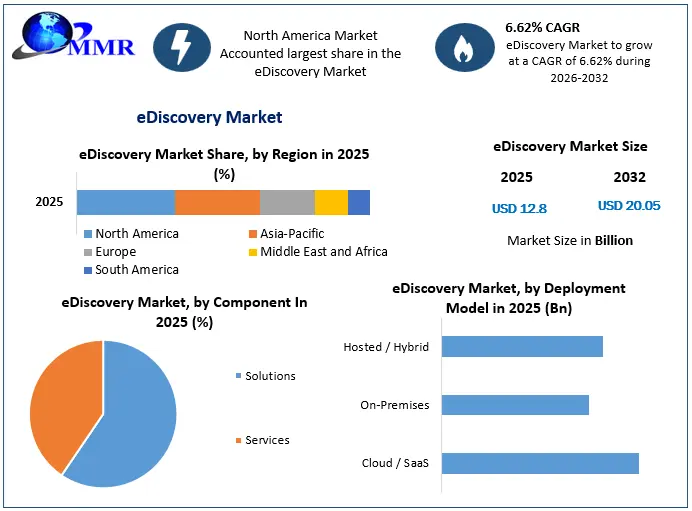
- Market valued at USD 12.8 billion in 2025.
- Expected to reach USD 20.05 billion by 2032.
- Forecast CAGR stands at 6.62%.
- AI-powered analytics and predictive coding are transforming legal workflows.
- Cloud computing and IoT continue to increase electronically stored information.
- Government agencies remain the largest end-user segment.
- North America maintains market leadership through strong regulatory enforcement.
- Asia Pacific records the fastest growth as digital transformation accelerates across enterprises.
Why This Matters Now
Organizations now manage unprecedented volumes of digital evidence generated through cloud platforms, remote work, mobile devices and connected systems. Regulatory investigations, litigation and cybersecurity incidents increasingly depend on electronic records. AI-powered eDiscovery platforms reduce review time, improve evidence accuracy and lower legal costs, making them a strategic investment rather than simply a compliance requirement.
Market Overview
The eDiscovery Market covers software and professional services used to identify, preserve, collect, process, review and produce electronically stored information for legal proceedings, regulatory investigations and corporate governance.
Demand continues to expand as enterprises generate larger volumes of digital content through cloud applications, collaboration platforms, IoT devices and hybrid workplaces. Traditional manual document review can no longer support growing litigation requirements, increasing reliance on automated legal technology.
Government agencies, financial institutions, healthcare organizations and multinational corporations remain the largest users because regulatory obligations require secure management of electronic evidence. Rising cybercrime, financial fraud, tax investigations and cross-border litigation further strengthen demand.
On the supply side, vendors are investing heavily in artificial intelligence, machine learning and cloud-native platforms that shorten review cycles while improving document accuracy. These capabilities help legal teams reduce operational costs while managing increasingly complex compliance requirements.
Key Trends Driving Growth
Artificial intelligence is becoming the defining technology across the industry. Predictive coding and machine learning automatically identify relevant documents, significantly reducing manual review workloads and improving legal accuracy.
Cloud-based deployment continues replacing traditional on-premise infrastructure. Organizations gain scalable processing capacity without expanding internal computing resources, making large investigations more cost-effective.
Privacy regulations such as GDPR and evolving U.S. data protection requirements are increasing enterprise investment in information governance and legal compliance solutions. Companies now require continuous monitoring rather than project-based discovery.
Digital transformation also expands the variety of discoverable information. Multimedia files, collaboration platforms, mobile communications and social media records require advanced analytics capable of processing unstructured content efficiently.
Meanwhile, rising electronic data volumes increase infrastructure costs, encouraging vendors to develop more scalable architectures with automated workflow management.
Explore detailed analysis, insights, and growth opportunities
Segment Insights
Dominant Segment: Solutions
The Solutions segment accounts for the largest share of the market as enterprises prioritize software platforms that automate legal hold, document review, data collection and compliance management.
Integrated analytics enable faster early case assessment while reducing legal review expenses. Vendors increasingly deliver platforms compatible with existing enterprise IT environments, simplifying deployment and lowering implementation costs.
Business impact is significant because organizations gain faster litigation readiness while improving regulatory compliance across multiple jurisdictions.
Fastest-Growing Segment: Government & Public Sector
Government and public sector organizations represent the fastest-growing vertical due to increasing digital investigations, anti-money laundering initiatives and electronic evidence requirements.
Regulatory agencies require secure audit trails, automated evidence preservation and efficient investigation workflows. High-profile financial crime investigations continue to reinforce investment in advanced eDiscovery platforms.
Business impact extends beyond compliance, enabling governments to improve investigative efficiency while strengthening public accountability.
Additional Key Sub-Segments
Cloud/SaaS Deployment
Cloud platforms continue gaining momentum because they provide scalable computing resources capable of handling rapidly expanding data volumes without substantial capital investment.
Large Enterprises
Large organizations remain the primary customers due to frequent litigation, international compliance obligations and extensive digital information repositories.
SMEs
Small and medium enterprises increasingly adopt cloud-based solutions as subscription pricing lowers entry barriers and simplifies legal technology adoption.
Applications
Litigation support, regulatory compliance, internal investigations, digital forensics and corporate governance remain the largest application areas as organizations seek integrated legal operations.
Regional Growth Story
North America
North America leads the global market through mature legal frameworks, strict compliance regulations and widespread enterprise technology adoption. The United States generates the largest regional revenue, supported by frequent litigation, cybersecurity investigations and advanced legal technology investments.
Europe
European demand remains driven by GDPR compliance and increasingly stringent data governance regulations. Organizations continue modernizing legal operations while balancing privacy protection with cross-border investigations.
Asia Pacific
Asia Pacific is expected to deliver the fastest growth. Rapid enterprise digitization, expanding cloud adoption and increasing digital evidence requirements create substantial opportunities. SMEs across China, India, Japan and Southeast Asia are investing in cloud-native legal technologies as regulatory frameworks mature.
Middle East, Africa and South America
Digital government initiatives and expanding enterprise compliance programs gradually increase adoption across emerging markets. Multinational organizations operating in these regions are introducing standardized legal discovery platforms to support international investigations.
Competitive Landscape
Competition is shifting from traditional document management toward AI-enabled legal intelligence platforms. Major technology vendors, specialized legal software providers and managed service companies compete by integrating analytics, automation and cloud infrastructure into unified workflows.
Microsoft, IBM, Relativity, Exterro, DISCO, Everlaw and OpenText continue strengthening enterprise platforms with advanced analytics and compliance capabilities. Meanwhile, specialized providers such as Casepoint, Consilio, KLDiscovery and Epiq differentiate through managed services and litigation expertise.
Recent acquisitions demonstrate a broader industry shift toward generative AI. Companies are purchasing specialized AI developers to accelerate document review, automate timeline generation and improve legal research. This consolidation increases competitive barriers while expanding platform capabilities across enterprise legal operations.
Recent Developments
- March 2026: Epiq acquired LitLingo to strengthen AI-powered legal risk mitigation and behavioral analytics.
- March 2026: Casepoint expanded its unified AI software suite across legal hold, investigations and eDiscovery workflows.
- February 2026: HaystackID acquired eDiscovery AI to accelerate machine learning-driven document review.
- February 2026: DISCO introduced an agentic AI platform integrating deposition management, timelines and automated legal analysis.
- October 2025: Everlaw launched enhanced AI Assistant and Writing Assistant capabilities without additional usage costs.
- June 2025: Consilio acquired TrueLaw, adding automated narrative generation and contradiction detection into secure legal discovery workflows.
Future Outlook
Organizations that combine AI-driven analytics, scalable cloud infrastructure and integrated compliance workflows will secure the strongest competitive advantage as digital evidence volumes continue expanding across every regulated industry.
Analyst Perspective – Yash Ghosalkar
Yash Ghosalkar is a Market Research Analyst specializing in global industry intelligence, market sizing, competitive benchmarking, and strategic trend analysis. His expertise spans emerging technologies, industrial automation, healthcare, ICT, energy, and consumer industries, with a strong focus on identifying growth opportunities, analyzing competitive landscapes, and evaluating long-term market dynamics. His research combines quantitative data with industry insights to help businesses make informed strategic decisions and capitalize on evolving market trends.
About Maximize Market Research
Maximize Market Research Pvt. Ltd. (MMR) is a global market research and consulting company that provides reliable, data-focused, and practical business insights. The firm serves a wide range of industries, including healthcare, pharmaceuticals, technology, automotive, electronics, chemicals, personal care, and consumer goods. Through market forecasts, competitive analysis, strategic consulting, and industry impact assessments, MMR helps organizations understand changing market conditions, identify growth opportunities, and make informed business decisions for long-term success.
Contact Us :
2nd Floor, Navale IT Park Phase 3
Pune Banglore Highway, Narhe
Pune, Maharashtra 411041, India
+91 9607365656
sales@maximizemarketresearch.com
